
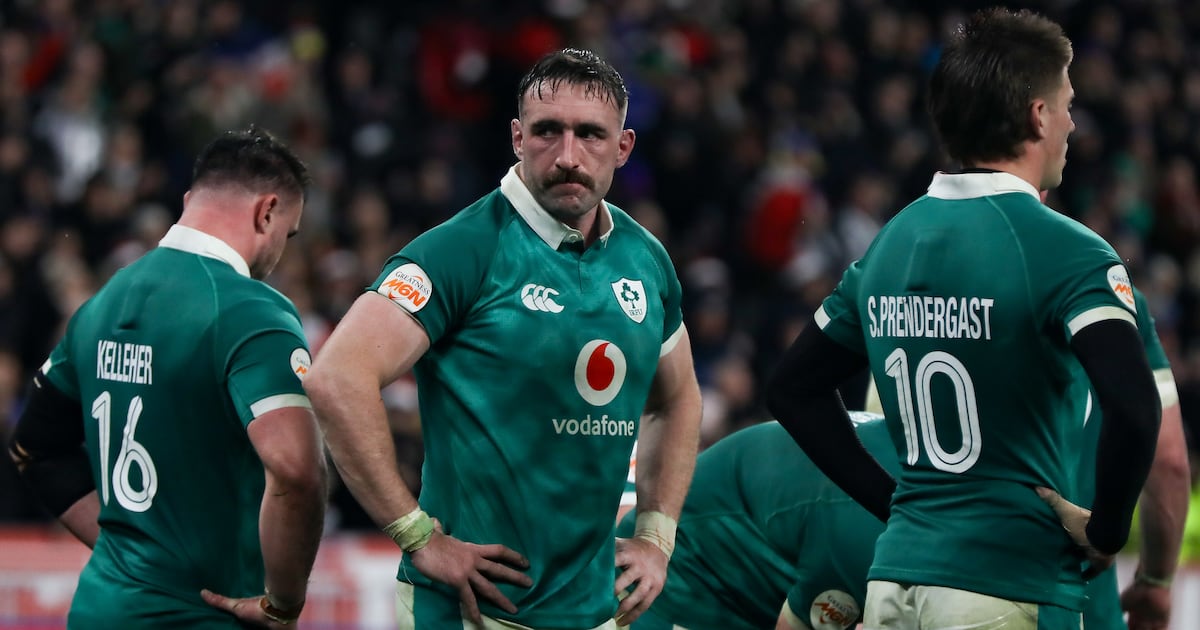
John Boyd, the American military strategist, developed what he called the OODA Loop: Observe, Orient, Decide, Act. The idea was simple but profound. In any conflict, the side that can cycle through those four steps fastest gains a decisive advantage, as they react in real time while their opponent works from an outdated picture of the battlefield.
Thursday night in Paris felt like watching that theory play out on a rugby pitch. France observed space, oriented themselves to it, decided to attack it and acted. It appeared that Ireland observed the same space, oriented themselves to a predetermined structure, decided to follow the plan and missed valuable half-chances as they presented themselves. The game, in many ways, was decided by that gap.
Paris strips away the external noise and shows you exactly where you are. I find myself torn between encouragement and serious concern. This wasn’t the apocalypse, but it wasn’t a performance that screams world-class.
Despite the fawning, France are not unbeatable and there is a fragility there that I suspect England might expose. Don’t get me wrong – they have world-class players in most areas of the pitch, but they were slightly flattered by the final margin on the scoreboard. Two of their five tries were facilitated by officiating mistakes that failed to pick up a forward pass and a knock-on.
 Are wounded Ireland vulnerable to an Italian job?
Ireland contained, frustrated and scrambled for their lives and it took moments of brilliance from Louis Bielle-Biarrey, showing what real pace can do in the modern game, Thomas Ramos, Matthieu Jalibert and Antoine Dupont to break Ireland down.
This is important. We haven’t suddenly become a bad team overnight. The quality is still there. And credit where it’s due, there was real character shown in the second half. At 72 minutes, Ireland are looking at a potential eight-point game if Caelan Doris doesn’t knock the ball on. We score that try, and we’re leaving Paris with our heads up. Still a loss, but something to build on.
Instead, we cough up the ball, and Théo Attissogbe scores down the other end of the pitch. Suddenly it’s a hammering. That’s the margins at this level when you’re away from home against one of the best teams in the world.
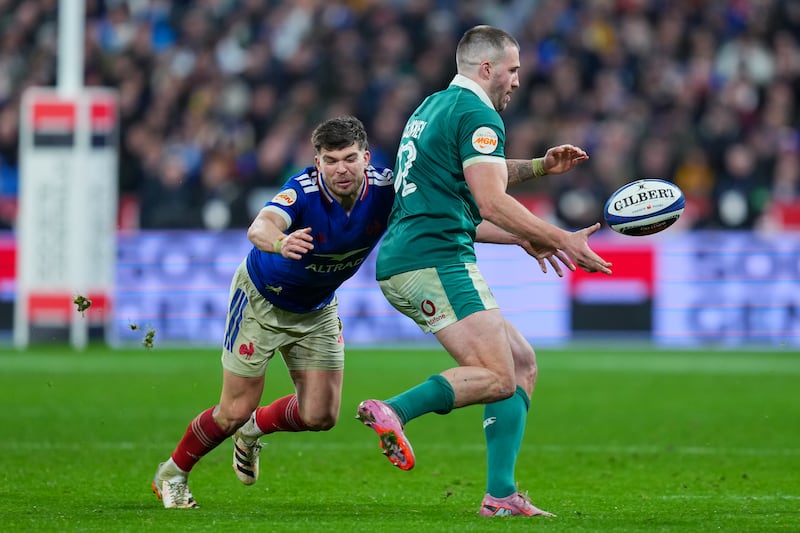 Stuart McCloskey of Ireland is tackled by Matthieu Jalibert of France during the Six Nations 2026 match in Paris. Photograph: Franco Arland/Getty Images
Set-piece worries were largely parked. The scrum was fine. Jeremy Loughman did his job. We had good ball from our lineout. For one week at least, we can stop panicking about that aspect of our game.
Now for the glass-half-empty version. I’m genuinely concerned. The biggest difference between these two teams is talent but more specifically how it is orientated at club level. Contrast the difference between the way Bordeaux and Toulouse play with the current versions of Leinster and Munster.
[ Ireland vs France analysis: A lesson for Ireland in the ways of modern Test rugbyOpens in new window ]
Ireland are playing percentages, trying to predict what might happen should we execute correctly from the whiteboard. A game plan will never tell you when there’s going to be quick ball, nor when the space is on the touchline or just behind the ruck.
A team should play with feel, understanding options and when best to take them. Sam Prendergast’s kick for Tommy O’Brien was arguably the only time in the first half we showed anything other than building shape.
France see the space and attack, react in real time. Dupont spotted gaps between our defensive line and the backfield cover. He attacked it.
I think we looked for it once, with the comfort of a penalty advantage. Now is that because Dupont is just better? Partly, yes. He and Jalibert are world-class. But it’s also about mindset. They’re encouraged to see the picture and back themselves. I’d ask the question: are we preparing players with this frame of mind?
To me, the Irish attack lacked confidence. Our kicking game was desperately poor, or at least the decision-making on when to kick and when to run. At times we were kicking off positive gainline ball, the exact moments when defences are less organised, when mismatches are available if you’re willing to take them.
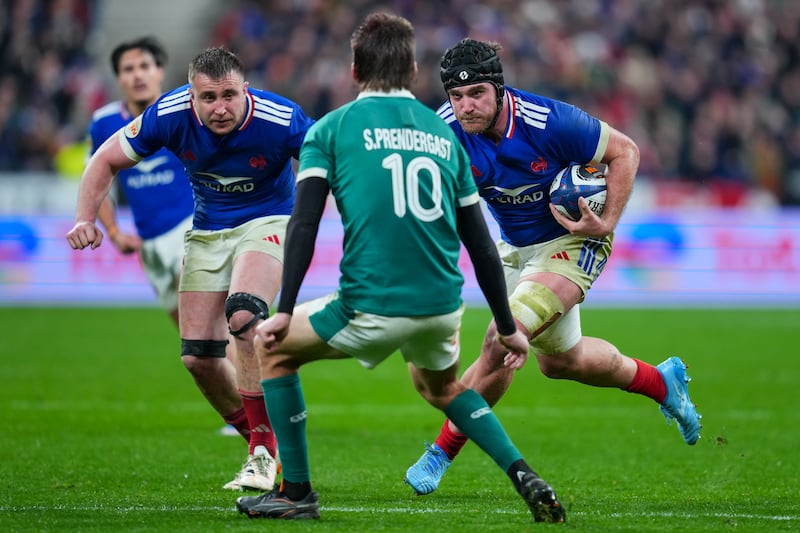 Lenni Nouchi of France runs with the ball during the Six Nations 2026 match between France and Ireland. Photograph: Franco Arland/Getty Images
Our launch attacks from the lineout were poorly executed, save for a few bright carries around the tail. We got hit behind the starting point, and had to kick off slow, static ball. What’s the plan here? We’re kicking off the back foot; we’re kicking off the front foot. There’s no coherent strategy.
It was only in the last half an hour that Ireland attacked with intent, by virtue of a brilliant impact from the bench. The clamour to start some of the reinforcements doesn’t always add up to them having the same influence from the off, the next day. Starting from the bench can be liberating, as you come into a game when there’s a bit more space.
There was one passage in the first half from a Doris offload where players froze. They’re looking at each other going what, now? That’s a problem right there.
The talk about playing what’s in front of you was completely absent. You can’t just switch that on like a tap. You can’t drill a rigid structure into players for weeks and then expect them to suddenly improvise when it matters.
The Ulster lads looked more comfortable keeping the ball alive. And when Jack Crowley came on, it seemed to give Prendergast a bit of a kick-start to play with more freedom. That tells me the players can do it; just not often enough.
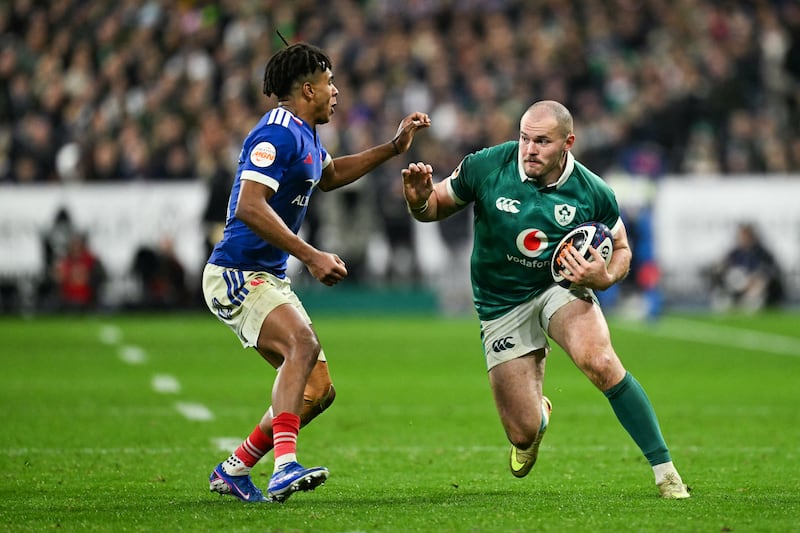 Ireland’s Jacob Stockdale challenges France’s Théo Attissogbe. Photograph: Julie Sebadelha/AFP via Getty Images
Form is a double-edged sword. When you’re picked on form, you arrive in camp knowing the coaches believe in you because of what you’ve been doing. You come in confident and that creates momentum.
When you’re selected despite being out of form, or worse, when the game plan doesn’t use or include what you’re good at, the opposite happens. You second-guess everything. You look for the safe option, freeze and ignore your instinct to play in those moments. Stuart McCloskey got the ball with proper momentum once. Jacob Stockdale got one pass and beat three players. Why pick them, if you’re going to largely ignore their attributes?
[ Right now, Ireland’s game plan does not suit its playersOpens in new window ]
Considering the amount of time Ireland put boot to ball I was disappointed by how disjointed the kick chase was, how we reacted. France got to our kicks before we did, turned defence into attack, hurt us. We couldn’t do the same. That’s the basics – work-rate, awareness and reading the game.
It’s not all doom and gloom. What’s missing is clarity in attack, the courage to back players to make decisions in the moment.
France are cycling through Boyd’s OODA loop faster than we are. Until we develop that same mentality, we will fail against the top teams. Time to switch focus.