
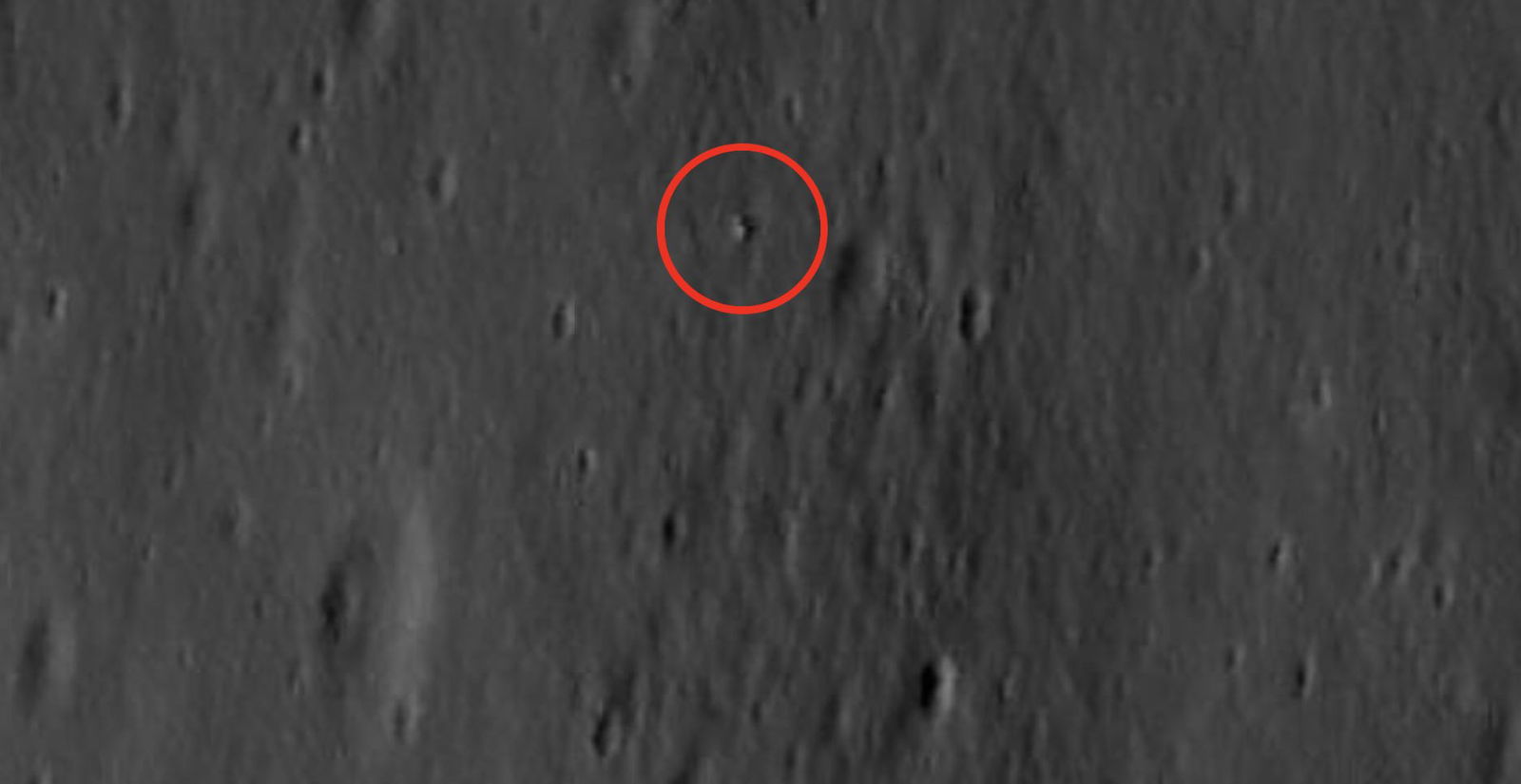
In 1966, the Soviet Union made history when its Luna 9 mission placed the first object built by humans on the surface of the Moon, broadcasting imagery back to Earth following its successful soft landing.
Despite the safe touchdown of Luna 9’s lander capsule, some questions have lingered about the Soviet spacecraft’s historic mission: namely, its final resting place, which remains unknown.
That could be about to change, however. With the help of artificial intelligence, an international team of researchers has identified several locations on the Moon they believe could finally reveal the location of the “lost” spacecraft.
Among these possible landing sites, one location near lunar N latitude 7.02907° and longitude -64.32867° is particularly promising, revealing a large crater with a bright area near one of its edges, which is surrounded by several other impact features, which researchers say may represent “potential spacecraft hardware objects” left behind by the 1966 mission. The team’s findings were published in npj Space Exploration.
A Cold War-Era Mystery
Luna 9’s historic 1966 lunar landing marked the first instance where a piece of human-built hardware had been placed on the surface of a celestial body beyond Earth.
By modern standards, the Luna 9 landing was hectic, with the spacecraft tumbling along the lunar surface on built-in shock absorbers before finally settling in its final resting place, where it remained operational for only a matter of days. During that roughly 36-hour window, the spacecraft successfully transmitted important information back to Earth, setting the pace for space exploration in the coming years that would eventually bring the first humans to the Moon.
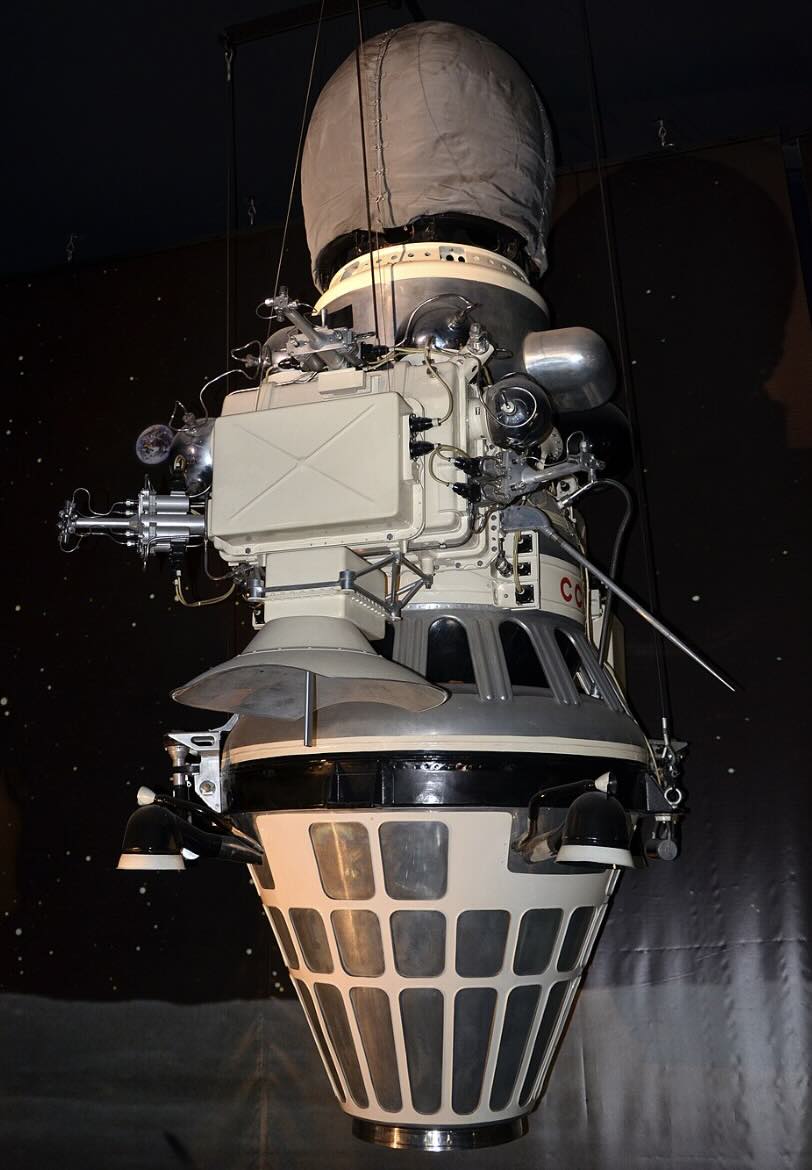 Above: A replica of the Luna 9 spacecraft, as seen in the Museum of Air and Space in Paris, France (Image Credit: Wikimedia/Pline/CC 3.0)
Despite high-resolution imagery of the lunar surface that has been readily available since the deployment of NASA’s Lunar Reconnaissance Orbiter Camera (LROC) in 2009, no confirmed detection of the Luna 9 landing site has been made. One reason for this involves the original calculations made about the spacecraft’s 1966 landing, which were far from exact. By some estimates, the location of Luna 9 could be as much as several dozen kilometers away from the general area where the spacecraft is believed to have landed.
Rediscovering a Lost Soviet Spacecraft
In recent research led by Lewis Pinault at University College London, along with colleagues Hajime Yano and Ian Crawford, artificial intelligence was used to narrow down possible locations of the “missing” Luna 9 lander.
Enter the intriguingly-named “You-Only-Look-Once – Extraterrestrial Artefact” (YOLO-ETA), which the researchers describe as a lightweight computer imaging system adapted from TinyYOLOv2, an architecture designed to detect human-built objects, such as spacecraft, in high-resolution LROC images.
Training YOLO-ETA using the well-known landing sites of NASA’s Apollo missions, the team says they reached an overall confidence score for possible spacecraft detections of around 80%, which enabled them to then train the imaging system on the general region where Luna was believed to have touched down.
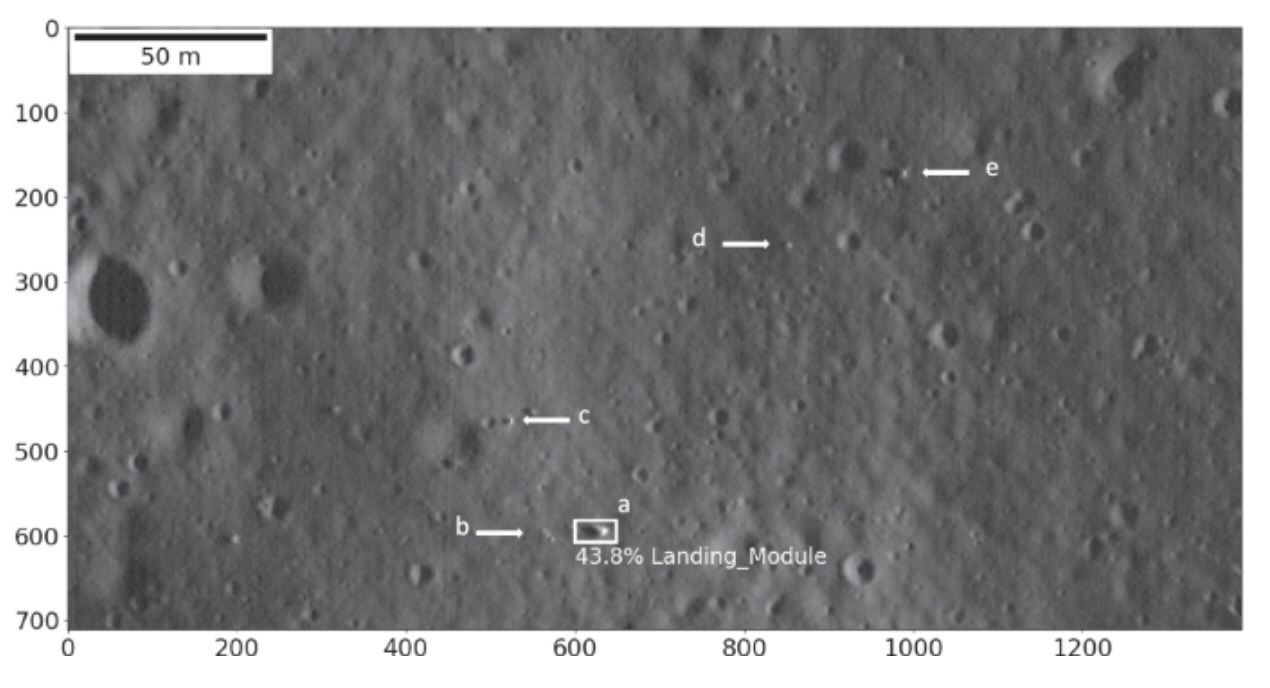 Above: possible locations where artificial objects, detected using YOLO-ETA, may indicate the landing site of the Soviet Luna 9 spacecraft (Image Credit: NASA/GSFC/Arizona State University/npj Space Exploration, Pinault, et al)
“Applying the model to a 5 × 5 km region surrounding the historically uncertain Luna 9 landing area yielded several high-confidence detections of artificial objects near 7.03° N, –64.33° E,” the researchers report. “Topographic analysis indicates that the candidate site’s horizon geometry is potentially consistent with Luna 9 surface panoramas.”
Notably, the team was able to determine a primary impact feature, in which a luminous area can be discerned, which they believe may be the final landing place of Luna 9. In the surrounding area, several additional impacts or other features can also be seen, which may be secondary “hardware objects”—essentially debris left over from the 1966 mission.
The locations Pinault and his colleagues identified appear to be consistent with the kinds of features associated with known spacecraft landings and the disturbances they have caused to the Moon’s surface during past lunar missions.
“These findings identify promising locations for follow-up imaging and demonstrate that compact, edge-deployable machine-learning models can support future orbital surveys of lunar artefacts and surface assets,” the team writes in their paper.
Going forward, Pinault and colleagues believe they YOLO-ETA may be useful “in detecting known lunar artefacts and can assist in the search for undetected historical spacecraft.” Such capabilities, they argue, are of great importance as they will help to support various space agencies’ ability to monitor the lunar surface in the coming years, especially as exploration of Earth’s natural satellite is expected to increase.
For now, the team’s findings remain to be confirmed, though they believe such an opportunity will likely occur as soon as next month, when India’s Chandrayaan-2 orbiter passes over the region. If YOLO-ETA’s assessment turns out to be correct, it will finally bring a resolution to one of the great unanswered questions of Cold War-era space exploration.
Pinault, Crawford, and Yano’s recent study, “Possible identification of the Luna 9 Moon landing site using a novel machine learning algorithm,” appeared in npj Space Exploration.
Micah Hanks is the Editor-in-Chief and Co-Founder of The Debrief. A longtime reporter on science, defense, and technology with a focus on space and astronomy, he can be reached at micah@thedebrief.org. Follow him on X @MicahHanks, and at micahhanks.com.