
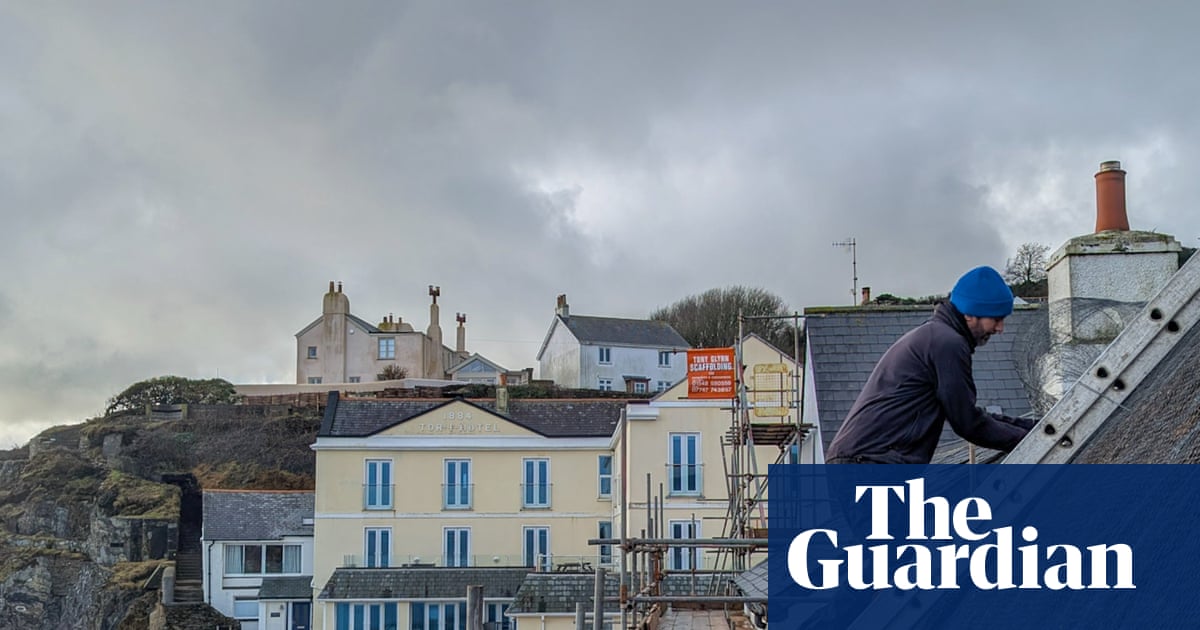
During the storm, the waves sounded like bombs going off under the house, Bonni Breeze Lincoln tells me. She lives on the seafront of Torcross, a Devon village that is accustomed to weathering storms, but even she is not used to waves shattering her storm shutters, or sending seawater down the chimney.
I’ve come to Torcross to repair the thatch on Bonni’s roof. Up the ladder, I tie bundles of reed, called “wads”, to pack them into the holes; the thatch is riddled with shingle, fragments of seaweed and even limpet shells. Looking down the seafront to torn up paving slabs and slate roofs that yawn open to the sky, it’s clear that this house – the oldest in the village – has come off comparatively well. The soft, springy nature of thatch allows it to absorb even the impact of breaking waves.
The scale of the damage to the wider area is still being assessed, and the village is in shock at how 2026 has begun. Three successive southerly storms in January removed much of the shingle – a vital natural defence for the village – then a fourth storm breached the sea barrier, destroying sections of the A379, which will be closed until at least 2027. More bad weather is forecast.
A limpet shell in the thatch. Photograph: Tom Allan
Furthermore, the A379 runs along a narrow spit of shingle between the sea and a freshwater lake, Slapton Ley. The Ley is a national nature reserve and a site of special scientific interest, home to Cetti’s warblers and 2,000 species of fungi. The Field Studies Council manages the Ley, and warns that if the shingle ridge is breached, freshwater species will be affected. Among them is the critically endangered plant strapwort, whose only natural UK site is at Slapton.
Rising sea levels make this – and damage to Torcross – more likely. Other factors put the village at risk, explains Gerd Masselink, a professor of coastal geomorphology at the University of Plymouth. In recent decades, as prevailing storm patterns shifted from east to south, 50,000 cubic metres of shingle have been moved from Torcross to the northern end of Start Bay, leaving it exposed.
Compared with such concerns, my own job is simple. I drive in a final handful of reed, and begin to tighten the wire netting. I lick a finger. It tastes of salt.
Under the Changing Skies: The Best of the Guardian’s Country Diary, 2018-2024, is available now at guardianbookshop.com