


Morning all, just back from a freezing, but also illuminating, Stockholm, where one senior inhouse lawyer told AL – and a room of 500+ other GCs – that law firm use of AI is providing zero benefits for them.
This is how the conversation at the Pocketlaw – now Miramis – Inhouse conference unfolded after discussing how legal teams are rapidly making use of AI skills, especially for more routine work.
AL – But, what about the law firms? After all the press releases about law firms using AI, what are you seeing as clients, what’s coming back the other way?
GC – We get nothing. They haven’t changed and probably next year the same work will cost even more.
The reaction from those around this inhouse lawyer, (who works at a global company and AL’s not naming them as they didn’t give permission to be quoted), was one of implicit agreement. AL later spoke to the same lawyer again.
AL – Going back to what you said, if the hourly rates for all the lawyers go up again and where your fees [for routine work] also rise despite the announcements about how they’re using AI to improve efficiency, what happens?
GC – This can’t go on.
AL – How do you mean? Is this one of those moments when you need to sit down with the managing partner [of X very well-known law firm] and tell them something has to change?
GC – Yes.
AL – But, I guess this is the kind of conversation that won’t happen for a long time. When will this have to take place?
GC – I think we’ll probably have to do it this year.
At that point an inhouse lawyer from another household name company came over and it was clear they didn’t feel moved to disagree with the above view at all.
—
What does this mean?
It’s the prerogative of every business to maximise profits, relative to the customers they serve and the market space they exist in. So, are law firms doing anything ‘wrong’ by shouting about buying X or Y legal AI system, but as far as the bills going out to clients are concerned, nothing changes, nor even the trajectory of cost increases?
Well, no, not really. That’s business. Maybe the law firm is using AI a lot, and it’s not just a press release / marketing strategy. Maybe they’re reducing non-billable time, which increases their profits? Maybe they’re using it to speed up fringe aspects of their work that perhaps get in the way of the main billable labour? Maybe they have no intention at all of reducing their fees or hourly rates because of AI, no more than they would pass on any cost savings from moving into a new, more modern and energy efficient office building.
It’s then the prerogative of the buyers to respond, to have the type of conversation above, and then if nothing changes to do something about it:
Increase the amount of work kept internally, and use AI to make that possible.
To shop around for other suppliers, at least for the lower value work – which is where the refusal to pass on cost savings seems to most annoy GCs.
Look at ‘NewMods’ / AI-first law firms that will use AI to provide some form of economic improvement for the clients.
To also improve the triage of what work goes out, as in part it’s the high volume of matters to law firms that include both high risk and low risk work that feeds this complacency on the part of the law firms.
Since Artificial Lawyer started in 2016, inhouse teams have talked about how technology might affect the pricing of legal work. This is the first time that it feels as if clients really might just push back – and the reason: they’re leveraging AI themselves at scale now inside the inhouse legal team and they can see what can be done.
And after you reach that point, you never look at a lot of legal work in the same way again.
—
What else?
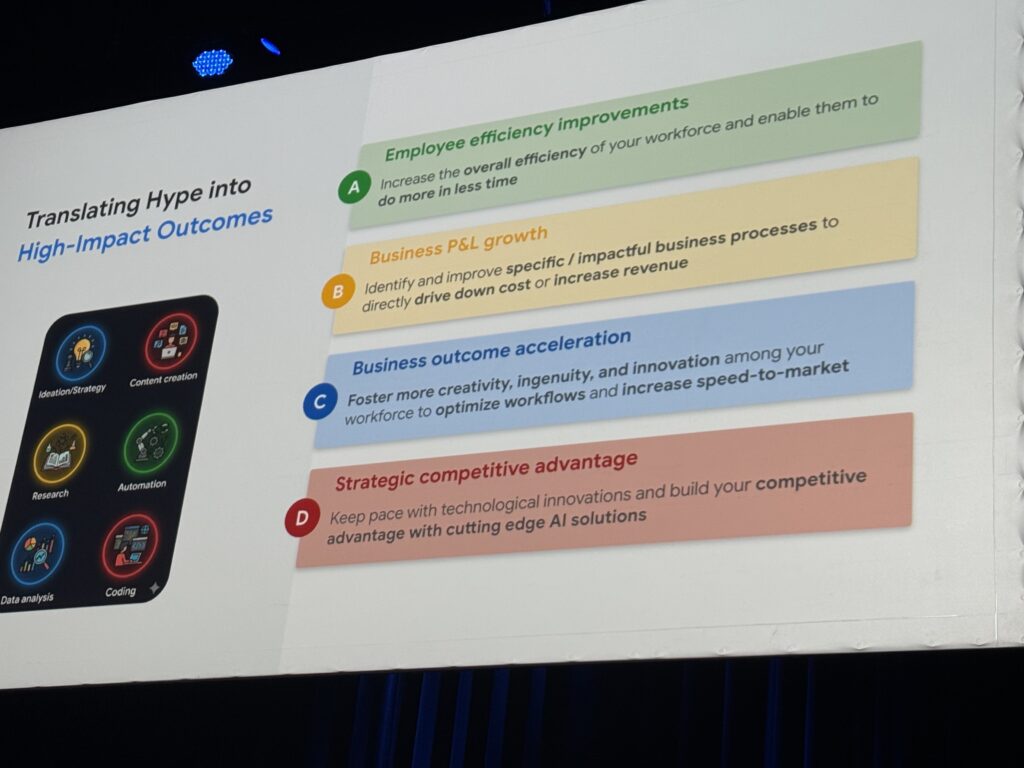
Filip Hinteregger Von Grienholzegg at Google gave a great overview of how you can map what AI does over to the various grades of complexity of legal work, from junior associate level, e.g. basic prompts, all the way up to senior partner level, e.g. proactive responses – perhaps driven by always-on agents that are ready to respond to emerging legal needs. He also connected AI to different ways it improves a business (see below).
CEO, Kira Unger Söderlind (pictured above), announced that Pocketlaw, the Stockholm-based AI-native CLM company, which she co-founded with Olga Beck-Friis, has now changed its name to Miramis, in part to reflect its focus on enterprise customers.
And finally, that overall, what AL saw and heard, from those on stage during the very candid panel I chaired with three senior inhouse lawyers, as well as during the rest of the event, was that finally…..after a decade…..something really is happening.
Every inhouse lawyer AL spoke to was using AI in meaningful ways. Some had bought in specific tools, others had platforms – you know the names, and others were drawing from company-wide general LLMs and adapting outputs to legal needs. And in some cases they were building their own tools. Plus, a notable group were already leveraging agents. If they were all part of a single law firm, then that law firm would no doubt receive a prize for being a world leader in legal innovation.
It was really impressive. Plus, if you add to that what AL saw at CLOC in London the other week, where again there was plenty of solid evidence inhouse lawyers are truly using AI now – not just talking about it – this tells us that a sea change is coming.
Will ‘the conversation’ happen this year, as the inhouse lawyer in Sweden told this site, or maybe later in 2027?
Seems like for many companies it will happen sooner, rather than later. You can’t have a group of buyers really using a technology to crush the time needed for things like contract review, or compliance checking, or helping with drafting, or legal research needs specific to their company – perhaps driven by agents, and for them not to change their perceptions and expectations of what is possible. And especially so when the sellers are in the press every week telling the world about how they’re using AI as well to drive efficiency.
You can’t change the buyer/seller equation with AI on both sides at the same time and expect nothing to happen.
Richard Tromans, Founder, Artificial Lawyer.
Discover more from Artificial Lawyer
Subscribe to get the latest posts sent to your email.