
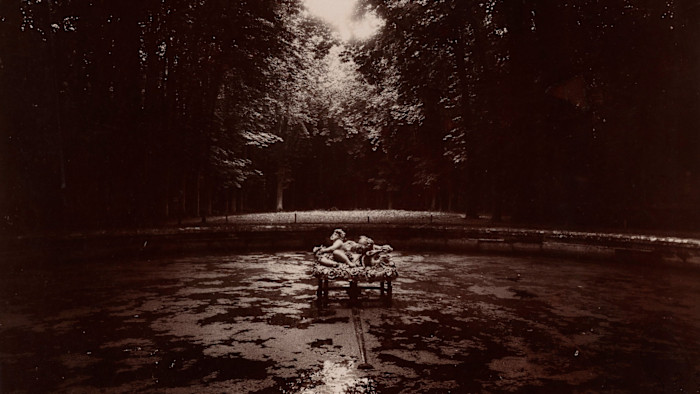
At his finest, Eugène Atget coaxed the visible world into harmony with his own temperament. Statues in the gardens of Versailles flex their stone muscles before his lens. Reflections in store windows animate mannequins that appear to mingle, wraith-like, with passers-by. The borders between the sentient and the inert start to blur, until the ordinary world trembles with quiet strangeness.
The Atget in the International Center of Photography’s new exhibition in New York is rarely at his finest. The ambitious but ultimately dispiriting homage — subtitled The Making of a Reputation — doesn’t contribute much to his renown, demonstrate why it grew, or explain how it galvanised later photographers. I’ve rarely seen a show in which the premise and its expression are so out of whack.
Atget was a pivotal figure, tempering the 19th century’s mania for precise realism with 20th-century attempts to wheedle magic from everyday life. For most of his career, from the late 1880s through to the 1920s, he regarded himself as a craftsman, supplying ready-made imagery to painters, architects and industrial designers.
Determined to document a Paris under threat from modernisation, he schlepped his unwieldy tripod camera and heavy glass negatives around the city, recording twisty staircases, vertiginous alleys, door-knockers, courtyards and statuary. He avoided people, and his empty streetscapes have a haunted and haunting quality.
 ‘Rue de la Montagne-Sainte-Geneviève’ (1898) © Eugène Atget
“Not for nothing were the pictures of Atget compared with those of the scene of a crime,” Walter Benjamin wrote in 1927. “But is not every spot of our cities the scene of a crime? Every passer-by a perpetrator? Does not the photographer — descendent of augurers and haruspices — uncover guilt in his pictures?”
Benjamin read those images through the prism of surrealism, and with good reason. Man Ray, who had a studio two doors down from Atget’s in Montparnasse, met his neighbour around 1923 and provided him an entrée to André Breton’s crowd. He also published one of his photos in the journal La Révolution surréaliste.
Man Ray’s darkroom assistant, Berenice Abbott, was even more enthralled by Atget’s optical imagination. Its impact, she wrote nearly 40 years later, “was immediate and tremendous. There was a sudden flash of recognition — the shock of realism unadorned. The subjects were not sensational, but nevertheless shocking in their very familiarity.”
Abbott visited Atget in his studio regularly in the couple of years before he died in 1927. The ICP has one of the three towering portraits she made (and he never saw): pale-eyed gaze, wispy hair, an artist’s furrowed face floating incongruously above a funereal necktie and a fine wool coat. He could be a slightly addled banker. Curator David Campany uses Abbott’s admiration as a point of departure, arguing that Atget owed his eminence largely to her efforts on his behalf.
 ‘Escalier 25 rue des Blancs-Manteaux’ (1903–4) © Eugène Atget
 ‘École des Beaux-Arts, Monument Henri Regnault’ (1903) © Eugène Atget
It’s true that it took a young American to shame the French into valuing their own national treasure. Abbott bought nearly 1,500 of his glass negatives and 8,000 prints, then printed more, talked magazines into publishing some of the pictures, and in 1930 shepherded a selection into a book. She was still magnifying his glory in 1968, when she sold most of her Atget archive to the Museum of Modern Art.
But the exhibition tries to fuse two incompatible things: covering the four years just before and after his death, when Abbott was cheerleading with the greatest ardour; and furnishing the ICP’s galleries from its own permanent collection. That hoard includes plenty of early work from the turn of the century but few of the later masterpieces. To see those, you must either squint at vintage periodicals in the vitrines or watch a slideshow of pages from the 1930 monograph.
And so, for anyone familiar with the Atget canon, this is an exhibition marked by what’s missing: street vendors; prostitutes; creepy reflective shopfronts chock-a-block with corsets, wigs and prosthetic limbs; lyrical, romantic shots of the Paris parks. Instead, we get an undistinguished catalogue of cast-iron banisters, balconies and gates.
It was the shots from the 1920s that bewitched Abbott and that MoMA’s noted historian John Szarkowski later singled out as Atget’s supreme achievement. Alas, the photos here date from two decades earlier, before his technique had caught up with his eye. The idiosyncratically composed “Versailles, Le Château” (1902) takes in the palace from afar, bounded by a featureless platform on one side and scruffy scaffolding on the other. The winter view of “Versailles, Le Parc” (1901) recedes into the distance and, with its marooned statue and stand of tousled trees, introduces, but doesn’t take full advantage of, Atget’s resistance to the park’s Gallic symmetries. Fortunately, he returned to the royal estate two decades later and came away with a series of truly original rhapsodies.
 ‘Versailles, Le Château’ (1902) © Eugène Atget
 “Versailles, Le Parc” (1901–3) © Eugène Atget
Szarkowski concluded that “perhaps 20 per cent of Atget’s work . . . attains the formal surprise or original grace by which we identify a successful work of modern art.” The ICP is strong on the other 80 per cent.
It does, however, have one masterful landscape: the hazily luminous “Trianon” (c1923-26). Atget points his camera towards the sun, which flashes through a stand of tall trees and glimmers on feathery leaves and a lily-laden pond. Light gathers around a sculpture of indolent cherubs, who seem to be shaking off sleep. The scene is less about the spirit of the place than about the artist’s sensibility, his search for the fulcrum between the real and the sublime.
(It would be easier for viewers to feel this if they didn’t have to struggle to see past the glare on the protective glass. How can an institution dedicated to photographs not have a better way of lighting them?)
That single image is a reminder of major absences. We get not even one of the 25 moody vistas of the park at Saint-Cloud that Atget shot in 1926, culminating in an oddly asymmetrical, end-of-the-day panorama of trees mirrored in a reflecting pool. His long-term partner of more than 30 years died while he was working on the series, which simultaneously conjures the ancien régime, meditates on transience, and dwells on grief.
It was this intense, almost tragic atmosphere of Atget’s visions that electrified Abbott and sent her back to the US in 1929, hoping to find a publisher for her haul. She had planned a short trip, but after eight years away, she discovered that New York, too, was metamorphosing and shedding its old skin. Inspired by her idol, she stayed and documented the burgeoning, ruthlessly self-erasing metropolis, its sidewalks and bridges, towers and riverfront. She made herself New York’s Atget.
The man who nearly slipped into oblivion along with his beloved old Paris instead became a formative influence not just on Abbott, but also on Walker Evans, Lee Friedlander and Henri Cartier-Bresson. Yet you’d never glean that from this truncated tour. Somehow, a show that invokes the lasting importance of his reputation breaks off before viewers understand why it mattered.
To May 4, icp.org
Find out about our latest stories first — follow FT Weekend on Instagram, Bluesky and X, and sign up to receive the FT Weekend newsletter every Saturday morning