
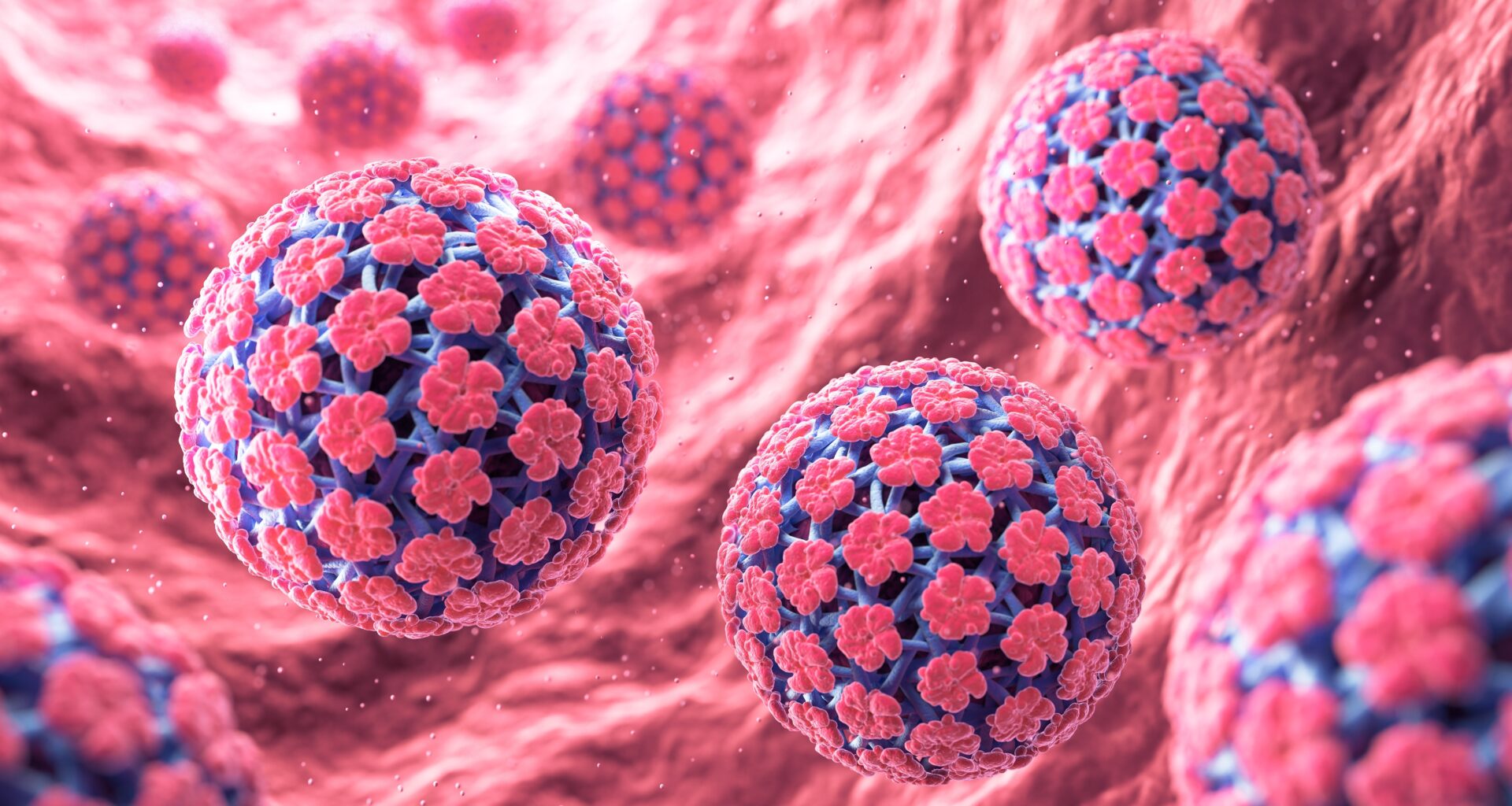
Researchers have discovered that reorganising a single cancer-targeting peptide within a spherical nucleic acid vaccine dramatically boosts the immune system’s ability to attack HPV-driven tumours.
Over the past decade, scientists at Northwestern University have discovered a new principle in vaccine design: performance depends not only on the components used but also on how they are structured.
After demonstrating this concept in multiple studies, the team applied it to one of the most challenging targets in cancer therapy – tumours driven by human papillomavirus (HPV). In a new study, they found that systematically altering the orientation and placement of a single cancer-targeting peptide can produce vaccine formulations that supercharge the immune system’s ability to attack tumours.
Building better vaccines from the ground up
The researchers first designed a vaccine in the form of a spherical nucleic acid (SNA), a globular structure of DNA that naturally enters and stimulates immune cells. They then deliberately rearranged the SNA’s components in multiple ways and tested each version in humanised animal models of HPV-positive cancer as well as in patient-derived head and neck tumour samples.
One design consistently outperformed the rest – shrinking tumours, prolonging animal survival and generating larger numbers of highly active cancer-killing T cells.
One design consistently outperformed the rest – shrinking tumours, prolonging animal survival and generating larger numbers of highly active cancer-killing T cells. The findings highlight how a subtle change in the arrangement of components can determine whether a therapeutic nanovaccine weakly activates the immune system or provides a powerful tumour-destroying response.
This insight underpins the emerging field of ‘structural nanomedicine,’ a term coined by Director of the International Institute for Nanotechnology at Northwestern, Chad A Mirkin, who also invented SNAs.
“There are thousands of variables in the large, complex medicines that define vaccines,” said Mirkin, who led the study. “The promise of structural nanomedicine is being able to identify from the myriad possibilities the configurations that lead to the greatest efficacy and least toxicity. In other words, we can build better medicines from the bottom up.”
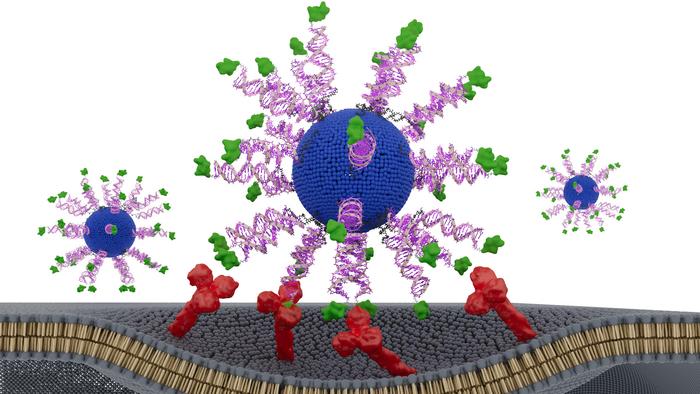
An artistic interpretation of a spherical nucleic acid (SNA) nanoparticle carrying HPV antigen (E7₁₁–₁₉) and CpG adjuvant DNA interacting with scavenger receptor A to facilitate cellular internalisation. Display and N-terminal orientation of the HPV antigen on N-HSNAs enhance antigen-specific CD8⁺ T-cell responses and anti-tumour activity. Credit: Image created by Connor Forsyth and Jake Cohen from the Mirkin Research Group/Northwestern University.
From blender approach to precision design
Traditional vaccine approaches often mix antigens and adjuvants into a simple cocktail before injection. Mirkin calls this the ‘blender approach,’ in which components are unstructured.
“If you look at how drugs have evolved over the last few decades, we have gone from well-defined small molecules to more complex but less structured medicines,” Mirkin explained. “The COVID-19 vaccines are a beautiful example – no two particles are the same. While very impressive and extremely useful, we can do better, and to create the most effective cancer vaccines, we will have to.”
Mirkin’s lab showed that organising antigens and adjuvants into precise configurations enhances efficacy and reduces toxicity compared to unstructured mixtures. The team has applied this approach to SNAs targeting melanoma, triple-negative breast cancer, colon cancer, prostate cancer and Merkel cell carcinoma, with seven SNA drugs already in human trials and more than 1,000 commercial applications.
A smarter immune attack against HPV cancers
HPV causes most cervical cancers and an increasing share of head and neck cancers. Current vaccines prevent infection but do not treat existing tumours.
HPV causes most cervical cancers and an increasing share of head and neck cancers.
The new vaccines were designed to train CD8 ‘killer’ T cells to recognise and destroy HPV-positive cancer cells. Each particle contained the same nanoscale lipid core, immune-activating DNA and short HPV protein fragment. Only the placement and orientation of the fragment varied.
“This effect did not come from adding new ingredients or increasing the dose,” said Co-lead Dr Jochen Lorch. “It came from presenting the same components in a smarter way. The immune system is sensitive to the geometry of molecules. By optimising how we attach the antigen to the SNA, the immune cells processed it more efficiently.”
The optimally structured vaccine triggered up to eight times more interferon-gamma production, slowed tumour growth in humanised mice and killed two to three times more cancer cells in patient tumour samples.
Future of vaccine design
Mirkin plans to revisit previously failed vaccines, showing that tweaking nanoscale architecture can transform weak formulations into potent therapies. Artificial intelligence may accelerate this process, helping identify the most effective structures among nearly limitless combinations.
“This approach is poised to change the way we formulate vaccines,” said Mirkin. “We may have passed up perfectly acceptable vaccine components simply because they were in the wrong configurations. We can go back to those and restructure and transform them into potent medicines. The whole concept of structural nanomedicines is a major train roaring down the tracks. We have shown that structure matters – consistently and without exception.”
Related topics
Drug Discovery Processes, Immuno-oncology, Immuno-oncology therapeutics, Nanomedicine, Oncology, Peptide Therapeutics, Precision Medicine, T cells, Translational Science, Vaccine, Vaccine development