
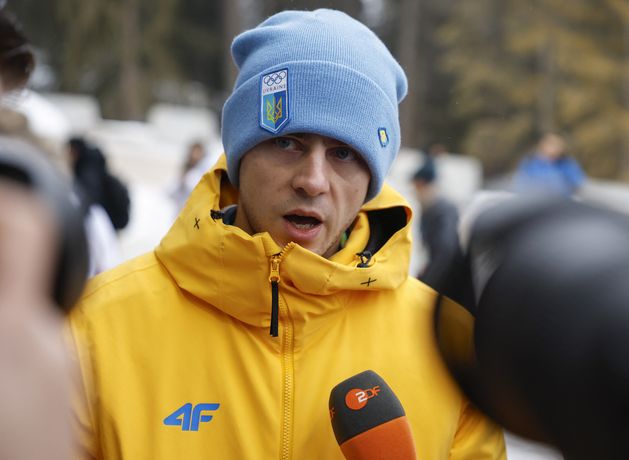
“Sport shouldn’t mean amnesia, and the Olympic movement should help stop wars, not play into the hands of aggressors,” he wrote on X.
Mr Heraskevych was disqualified from the skeleton competition at the Winter Games on Thursday over his “helmet of remembrance” depicting athletes killed since Russia’s invasion despite a personal appeal from a tearful IOC president.
The 27-year-old, who had been training in Italy with the helmet showing two dozen dead compatriots, was barred and initially told he would be stripped of his accreditation minutes before competition was due to start at the sliding venue.
The IOC, however, later said Heraskevych was allowed to keep his credentials and stay at the Milano Cortina Games after President Kirsty Coventry asked its Disciplinary Commission to “reconsider the withdrawal” of the athlete’s accreditation.
President Zelensky said: “Unfortunately, the decision of the International Olympic Committee to disqualify Ukrainian skeleton racer Vladyslav Heraskevych says otherwise,” adding the athlete’s helmet bearing images of Ukrainian athletes killed in the war was a reminder of Russian aggression. “No rule has been broken.”
Mr Heraskevych said: “I am disqualified from the race. I will not get my Olympic moment,” said Heraskevych, who according to the International Olympic Committee would have contravened rules aimed at keeping politics off the field of play. “They (Ukrainian athletes) were killed, but their voice is so loud that the IOC is afraid of them,” he added.
Heraskevych’s team said they would appeal the decision at the Court of Arbitration for Sport.
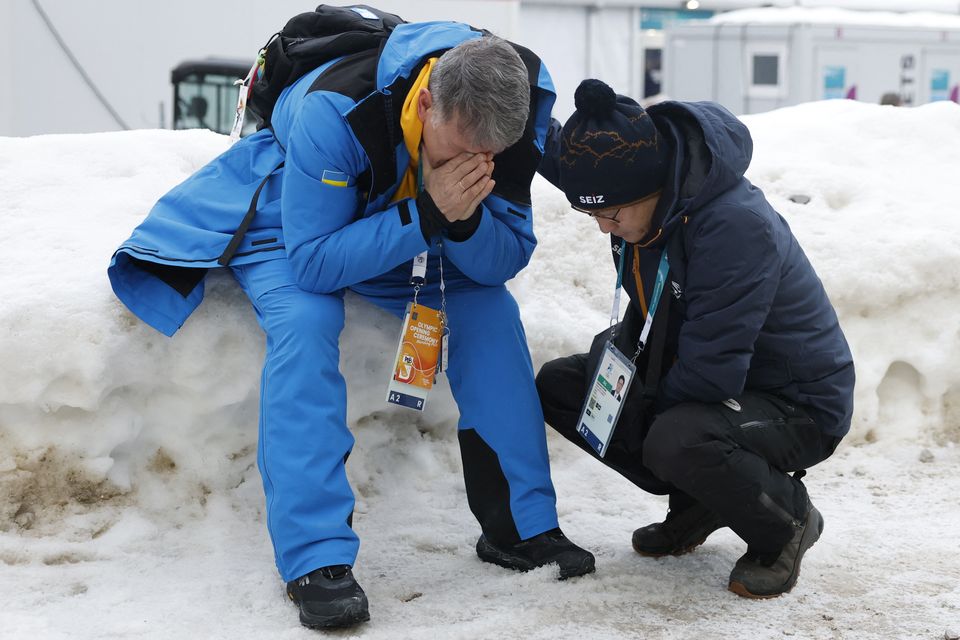
Mykhailo Heraskevych (l), the father of Ukraine’s Vladyslav Heraskevych, reacts after his son was disqualified.
Coventry arrived in the early morning near the start gate and, after waiting for more than half an hour in light snowfall, met Heraskevych before the decision. She choked up with tears when telling reporters she was unable to broker a solution.
“I thought it was really important to come here and talk to him face-to-face,” she said after the meeting that lasted about 10 minutes. “No one, especially me, is disagreeing with the messaging, it’s a powerful message, it’s a message of remembrance, of memory.”
The IOC had suggested compromises including wearing a black armband or showing the helmet before and after racing.
“Sadly we’ve not been able to find that solution. I really wanted to see him race. It’s been an emotional morning,” Coventry said. “It’s literally about the rules and the regulations and that in this case … we have to be able to keep a safe environment for everyone and, sadly, that just means no messaging is allowed.”
It is not the first time the IOC has sanctioned an athlete for a political message. The most famous case was at the 1968 Summer Olympics in Mexico City when U.S. sprinters Tommie Smith and John Carlos raised black-gloved fists during the 200 metres medal ceremony to protest racial injustice in the United States.
That led to their expulsion from the Games, although Smith kept his gold medal and Carlos his bronze.
“If we allow one athlete this expression … it will lead to chaos,” IOC spokesperson Mark Adams told a press conference.
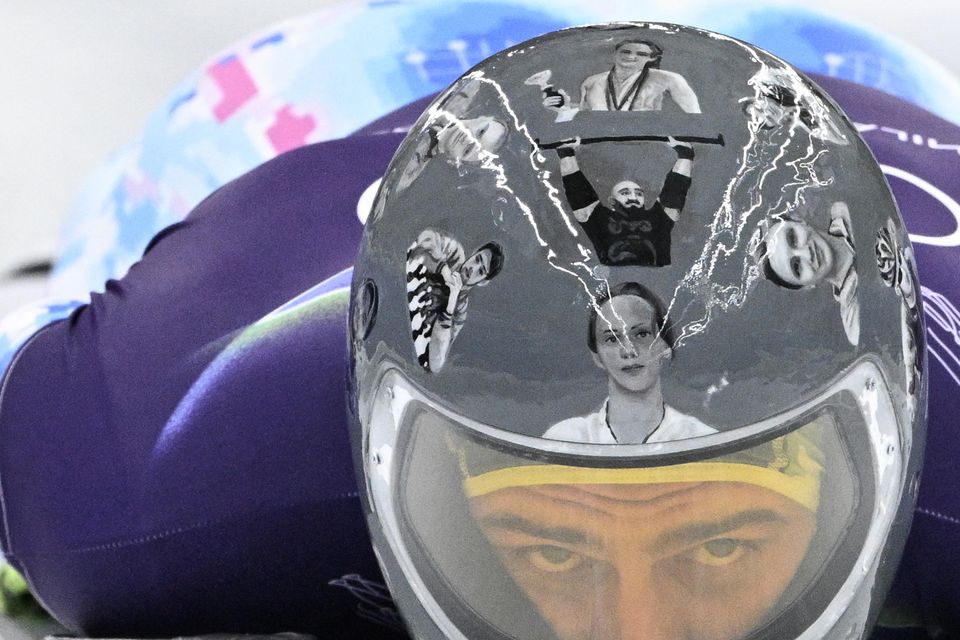
Ukraine’s Vladyslav Heraskevych takes part in the skeleton men’s training session at Cortina Sliding Centre yesterday.
Ukraine’s Olympic Committee said it was planning some sort of protest but would not boycott the Games.
Ukraine’s Youth and Sports Minister Matvii Bidnyi wrote on X: “We will correct this mistake through legal channels. Vladyslav, you acted with dignity. This story will definitely continue. We stand with you.”
Ukrainian team members were seen in tears and hugging each other after the decision.
Heraskevych’s father and coach Mikhailo Geraskevych sat on a dirty snowbank, his face buried in his hands. Heraskevych, holding the International Bobsleigh and Skeleton Federation (IBSF) notification of his withdrawal, said the case played into Russia’s narrative about the four-year war in his nation. “Even though the IOC wants to betray the memory of these athletes, I will not betray them,” added Heraskevych, who also displayed a “No War in Ukraine” sign at the Beijing 2022 Olympics days before Russia’s invasion.
“I sincerely believe that it is precisely because of their sacrifice that these Olympic Games can take place at all today.”
American skeleton athlete Daniel Barefoot praised Heraskevych’s courage.
“First off, he stands by whatever he believes in … he’s telling the truth and he’s not going to back off on race day,” he told reporters.
“But I also was thinking that maybe the IBSF or whoever is in power would sort of back off and let him be.
“When I found out that he was going to be disqualified, to be honest, I was shocked. He’s one of the best sliders in the world but he obviously believed that that was more important than the sliding.”
There has been no comment on the case from Moscow and the IOC said it had received no communication from Russia. Latvian coach Ivo Steinbergs told Reuters he had filed a protest with the IBSF to try to get Heraskevych reinstated and contacted other teams for them to join the action.
An IBSF spokesperson told Reuters it had received an email, but no formal protest.
The skeleton started on Thursday morning. Following Moscow’s invasion of Ukraine in 2022, athletes from Russia and Belarus were largely barred from international sport, but the IOC has since backed their gradual return under strict conditions. Moscow has condemned the mixing of sport and politics in decisions to exclude its competitors from global competitions. (Reporting by Julien Pretot, Karolos Grohmann, Mitch Phillips; Additional reporting by llze Filks and Christine Uyanik, Editing by Peter Rutherford, Andrew Cawthorne and Ken Ferris)