
Mars has long captivated scientists with its mysterious volcanic landscape, but new revelations are changing the way we understand the planet’s fiery history. For years, experts believed that Martian volcanoes were shaped by short, simple eruptions. However, fresh research is revealing a far more intricate story, one in which volcanic activity is driven by complex, evolving magma systems beneath the surface. By analyzing volcanic minerals and surface features from orbit, scientists are now uncovering the dynamic processes that have shaped Mars’ youngest volcanoes.
Unveiling the Complex Magma Systems Beneath Mars’ Surface
In the study published in Geology, an international team of researchers investigated a volcanic system located south of Pavonis Mons, one of Mars’ largest volcanoes. The study, which combines detailed surface mapping with orbital mineral data, reveals a much more complicated volcanic history than initially thought.
“Our results show that even during Mars’ most recent volcanic period, magma systems beneath the surface remained active and complex,” says Bartosz Pieterek of Adam Mickiewicz University.
This analysis suggests that the volcanic activity was not the result of a single eruption but rather a series of eruptions occurring over a prolonged period. Rather than being the product of a single, brief eruption, the volcanoes evolved over time as conditions within the subsurface changed. This complexity is significant because it challenges the older notion that volcanic activity on Mars was relatively simple and short-lived.
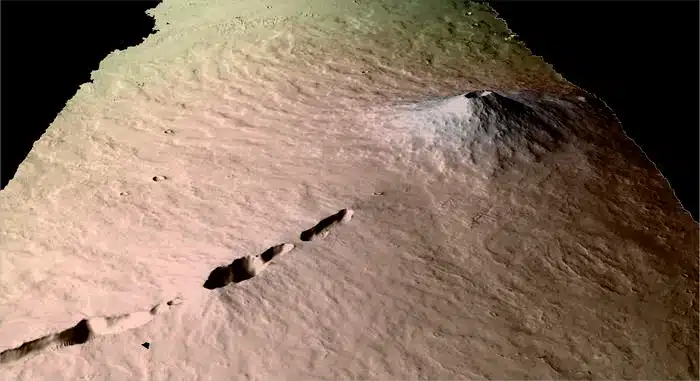 Visualization of the studied volcanic system (Pavonis fissure). Image courtesy Bartosz Pieterek.
Credit: Image courtesy Bartosz Pieterek.
How Volcanic Eruptions Evolved Over Time
One of the key discoveries from this research is that Mars’ youngest volcanoes developed through multiple eruptive phases, each reflecting a distinct stage of magmatic evolution. The team observed that these volcanic systems transitioned from fissure-fed lava emplacement to later phases of point-source activity, which resulted in the formation of cones.
“The volcano did not erupt just once—it evolved over time as conditions in the subsurface changed,” explains Pieterek.
These findings indicate that the underlying magma systems were not static; instead, they evolved beneath the surface, with magma moving, changing, and interacting in various ways over time. Each eruptive phase was marked by different mineral signatures, offering a clear record of the magma’s evolution. This adds a new layer of complexity to our understanding of Martian volcanic systems, highlighting the dynamic nature of the planet’s subsurface.
Pavonis Mons, rising roughly 12 km above the surrounding plains, is the central volcano of the three ‘shield’ volcanoes that comprise Tharsis Montes. Gently sloping shield volcanoes are shaped like a flattened dome and are built almost exclusively of lava flows. The context map is centred on Pavonis Mons, one of the three volcanoes called Tharsis Montes (the others being Arsia and Ascreus Montes, aligned with Pavonis in a line nearly 1500 kilometres long).
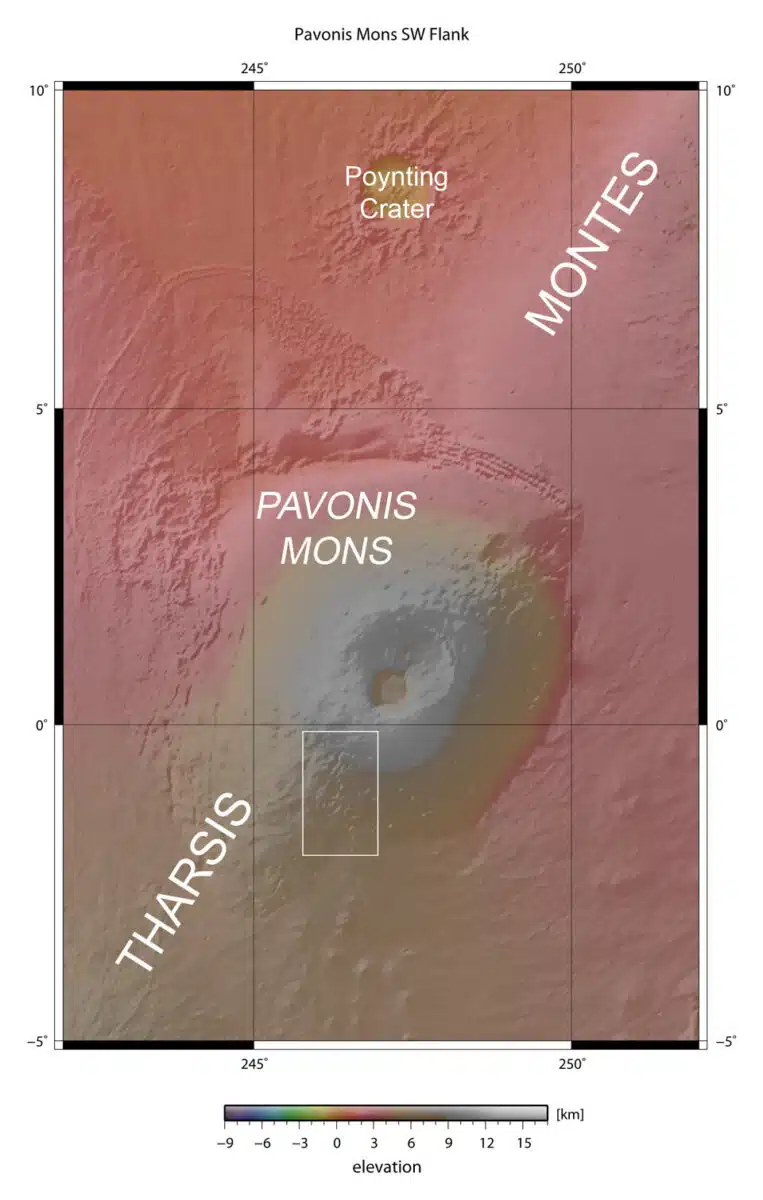 Pavonis Mons, rising roughly 12 km above the surrounding plains, is the central volcano of the three ‘shield’ volcanoes that comprise Tharsis Montes. Gently sloping shield volcanoes are shaped like a flattened dome and are built almost exclusively of lava flows. The context map is centred on Pavonis Mons, one of the three volcanoes called Tharsis Montes (the others being Arsia and Ascreus Montes, aligned with Pavonis in a line nearly 1500 kilometres long).
Credit: ESA/DLR/FU Berlin (G. Neukum)
The Role of Mineral Signatures in Understanding Magmatic Evolution
One of the most fascinating aspects of the study is how mineral analysis revealed the evolving nature of the magma beneath Mars’ surface. By examining the surface products of volcanic eruptions, scientists were able to identify distinct mineral signatures that reflect the changing conditions of the subsurface.
“These mineral differences tell us that the magma itself was evolving,” Pieterek explains. “This likely reflects changes in how deep the magma originated and how long it was stored beneath the surface before erupting.”
These mineral signatures are crucial because they provide the first real evidence that Mars’ magmatic systems were not uniform. The evolution of magma over time is a critical piece of the puzzle in understanding how volcanic systems work on Mars. The study suggests that the magma underwent significant changes, both in terms of its source and the conditions it experienced before eruption. This could have implications for the potential habitability of Mars, as well as the planet’s geological history.