
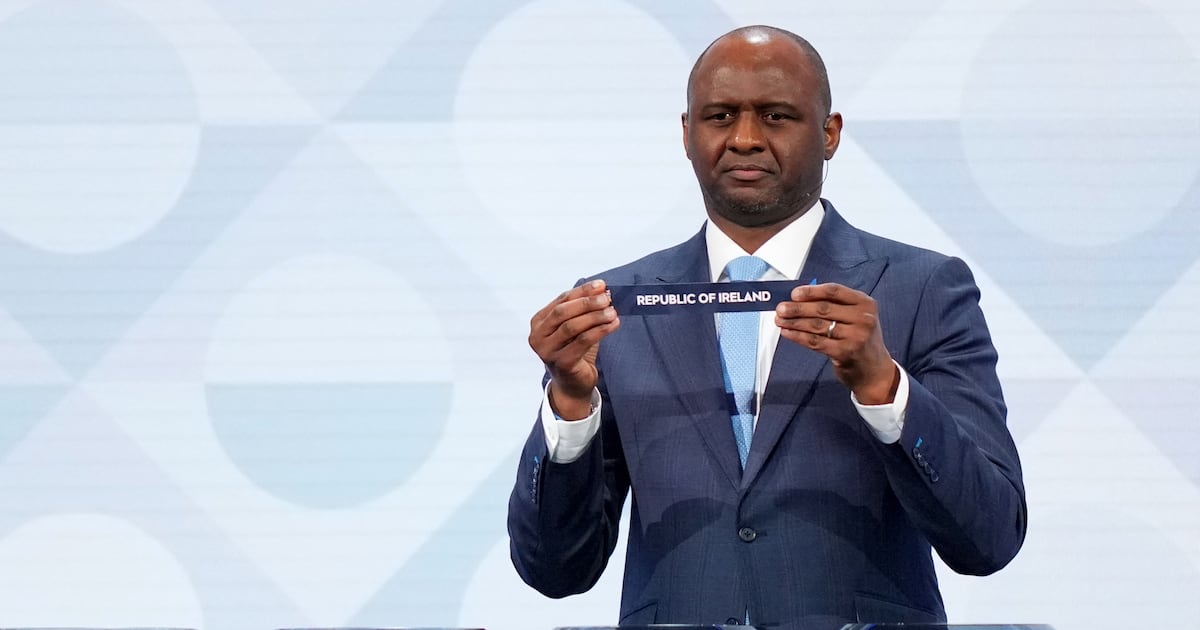
The FAI have confirmed that the Republic of Ireland will fulfil their two fixtures against Israel in the Nations League.
Heimir Hallgrímsson’s Ireland team have been drawn in Group B3 to play home and away against Israel, Austria and Kosovo between September 24th and November 17th.
The FAI said, in a prepared statement that was released immediately following the draw in Brussels, that the men’s national team will “fulfil” the Israel fixtures despite sending a motion to Uefa last November calling for the Israel FA’s suspension from European club and international competitions.
“In 2025 a motion was proposed by members of the FAI General Assembly to vote on issuing a formal request to the Uefa executive committee for the immediate suspension of the Israel FA from Uefa competitions for a breach of Uefa statutes,” read the FAI statement.
“Members then voted in favour to submit the motion to Uefa, which the association did in November 2025.
“While consultation has taken place with Uefa officials, the association does recognise that Uefa regulations outline that if an association refuses to play a match then that fixture will be forfeited, and further disciplinary measures may follow – including potential disqualification from the competition.”
The dates for the Nations League will be released on Friday afternoon, with venues to be confirmed at a later date, but Uefa recently confirmed that due to “safety and security concerns” Israeli clubs in European competitions and the international side must play their home matches at a neutral venue.
[ A closer look at Ireland’s Nations League opponentsOpens in new window ]
Israel have 120 days before the deadline to submit a neutral venue. Last year, they played World Cup qualifiers against Italy, Norway and Estonia at the Nagyerdei Stadium in the Hungarian city of Debrecen.
In November, the FAI’s general assembly voted 74-7 in favour of a motion, proposed by Bohemians, calling for Israel to be banned from football. The motion noted “the organisation of clubs in illegal settlements in the occupied West Bank without the consent of the Palestinian Football Association, [is] in breach of Fifa statutes (Article 73) and Uefa statutes (Article 5)” and it highlighted the “failure” of the Israeli association “to implement and enforce an effective antiracism policy”.
However, on the same day the motion passed, FAI president Paul Cooke stated that Ireland would play Israel if drawn against them in a Uefa-sanctioned competition.
“Straight off the bat, we would play them,” said Cooke.
Responding to the FAI motion in December, Uefa wrote to Cooke to say that the situation was being “closely monitored.” However, the motion to suspended Israel was not discussed at the Uefa Congress in Brussels on Thursday morning.
Cooke and the FAI chief executive David Courell declined a request to speak with the Irish media that travelled to Brussels, which left Hallgrímsson to field a stream of questions.
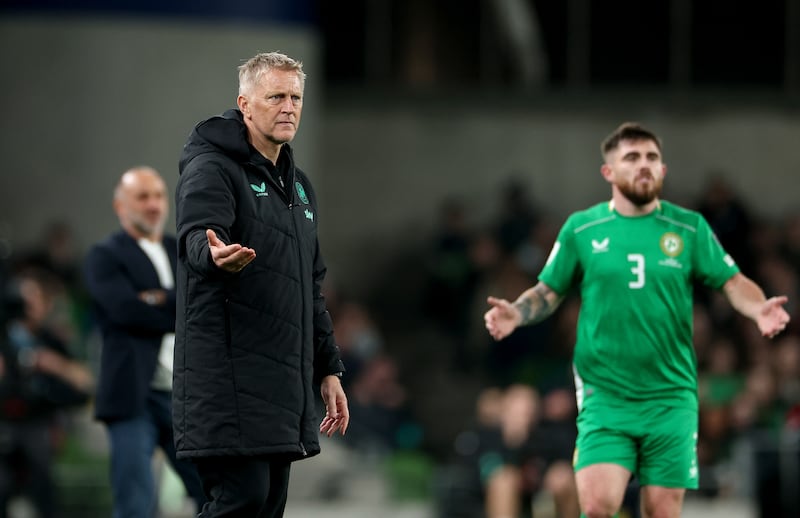 Heimir Hallgrímsson pitch side during Ireland’s World Cup qualifier against Armenia in October 2025. Photograh: James Crombie/Inpho
The Icelandic coach was determined to stick to football matters despite his comments on Israel last October when he said he did not “see the difference in Fifa and Uefa banning Russia, and not Israel.”
“I’m on record saying that,” said Hallgrímsson. “I stand by that. But it’s not my decision if you play or not against them or what decision is taken on a higher level. I am the head coach.”
Russia remain banned from all European club and international competitions since the invasion of Ukraine in 2022.
“I need to focus on the football,” Hallgrímsson continued. “My opinion is not relevant in this case. I hope when we play [Israel], the supporters will support Ireland and support us to do a good job.
“Football-wise it is going to be a tough group.”
When asked about Irish players potentially deciding not to line out against Israel in Dublin or a neutral venue, Hallgrímsson said: “It’s obviously every player’s decision to play for the national team or not.”
Ireland also drew Austria in Group B3 with Ralf Rangnick’s side already qualified for this summer’s World Cup, having been drawn in Group J alongside Argentina, Algeria and Jordan.
Austria are 24th in the Fifa world rankings with Ireland currently 59th, Israel 77th and Kosovo 79th.
“I didn’t realise the record Kosovo had,” said Hallgrímsson. “Really impressive from the last 15 games, they’ve registered two losses and two draws. They’re in the World Cup playoff, like us, so really a tough opponent.
“We know a little bit more about Austria and Ralf Rangnick; I really like the way his teams play football.”
England, meanwhile, were drawn in a group with Spain, Croatia and Ireland’s World Cup semi-final play-off opponents the Czech Republic.
The Czechs host Ireland in Prague on March 26th with the winners facing either Denmark or North Macedonia.
Denmark are in Group A4 alongside Wales, Norway and Portugal.
Nations League A1: France, Italy, Belgium, TurkeyLeague A2: Germany, Netherlands, Serbia, GreeceLeague A3: Spain, Croatia, England, Czech RepublicLeague A4: Portugal, Denmark, Norway, WalesLeague B1: Scotland, Switzerland, Slovenia, North MacedoniaLeague B2: Hungary, Ukraine, Georgia, Northern IrelandLeague B3: Israel, Austria, Republic of Ireland, SwedenLeague B4: Poland, Bosnia and Herzegovina, Romania, KosovoLeague C1: Albania, Finland, Belarus, San MarinoLeague C2: Montenegro, Armenia, Cyprus, Gibraltar OR Latvia,League C3: Kazakhstan, Slovakia, Faroe Islands, MoldovaLeague C4: Iceland, Bulgaria, Estonia, Malta OR Luxembourg