

Track your investments for FREE with Simply Wall St, the portfolio command center trusted by over 7 million individual investors worldwide.
Nvidia agreed to acquire Groq’s AI inference chip assets for $20b, aiming to expand its position in AI deployment hardware.
The company introduced its new Rubin chip platform, designed around next generation memory technology for inference workloads.
Samsung and Micron are set to supply HBM4 memory for Nvidia’s new GPU platforms, signaling changes in its component supply chain.
Recent U.S. policy signals on legacy AI chip exports to China may affect how Nvidia serves that market.
NVIDIA (NasdaqGS:NVDA) enters this phase of product and deal news with a share price of $186.94 and a one year return of 38.2%. Over the past week, the stock is up 8.8%, while the year to date return sits at a 1.0% decline, reflecting some recent volatility.
For you as an investor, the Groq acquisition and Rubin launch are mainly about where Nvidia wants to compete as AI usage shifts toward real world applications. Memory partnerships and evolving China export rules add extra moving parts that could influence demand, pricing power, and how its product roadmap plays out, all of which are worth watching alongside the share price.
Stay updated on the most important news stories for NVIDIA by adding it to your watchlist or portfolio. Alternatively, explore our Community to discover new perspectives on NVIDIA.
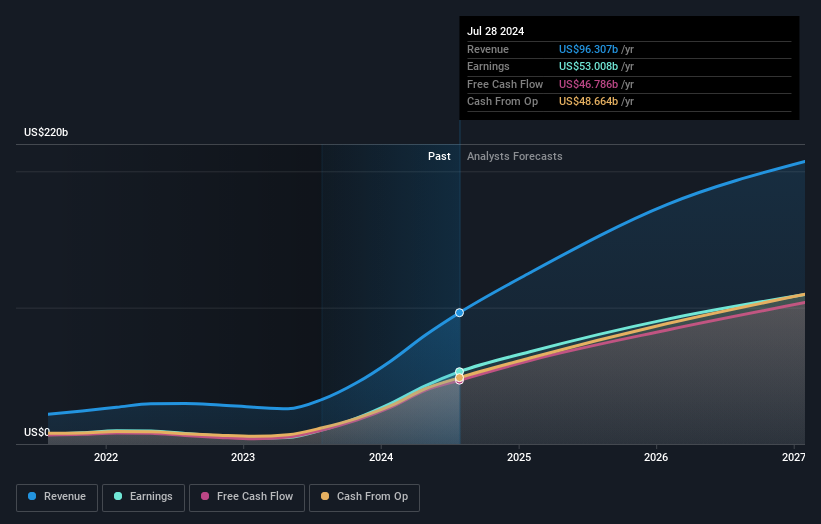 NasdaqGS:NVDA Earnings & Revenue Growth as at Feb 2026
📰 Beyond the headline: 2 risks and 4 things going right for NVIDIA that every investor should see.
Nvidia’s $20b move for Groq’s inference assets and the Rubin platform launch point to a clear push beyond training GPUs into AI-inference specific hardware. That fits with what you are seeing elsewhere in the business, from distributed inference trials with Prologis and EPRI at utility-adjacent micro data centers to heavier use of Nvidia’s Isaac and BioNeMo platforms in areas like warehouse autonomy and lab robotics. The announced use of Samsung and Micron HBM4 on upcoming GPUs ties Nvidia more tightly to key memory suppliers, which may help support Rubin and Vera Rubin ramps but could also concentrate supplier risk. On the policy side, signals that older Hopper-generation chips might see looser export treatment to China, while newer architectures stay tightly controlled, effectively segment Nvidia’s portfolio by region and performance tier. For you, the thread across these developments is that Nvidia is working to secure more of the inference stack, from edge sites to large AI factories, while juggling supply chain depth and export rules that can affect where and how quickly new products scale.
The Groq acquisition, Rubin platform work and distributed inference partnerships support the narrative that Nvidia is leaning into an AI infrastructure supercycle that spans both training and inference across data centers and edge locations.
Greater reliance on specific HBM4 suppliers and export segmentation between Blackwell or Rubin and older Hopper chips underscores narrative risks around supply chain fragility and geopolitical limits on total addressable market.
The focus on inference specific hardware and micro data centers, as well as physical AI in labs and factories, extends the story into use cases that are not fully captured by a training centric view of AI data center growth.
Knowing what a company is worth starts with understanding its story. Check out one of the top narratives in the Simply Wall St Community for NVIDIA to help decide what it’s worth to you.
⚠️ Tighter links to a handful of HBM4 suppliers may expose Nvidia to component shortages or pricing pressure if memory capacity becomes constrained or terms change.
⚠️ Export rules that keep the latest Blackwell and Rubin chips out of China could cap growth in that market and push some large customers toward domestic or alternative accelerators from peers like AMD or in house silicon.
🎁 The Groq asset purchase and Rubin inference focus give Nvidia more product depth against inference competitors such as AMD and custom ASIC providers, which can help support its position across the AI stack.
🎁 Memory partnerships with Samsung and Micron, plus work on distributed inference sites, can help Nvidia stay aligned with where AI workloads are heading, from large training clusters to latency sensitive edge deployments.
From here, it is worth watching how quickly Nvidia integrates Groq’s technology into shipping inference products and whether Rubin based systems gain traction with cloud providers and large enterprises. The terms and volumes associated with Samsung and Micron HBM4 supply will be important signals for how smoothly future GPU ramps can proceed. On the policy side, any concrete rules around legacy Hopper exports to China, compared with continuing restrictions on newer architectures, will help clarify how much of Nvidia’s portfolio can serve that market. Together, these factors will influence how balanced Nvidia’s AI exposure is between training and inference, and how diversified its demand and supply chains remain.
To ensure you’re always in the loop on how the latest news impacts the investment narrative for NVIDIA, head to the community page for NVIDIA to never miss an update on the top community narratives.
This article by Simply Wall St is general in nature. We provide commentary based on historical data and analyst forecasts only using an unbiased methodology and our articles are not intended to be financial advice. It does not constitute a recommendation to buy or sell any stock, and does not take account of your objectives, or your financial situation. We aim to bring you long-term focused analysis driven by fundamental data. Note that our analysis may not factor in the latest price-sensitive company announcements or qualitative material. Simply Wall St has no position in any stocks mentioned.
Companies discussed in this article include NVDA.
Have feedback on this article? Concerned about the content? Get in touch with us directly. Alternatively, email editorial-team@simplywallst.com