
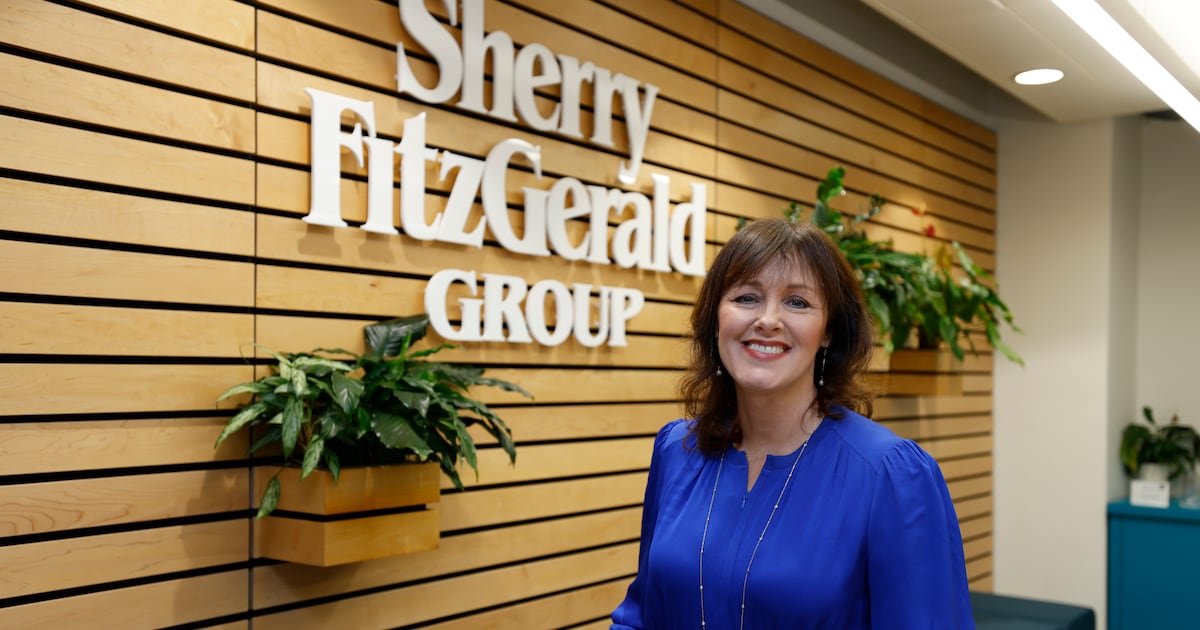
“I was thinking we’d sit here,” says Sherry FitzGerald chief executive Marian Finnegan, pointing to two fashionable, light green tub chairs on the opposite side of her desk in her bijou office on Ballymoss Road in Sandyford.
“My desk chair is higher up and I don’t like being up higher than the person I’m speaking with.”
As chief executive of Ireland’s largest estate agency, Finnegan’s perch gives her a bird’s-eye view of Ireland’s housing crisis.
Sherry Fitz’s wholly owned business sold about 4,500 new and second-hand properties last year. In addition, its network of franchisees around the country sold almost 4,600 homes between them. That’s a total of around 9,100 properties. Some 30 per cent of units it sells are investment properties.
That was in a market where around 48,000 second-hand transactions took place, alongside the sale of 10,000 new homes.
It gives Sherry Fitz a market share of about 15 per cent nationally but this would rise to 25-30 per cent in some parts of south county Dublin, its key market.
About 100,000 people here are looking to buy a home at any one time, according to Finnegan. She estimates there are three first-time buyers out there per each new home.
A report by property website MyHome, which is owned by The Irish Times, found that 40 per cent of properties sold in the Republic in 2024 were settled at 10 per cent or more above the original asking price. One in seven transactions was settled at 20 per cent above the asking price.
With demand outstripping supply, this should be a great time to be an estate agent, with bidding wars breaking out on many properties. Finnegan disagrees.
“Demand exceeding supply causes its own problems,” she says. “It impacts on transaction activity, it impacts on time to sell, it impacts fees because the industry becomes desperate for stock so there’s a fee war,” she says.
[ Sherry FitzGerald appoints Marian Finnegan as CEOOpens in new window ]
Research from the ESRI this week found that buyers’ bids were pushed higher in open auctions managed by estate agents or online platforms than in sealed bid auctions. Some 14 per cent of respondents felt they had been the subject of so-called ghost bids – fake offers designed to drive up the price by the seller or their agent.
Finnegan says the property sector is now “heavily regulated and is not the market that was there several decades ago, when more people were suspicious of the market”.
“You shouldn’t be nervous if you’re investing €500,000 or more in a property that the bid against is real or not. The industry has to be transparent as possible.”
For its own part, Sherry Fitz has operated an anonymised bidding system for a number of years via an online portal.
“MySherryFitz is that tool. You register, you can bid, your identity is anonymised and you can see the bids as they occur. It’s a very transparent process,” she says, adding that the bids can be inspected and scrutinised by the Property Services Regulatory Authority.
Some 70 per cent of the bids it receives for properties it has marketed are made through the online portal, she says.
Finnegan reckons there are about 14,000 properties for sale at the moment in the second-hand market and that the country is taking “baby steps” towards solving the housing crisis.
“We’re probably seeing greater activity in the eastern corridor and flatter activity everywhere else where there just isn’t the product,” she says.
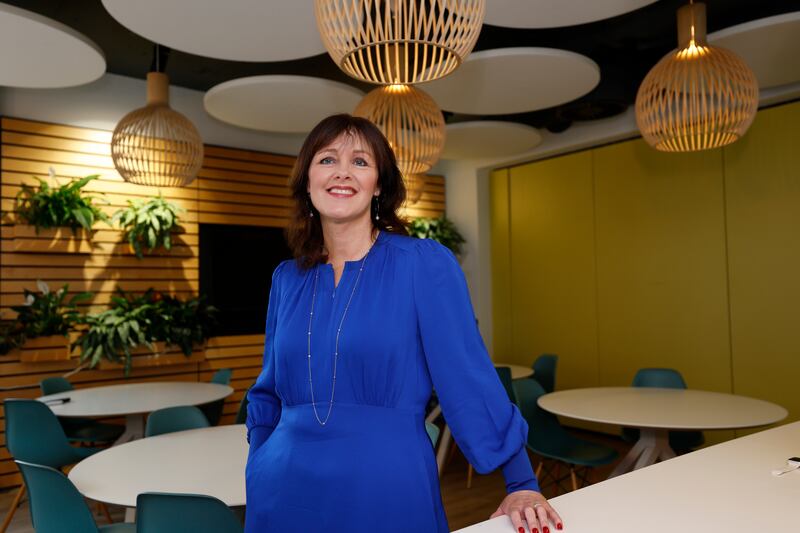 Sherry FitzGerald chief executive Marian Finnegan. Photograph Nick Bradshaw
While there is no silver bullet solution, Finnegan says the accumulation of a lot of different measures will have an impact. For example, Bank of Ireland recently launched a bridging finance product, to assist those looking to downsize to secure a new property without having to sell their existing one first.
“That small little bit of hope around bridging finance might help allow a transaction to occur. Without that, you get this protracted period and we have a lot of chains in the market now, which creates a lot of stress for potential purchasers.”
She says we need to have 2-2.5 per cent of our housing stock available for sale at any one time to give people choice and not “feel that frenzy in terms of price inflation”.
“At the moment we have 0.7 per cent of our stock available for sale and that’s what’s pushing up the prices.”
Finnegan says too much policy focus by Government has been placed on first-time buyers. “For 30 years … all the Government has focused on is first-time buyers, they don’t look at the rental sector, they don’t look at trade down or up sector and for many years they didn’t look at the student accommodation.
“We are never going to see normalised activity in the second hand market if we’re not providing people with options and choice. Building first-time buyer apartments and houses is not providing optionality for everybody else.
“A first-time buyer apartment is not suitable for someone who is trading down. Typically people want to bring memories with them, be that furniture, a piano, the golf clubs or whatever and in a small apartment they’re not going to be able to do that.”
She also argues that we also need to incentivise the development of infill sites in urban locations.
Finnegan says it typically takes seven months to sell a home from the moment it goes on the market to when the money changes hands. She says econveyancing (to deal with the documentation in a property sale) would help speed things up but is probably years away, in spite of being talked about for years.
While a smaller part of its business, selling new homes is more profitable for Sherry Fitz. Finnegan says its margin on new homes is 30 per cent compared with 18-20 per cent on second-hand transactions.
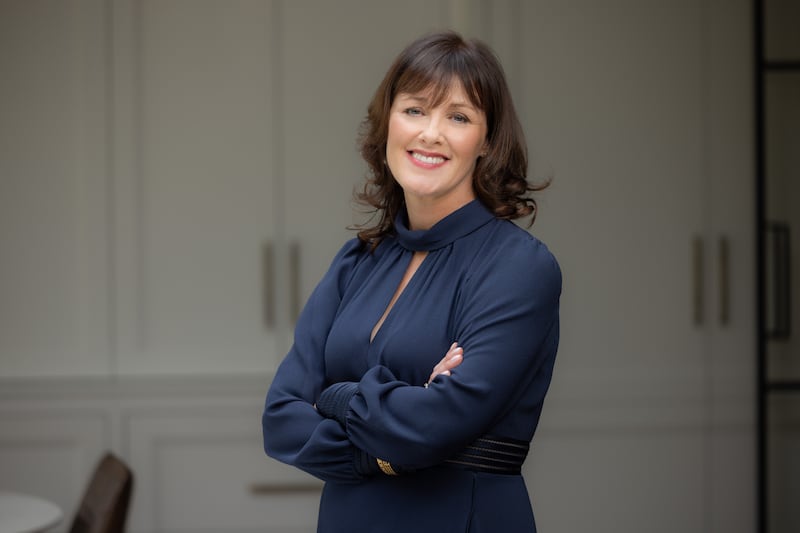 Marian Finnegan hails from Barna in Connemara, Co Galway. Photograph: Naoise Culhane
It typically charges a commission of 1.3 per cent to sell a home, down to about 1 per cent for those with big ticket prices. “The Cork market secures a much better fee, about 1.75 per cent,” she reveals, which might explain why it is about to open its third office there in Carrigaline.
“We have a very strong database of buyers and people will pay for quality,” she says by way of explanation.
[ Have Irish property prices reached their peak? Five experts give their takeOpens in new window ]
Is the same not true in Dublin? “We’ve a more competitive marketplace here. We acquired that business in Cork in 1999 and they had a policy of a strong high fee. It is spectacular. They think we’re nuts with the fee we charge [in Dublin].”
In Northern Ireland, where Sherry Fitz owns the Simon Brien agency, fees are typically around 0.8 per cent. “Lower values, too,” she adds.
Sherry Fitz used to have a presence in the UK but sold its majority stake in Marsh & Parsons in 2011, netting a tidy €44 million, which allowed it to clear its debts and secure the future of the core Irish business.
To diversify its income stream, Finnegan has an eye on a return to the London market over the “medium to long term”.
It is also hoping to close a deal in the first quarter to acquire Knight Frank, which would mark its re-entry into the Irish commercial property market.
In terms of trends, Irish people still want a three bedroom semi, with a front and back garden, she says. “Apartments are a slower burn because they are more expensive.
“On the second hand side, it’s the same as it always was in terms of affordability, being close to work, close to family and what’s available. The biggest issue is availability so people always have to compromise: on size, on location, on quality of the properties.”
Finnegan last bought a home in August 2022, although it was almost three years before they were able to move in to the property. The listed property in Clontarf was derelict and in need of total renovation.
“A labour of love, almost divorced,” she jokes while scrunching up her face.
Would she do it again? “No. We have it now so it’s grand but it was torture for three years.”
Finnegan hails from a farm in Barna in Connemara, Co Galway. “We had everything: cows, horses, small farm, bit of everything. Hard life,” she says.
“My kids would say ‘you were so lucky growing up on a farm’ and I’d say ‘you’ve no idea lads’. Whether you were saving hay, gathering turf, weeding vegetables, growing vegetables, moving cows, helping with everything. It was lovely but shocking hard work and very little return for all the labour. It’s underestimated how much hard work it is.”
Her parents are both deceased and the land is rented out but the family house is a “holiday home” of sorts for Finnegan and her brother. Her husband is also from Galway and one of their sons is going to college there (doing economics and law) so the connection remains strong.
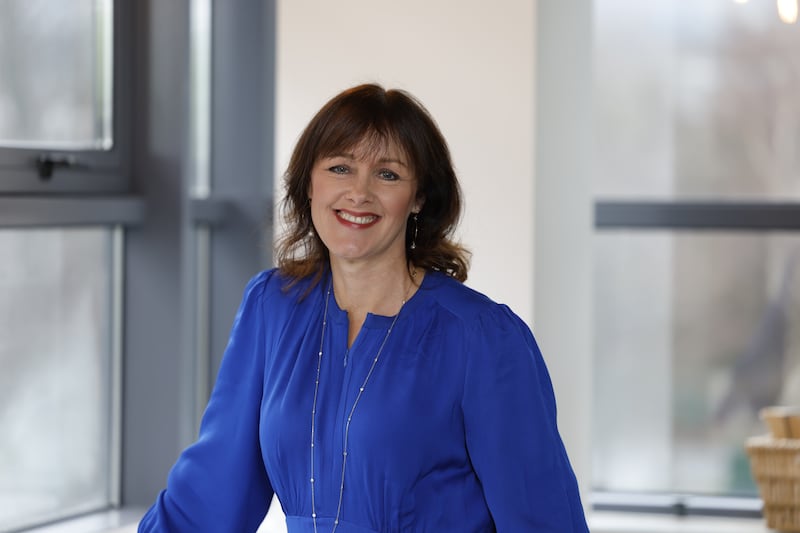 Sherry FitzGerald chief executive Marian Finnegan. Photograph Nick Bradshaw
Finnegan went to a local school and then the all-girls Dominican College, Taylor’s Hill. At UCG, she started doing law but “gave it up” and took a degree in economics and Italian in UCG and then a masters in economics.
Why give up law?
“I don’t know. I’m probably more quantitative so I really enjoyed economics and I probably got lazy doing law if I’m really honest. I half regretted it for most of my career because I really would have enjoyed it.”
After college she went lecturing in economics in Galway and Limerick and was preparing to do a PhD in urban economics when she saw a “tiny” job ad on the back page of The Irish Times for an estate agency looking for an economist.
“I thought I’d have a little look to see what that was about. I didn’t even know who Sherry FitzGerald were. Mark [FitzGerald, its co-founder] had a vision to set up a research unit to look at trends, more on the commercial property side. The first thing I did was to start looking at what historical information we had and then manually gathering everything we could get on to Excel to begin with.”
This gathering of data was a “game changer” for Sherry Fitz in terms of how it approached the market and valued properties, she says.
In May, she will celebrate 30 years with the agency, which had about half a dozen offices when she joined. It now has 31 of its own branches, along with a network of franchisees.
Six years ago, she was appointed to head the residential arm and she took over the CEO post in September of last year.
Mark FitzGerald, probably the best known estate agent in Ireland, sold the business in 2022 to Tommy Kelly’s CastleGate Investments for about €50 million.
What was FitzGerald like to work for?
“Very visionary. He has 2,000 ideas a minute. He was focused on gender balance at a time when nobody else was. And he gave me autonomy, which was hugely important. As an economist coming into the industry, I was an alien species and I needed to have a free run to say prices are going up or prices are going down.
“The first time I reported prices falling it was unheard of. In the mid 1990s that wasn’t something that estate agents did.”
FitzGerald still rings her most days to chew the cud, she says, and to share some ideas.
How has the business changed since Kelly assumed ownership?
“When he stepped down from eShopWorld, he became more involved and became better known in the industry. Nobody knew who he was three years ago. He’s on a learning curve with us … but he’s very attuned to the market. It’s working very well,” she says, adding that Kelly is not involved in the day-to-day running of the business.
Finnegan says being head of residential gave her a “wider” view of operations and when the top job became vacant last year “I knew I wanted to lead the business”.
“Sherry Fitz has been my work home for 30 years … my husband says I’m married to it. It felt like the natural next step for me.”
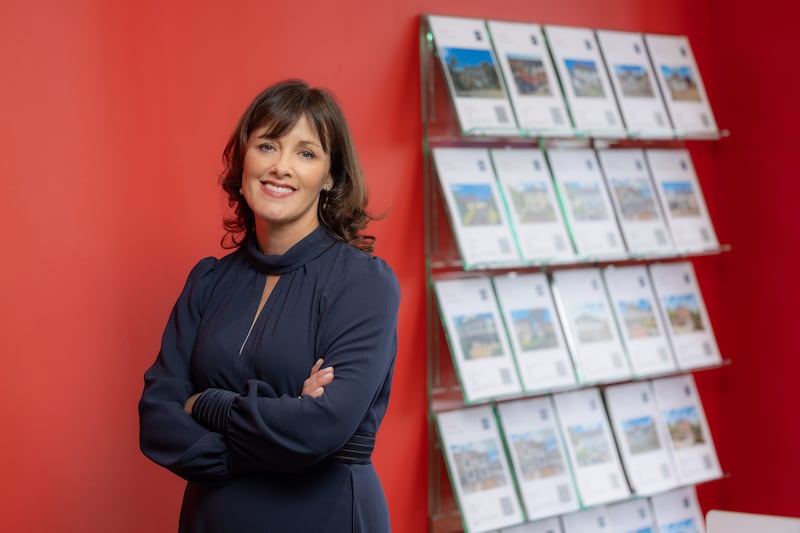 Marian Finnegan has been with Sherry FitzGerald since 1996. Photograph: Naoise Culhane
What is she hoping to achieve in her time at the helm?
“Investment in technology is something I’m very interested in. Property as a process is very labour intensive and there is a lot more that technology can do to support a transaction.
“I would love to see the investment in Knight Frank expanding, going into new business areas, it’s a huge opportunity for them and for us to look at a full service offering in the sector.
“We’d like to look at other opportunities in the North and in the medium to long term if you’re looking to diversify as a business you need to diversify outside one economy. I would like to look at the UK. London is the obvious choice but that’s just an aspiration rather than a plan.”
Does she think we can solve the housing crisis over the next 10 to 15 years?
“I’m not confident that we will ever fully solve the housing crisis in Ireland. I’ve been looking at this market for 30 years and we have never got it 100 per cent right,” she says.
“The [2008] crash brought about a fear that the worst is always around the corner and we’re somewhat risk averse when it comes to housing. What would be necessary to truly stabilise it is unlikely, we’re not going to get there but I think we will be in a better position in 10 years time than we are now.”
CV
Name: Marian Finnegan
Job: Chief executive, Sherry FitzGerald
Age: She will be 55 in June
Lives: Clontarf in Dublin
Family: Married to Mike, with three children Emma, Ross and Rowan
Hobbies: “I go to the gym a couple of times a week, walk as often as I can and I read as much as I can.”
Something we might expect: As an economist, she is a data junkie.
Something that might surprise: She bought her home from Lisney. Staff at Sherry Fitz aren’t allowed to buy from its own book of properties. “Which is hugely limiting. It’s the only way you could operate in the second-hand market with the size we are, you couldn’t have people buying off our own books. You have to respect it.”