
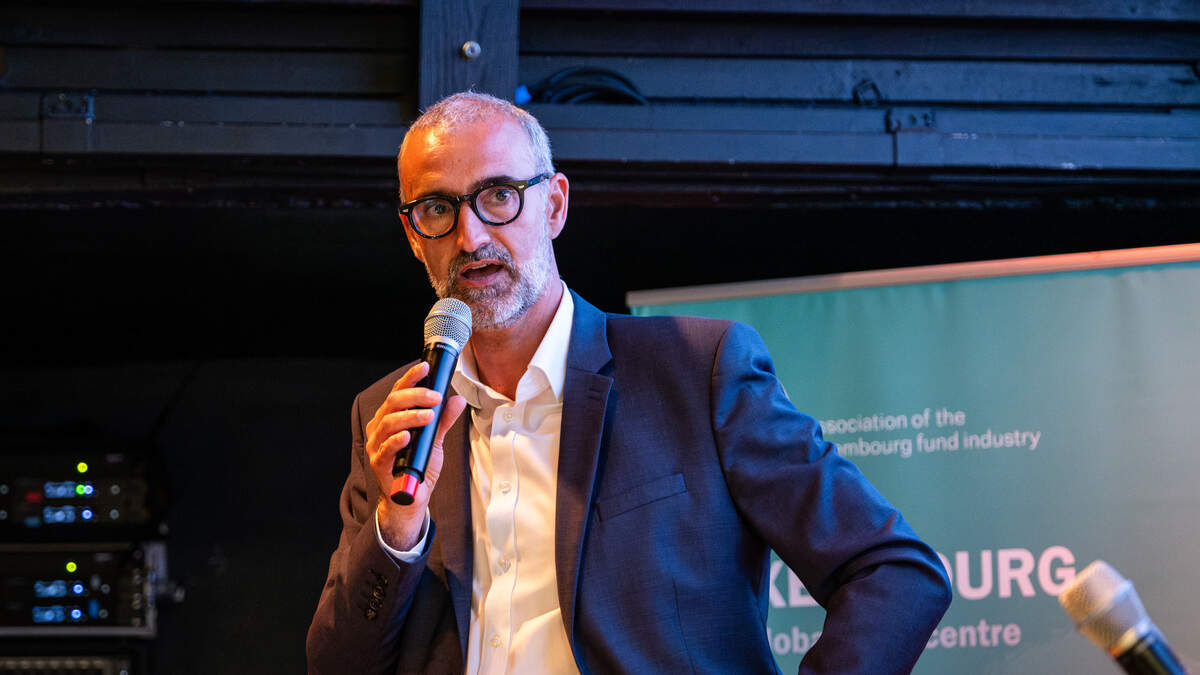
Luxembourg’s largest investment fund lobby group has railed against renewed attempts to centralise regulation of the asset management sector at European level, calling the idea a power grab by Paris that would present increased risks to investors.
Under a draft proposal, the European Securities and Markets Authority (Esma), an EU agency based in Paris, “is tasked with defining standards, procedures and templates for approving funds and products,” Serge Weyland, CEO of the Association of the Luxembourg Fund Industry (Alfi), said at a press briefing on Thursday.
“Standardisation is fine, but we are in a complex environment,” Weyland commented. “Our concern is that any product that is going to be innovative, that will be a little bit out of the norm [will lead national financial regulators to say] ‘it’s a bit outside the standards that were defined by Esma [and] I need to call my colleagues in Paris. This is the effect of centralisation.”
Fund executives frequently report that today Luxembourg’s financial regulator, the CSSF, is fairly quick to understand new structures, leading to faster review and authorisation times.
Converging requirements
Overly harmonised standards would ignore market diversity, Weyland said. “Products in Luxembourg are very different from the ones in Italy or France, so we’re trying to find the right balance in ensuring more convergence at the European level but at the same time maintaining the innovation and agility of the space.”
The objections are not intended to preserve the Grand Duchy as Europe’s largest fund hub, he asserts. “It’s less about protecting Luxembourg than protecting the interests of the industry, because I think if those proposals go through, we feel that might weaken the European asset management industry, because there’s a fair amount of innovation that is coming through,” Weyland said, citing the tokenisation of funds and innovations in exchange-traded funds (ETFs).
“Innovation needs to happen where you’re close to the market,” said Weyland. “Having an Esma ivory tower make the calls would be very difficult [for firms] and for [Esma] to reach the level of expertise that is now present in the various domiciles will probably take a decade, which we will have lost.”
The change in the supervisory framework would be a distraction from previously established European goals to channel more householders’ cash into “long-term pension savings that only that will create deeper capital markets in Europe and will enable Europe to finance its future needs, [such as] infrastructure needs, defence needs, innovation needs,” Weyland said.
Also read:More private investment could boost Luxembourg public pensions by billions
“A lot of these proposals are driven by national interests from the larger member states, especially France, because they see their own self-interest in pushing for more centralisation [into the hands of] Esma, which is based in Paris and they hope that by doing so, they will be able to capture more firms establishing themselves in Paris. So that’s unfortunately where we are in Europe,” he said.
Level playing field vs ‘monster’
Investment funds are currently supervised by national regulators, such as the CSSF in Luxembourg, following common European guidelines. EU member states can add their own local requirements on top of those pan-European rules. The argument in favour of a centralised financial supervisor is that it would eliminate these country-by-country variances and create a level playing field.
More standardisation across Europe would be helpful in certain areas, such as permitting financial firms to report the same set of figures to regulators instead of being forced to provide different datasets in each jurisdiction, Claude Marx, director general of the CSSF, stated last year. But Marx said that a single European financial regulator would be a “monster”.
“Instead of boosting competitiveness, it will increase burden and also complexity,” Gilles Roth, Luxembourg’s finance minister, said at a conference in September 2025.
I have not seen any good proposals on this matter so far
Luc Frieden
Prime Minister
The European Commission in December decided against an earlier proposal that would have empowered Esma to directly regulate the largest European asset managers, while smaller firms would still be supervised at national level. The renewed call for centralised supervision, on Brussel’s agenda this year, would focus just on creating a common rulebook instead.
Centralised supervision “can be discussed” but will not lead to a deeper and more unified European financial market, Luc Frieden, Luxembourg’s prime minister, said arriving for an EU economic summit in Belgium on Thursday.
“Luxembourg will always seek a European solution,” the Luxemburger Wort quoted Frieden as saying. However, the PM reiterated his opposition, stating: “I have not seen any good proposals on this matter so far.”
National variances
Harmonised standards still leave room for manoeuvre by member states who want to implement protectionist measures. Weyland cited an Italian product where capital needs to be invested in Italy for investors to receive a tax benefit.
French rules mean that a type of investment product called an Eltif can only be sold in an insurance wrapper if the Eltif is registered in France. Buying funds through an investment wrapper is popular among French retail investors and the number of French-domiciled Eltifs duly rose last year.
According to Weyland, the European Commission has “singled out” the French Eltif rules. “They made it very clear it was unlawful [and] now we expect the commission to take action,” meaning the matter could eventually end up before the Europeans court in Kirchberg. “We will continue to be vocal about it because it’s simple unacceptable. That’s not how you build markets in Europe.”
‘Unacceptable risks’
European policymakers forced the Grand Duchy to withdraw a local product that limited investments to Luxembourg companies in 2000s, Corinne Lamesch, the deputy CEO and general counsel at Alfi, noted during the same press briefing on Thursday.
The EU crackdown back then, Weyland said, “was good because it was very bad for our citizens to only have exposure to Luxembourg companies. If you think about it, this is crazy. You need diversification. Pushing French investors into French start-ups only or French private equity only [is] too risky. From an investor perspective, that’s not acceptable.”
Also read:There is a clear line between financial advice and opinion for regulators
However, these local variations are not an argument in favour of centralised supervision, Weyland argued. “Exactly the opposite, because supervision will not solve that problem.”
Hypothetically, “if tomorrow Esma was tasked with directly supervising the whole asset management industry, which is not at all in the proposal, even then they would not be able to address this, because [the protectionist measures are enshrined] within local laws [and] regulators cannot change local laws,” he said. “It has to go in front of the court of justice.”
“These are the things that are killing Europe and no one talks about it,” Weyland stated. “Then the French are lecturing the rest of Europe. It’s a joke.”
Alfi represents some 1,400 fund firms and service providers, the organisation said during the press briefing. Luxembourg-domiciled investment funds collectively have €7.95 trillion in assets under management.
Weyland said he expected talks on potential regulatory centralisation will be a “big item for the industry the next 12 months.”
Also read:Luxembourg tax revenue from funds rises to €2.3bn as assets grow