
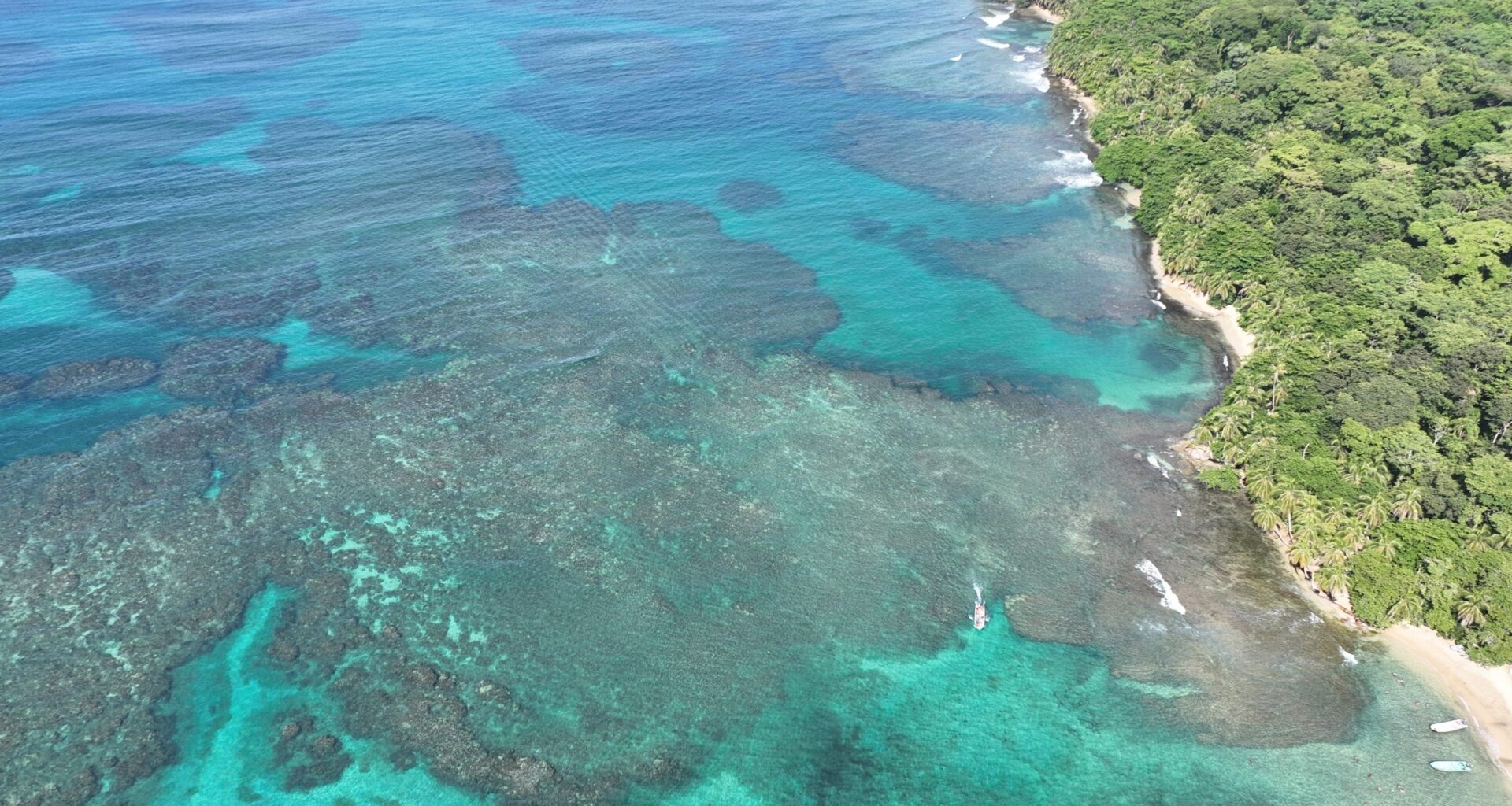
Ancient Caribbean reefs functioned in ways modern ecosystems no longer do, according to a new study.
Food chains that once supported a complex web of predators and prey have compressed by up to 70%, stripping reefs of an entire layer of ecological complexity.

The research was led by scientists at the Smithsonian Tropical Research Institute (STRI).
The study reveals major changes in how energy moves through Caribbean reef ecosystems.
Ancient reefs and modern food chains
Coral reefs across the Caribbean are in trouble. Coral bleaching events have increased and coral cover has dropped. Many fish and shark populations have declined over recent decades.
Scientists already knew reefs were losing species. But one big question remained. Has the way energy flows through reef food chains also changed?
To answer this, the research team compared ancient reefs from 7,000 years ago with modern reefs in Panama and the Dominican Republic. Ancient reefs formed during the mid-Holocene, long before major human impact.
What the scientists found was shocking. Food chains today are 60 to 70 percent shorter than in ancient times.
This means the distance between small fish and larger predators has shrunk. Energy now moves through fewer steps before reaching top consumers.
Analyzing ancient fish bones
Fish have tiny structures in their heads called otoliths, also known as ear stones. These small bones help fish balance and hear. When fish die, otoliths can remain preserved in reef sediments for thousands of years.
Each otolith contains nitrogen from food the fish ate during its lifetime. By studying nitrogen isotope ratios inside these ear stones, scientists can figure out where a fish stood in the food chain.
Working in Daniel Sigman’s laboratory at Princeton University, Jessica Lueders-Dumont developed a high-sensitivity method to extract and measure nitrogen trapped inside otolith minerals.
Encased in calcium carbonate, the nitrogen remains protected for millennia, preserving an intact isotopic signature.
Aaron O’Dea and his team began excavating exceptionally well-preserved fossil reefs in Panama in the early 2010s.
Their work later expanded to the Enriquillo Basin in the Dominican Republic, where researchers collected tons of reef sediment and painstakingly sorted through it grain by grain.
Reefs fossils track food chain history
Brígida de Gracia and Chien Hsiang Lin sorted and identified thousands of otoliths from ancient reef sediments. This work required patience and deep knowledge of fish anatomy.
“Picking otoliths from sediment, grain by grain, is challenging but you develop an intimate relationship with these ancient reefs,” said de Gracia.
“Every otolith tells the story of a fish that lived thousands of years ago. To see those stories come alive through isotope chemistry is incredibly rewarding.”
Aaron O’Dea also recognized early on how valuable these tiny bones could be.
“Otoliths are incredible structures, and when we first started finding them in our fossil reef samples, I realized we had an opportunity to reconstruct not just what corals were like before humans, but also the fishes that live on reefs” said O’Dea.
Major changes in fish diets
Researchers studied four fish families. Gobies are small bottom dwellers. Silversides swim in open water in schools. Cardinalfishes hunt at night. Grunts are larger fish that move between reefs and mangroves.
Most of these fish are not heavily fished by humans. That means changes in diet likely reflect broad ecosystem shifts, not just fishing pressure.
Results showed that higher level fishes like grunts and cardinalfishes now feed lower in the food chain. Meanwhile, smaller fish like gobies have shifted slightly higher. The gap between predator and prey has compressed by about 60 percent.
Even more surprising, individual fish within the same family now eat more similar diets. In ancient reefs, different individuals specialized in different prey. Today, dietary variation within families has narrowed by 20 to 70 percent.
“What struck us is how consistent the pattern is,” said Jessica Lueders-Dumont. “In every fish family we examined, in both Panama and the Dominican Republic, the dietary diversity has contracted.”
“These reefs have lost an entire dimension of ecological complexity that we didn’t even know was missing.”
Implications for modern reefs
When many fish rely on the same food source, one disruption can harm an entire population at once. Ancient reefs had many different energy pathways. If one food source declined, others could support the system.
Modern reefs may look similar at first glance, but function differently underneath. “We already knew that modern Caribbean reefs are home to fewer corals and fewer sharks,” said O’Dea.
“Now we can see that the fish that remain are feeding and behaving differently too. It strengthens the case that modern Caribbean reefs are not simply diminished versions of what came before; they are potentially functioning in different ways”
Reefs with shorter food chains
“We now have a way to explore how entire systems function,” said Lueders-Dumont. “These tiny ear stones are opening a window into how energy moves through reef ecosystems on time scales previously unimaginable to ecologists”.
Ancient reefs were more complex and flexible. Modern reefs have lost hidden layers of diversity. Understanding these changes may help guide conservation efforts before more ecological balance disappears.
The study is published in the journal Nature.
—–
Like what you read? Subscribe to our newsletter for engaging articles, exclusive content, and the latest updates.
Check us out on EarthSnap, a free app brought to you by Eric Ralls and Earth.com.
—–