
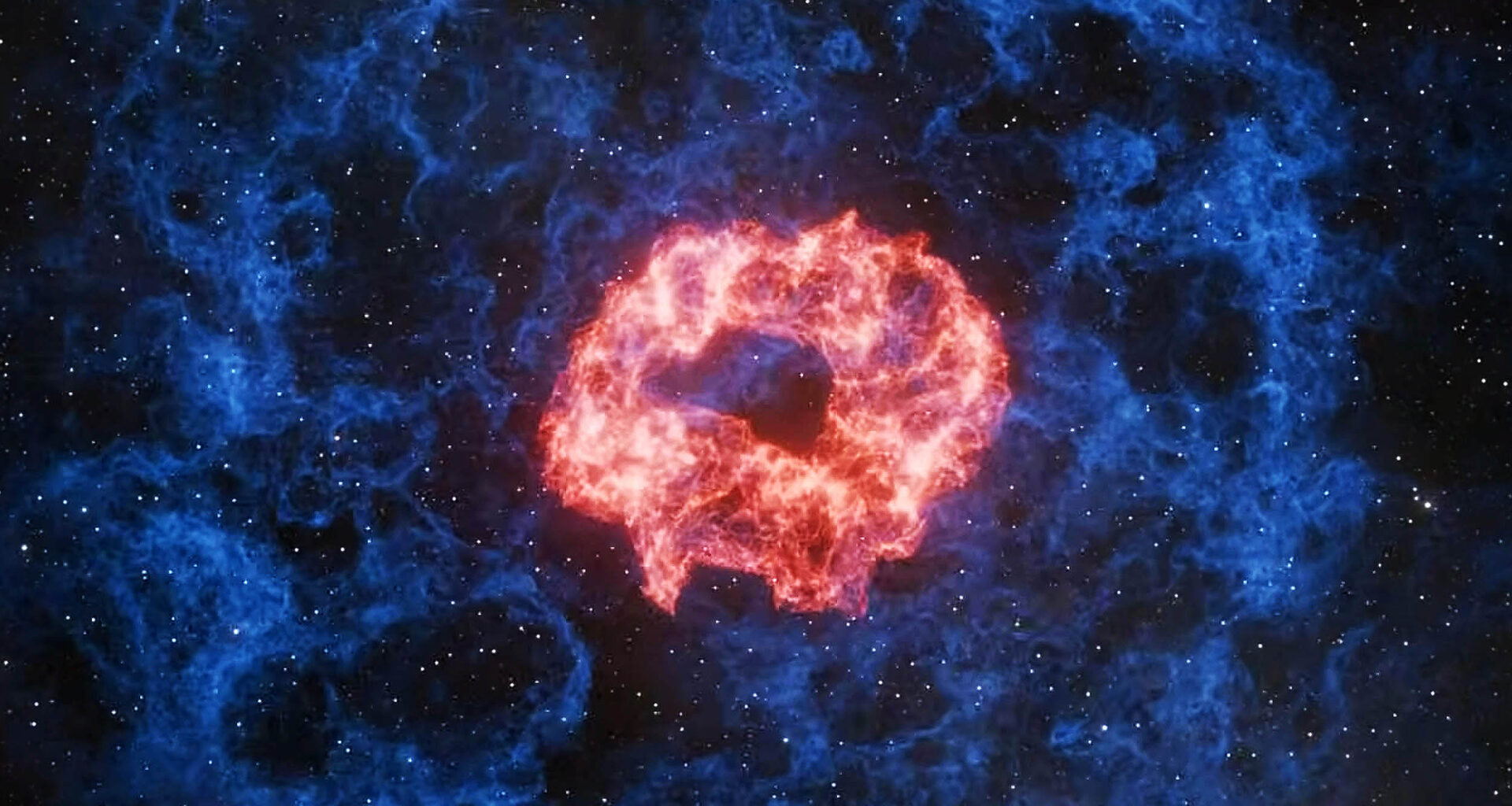
Supernova explosions are part of how the universe builds matter, but they’re not the only cosmic blasts that shape what we’re made of.
When a massive star runs out of fuel, it ends its life as a supernova. The star’s core collapses, its outer layers blast outward, and the explosion scatters heavy elements like carbon and iron into space.

There is also a second, much rarer kind of explosion. In a kilonova, two neutron stars collide and produce even heavier elements, including gold and uranium.
Over time, those materials become part of new stars, rocky planets, and everything that forms after them.
Potential “Superkilonova”
For years, astronomers have had only one clean, slam-dunk example of a kilonova: GW170817 in 2017. That event was special because it appeared in two ways at once.
Gravitational waves rippled through spacetime, and light from the blast lit up telescopes around the world. It was a cosmic one-two punch that let scientists connect the ripples and the flash to the same collision.
Now there is a possible second case. It has a name that sounds like a license plate: AT2025ulz. And it is messy.
Researchers think it did not happen alone, because it may have been entangled with a supernova that exploded just hours earlier and ejected debris that later interfered.
Gravitational waves raise alarms
On August 18, 2025, the Laser Interferometer Gravitational-Wave Observatory (LIGO) in Louisiana and Washington, along with the Virgo detector in Italy, picked up a new gravitational-wave signal.
Within minutes, the collaboration sent out an alert with an approximate sky location and a key detail: the merger looked like it involved two objects, and at least one of them seemed unusually small.
“While not as highly confident as some of our alerts, this quickly got our attention as a potentially very intriguing event candidate,” said David Reitze, executive director of LIGO and a research professor at Caltech.
“We are continuing to analyze the data, and it’s clear that at least one of the colliding objects is less massive than a typical neutron star.”
A few hours after the alert, the Zwicky Transient Facility, a survey camera at Palomar Observatory, spotted a fast-fading red object about 1.3 billion light-years away.
It was first labeled ZTF25abjmnps and later renamed AT2025ulz by the International Astronomical Union Transient Name Server.
Supernova, kilonova, or superkilonova
At first, AT2025ulz behaved in a way that made astronomers sit up straight. Its light faded quickly and glowed red, a look that matched what telescopes saw in GW170817.
In kilonovae, freshly formed heavy elements produce the red glow. Those atoms have lots of electron energy levels, which makes them good at blocking bluer light while letting redder light through.
“At first, for about three days, the eruption looked just like the first kilonova in 2017,” said Mansi Kasliwal, professor of astronomy and director of Caltech’s Palomar Observatory.
“Everybody was intensely trying to observe and analyze it, but then it started to look more like a supernova, and some astronomers lost interest. Not us.”
Days later, the story changed. AT2025ulz began to brighten again. It shifted toward bluer light and showed hydrogen in its spectra, which are classic signs of a supernova, specifically a stripped-envelope core-collapse supernova.
That created a problem: supernovae in distant galaxies usually aren’t expected to produce gravitational waves strong enough for LIGO and Virgo to detect, while neutron-star mergers are.
Making the superkilonova case
Kasliwal and her colleagues reported their findings in a journal and proposed that the event represents something never seen before: a superkilonova, a kilonova linked to a supernova.
The big clue is that AT2025ulz didn’t fit neatly into either box. It didn’t behave like GW170817 for long, but it also didn’t look like an average supernova.
The gravitational-wave data matters here, too. Neutron stars are the collapsed leftovers of massive stars that explode as supernovae. They’re incredibly dense and typically have masses between about 1.2 and three times the mass of the Sun.
Neutron stars are also small in size, around the width of a major city, roughly 15.5 miles across. But in this new signal, at least one object appeared to be less massive than the Sun, which would fall outside what astronomers usually see.
 This artist’s concepts shows a hypothesized event known as a superkilonova. A massive star explodes in a supernova (left), which generates elements like carbon and iron. In the aftermath, two neutron stars are born (middle). The neutron stars spiral together, sending gravitational waves rippling through the cosmos, before merging in a dramatic kilonova (right). Credit: Caltech. Click image to enlarge.Linking supernova and merger
The leading ideas for how that could happen start with a rapidly spinning star going supernova. In one proposed route, the newborn object splits into two tiny neutron stars through fission.
In another, called fragmentation, a disk of material forms around the collapsing star, and clumps in that disk gather into a small neutron star.
Brian Metzger of Columbia University, a co-author on the study. He argued that two newly formed neutron stars like this could spiral together fast and merge, producing both a kilonova and a supernova-linked scene that hides part of the action.
“The only way theorists have come up with to birth sub-solar neutron stars is during the collapse of a very rapidly spinning star,” said Metzger.
“If these ‘forbidden’ stars pair up and merge by emitting gravitational waves, it is possible that such an event would be accompanied by a supernova rather than be seen as a bare kilonova.”
In this picture, the supernova happens first, then the two “baby” neutron stars merge soon after, the kilonova would start off red, matching what ZTF saw early on.
Then the earlier supernova debris could block the view, making the event look more like a typical supernova as time goes on.
What astronomers will look for next
Even with all that, the team says the evidence isn’t strong enough to close the case. The cleanest way forward is simple in concept and hard in practice: find more events like this.
The only way to test the superkilonova theory is to find more. According to Kasliwal, future kilonovae events may not look like GW170817 and may be mistaken for supernovae.
“We can look for new possibilities in data like this from ZTF as well as the Vera Rubin Observatory, and upcoming projects such as NASA’s Nancy Roman Space Telescope, NASA’s UVEX, Caltech’s Deep Synoptic Array-2000, and Caltech’s Cryoscope in Antarctica,” said Kasliwal.
“We do not know with certainty that we found a superkilonova, but the event nevertheless is eye opening.”
—–
Like what you read? Subscribe to our newsletter for engaging articles, exclusive content, and the latest updates.
Check us out on EarthSnap, a free app brought to you by Eric Ralls and Earth.com.
—–