

US-based AST SpaceMobile has successfully unfolded BlueBird 6, its newest and most ambitious satellite.
Measuring roughly 2,400 square feet, the satellite now holds the record for the largest commercial communications array ever deployed in low Earth orbit (LEO).
Announced on February 10, this satellite aims to provide cellular broadband directly to standard, unmodified smartphones.
The system is designed to achieve peak cellular broadband speeds of 120 megabits per second (Mbps). As per the company, it offers 10 times the bandwidth of its predecessors, the BlueBird 1-5 series.
It uses “beamforming” to focus signals into tight, high-quality coverage areas, ensuring that 4G and 5G services — including video calls — actually work.
“BlueBird 6 is the result of specialized American manufacturing combined with world-class engineering ingenuity,” said Abel Avellan, Founder, Chairman, and CEO of AST SpaceMobile.
“These teams are contributing directly to developing unprecedented capabilities that will change how the world connects in a market we invented. We have developed a unique design and a proprietary process, and we are building the future of connectivity right here at home,” Avellan added.
4G and 5G services
On December 23, 2025, BlueBird 6 successfully took flight from the Satish Dhawan Space Center aboard India’s LVM3 rocket.
It delivers high-performance connectivity through its architecture, which includes a massive antenna array.
Interestingly, the array’s large aperture allows for “beamforming,” a technique that creates narrow, highly focused coverage zones on the ground.
The satellite concentrates signals so precisely that it eliminates interference and boosts network capacity, providing a user experience with the reliability and speed of ground-based cellular infrastructure.
“The aperture enables full 4G and 5G cellular broadband services, including voice, data, and video to standard, unmodified smartphones everywhere,” the company stated.
What comes next?
As of now, the company is wasting no time. With BlueBird 6 fully deployed, all eyes are on the BlueBird 7 launch, which is expected to take place in late February on Blue Origin’s New Glenn rocket.
The company is currently on track to launch between 45 and 60 satellites by the end of the year.
Reportedly, each satellite will carry 10 gigahertz of bandwidth to keep up with millions of mobile users.
With a launch planned every one to two months, the goal is to create a blanket of coverage worldwide.
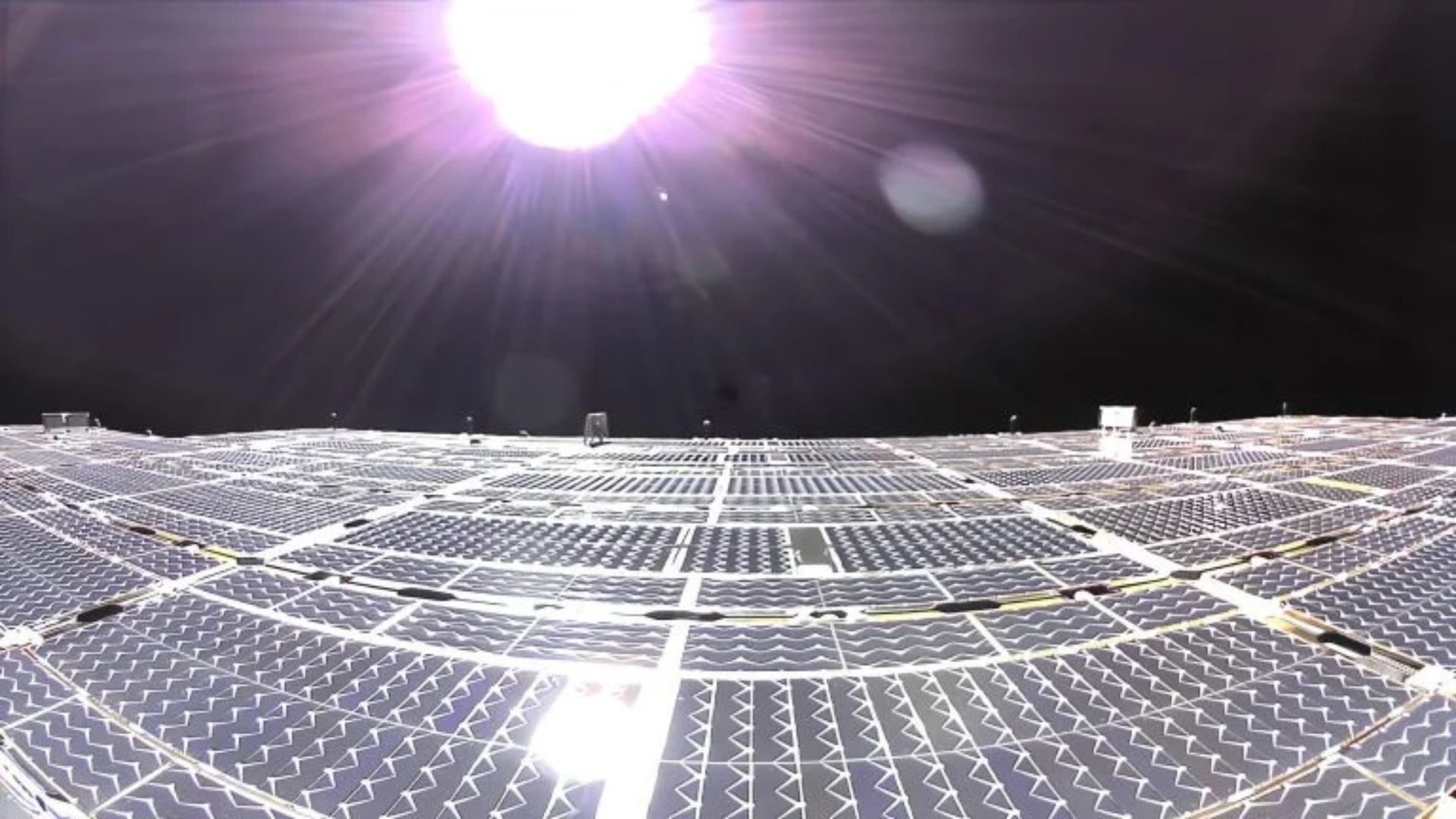 AST SpaceMobile 2,400 square feet phased array.
The Texas-based startup has already built strategic partnerships with industry giants like AT&T, Verizon, Google, and Vodafone.
With over 50 mobile network operators’ agreements, the company has cleared a path to reach nearly 3 billion subscribers worldwide. This means its space-based broadband could be easily integrated into existing global telecommunications infrastructure.
The brightness issue
Since launching the BlueWalker 3 prototype in 2022, AST SpaceMobile has successfully demonstrated the viability of “cell towers in space.” Notably, the satellite facilitated the first-ever 5G call to a standard smartphone in 2023.
However, the mission’s technical success — including the deployment of five additional large-scale satellites — has fueled an industrial space race that deeply concerns the scientific community.
Astronomers warn that these massive, tennis-court-sized arrays are outshining most stars and littering the night sky.
Observations of the first BlueBird series showed an average brightness of 3.44, with peaks reaching 0.5, making them among the brightest objects in the night sky, outshining most stars.
It creates visual interference that threatens ground-based telescopes’ ability to observe the cosmos.
On the other hand, the explosion of satellite mega-constellations is fueling an orbital crisis, characterized by extreme congestion and a heightened risk of Kessler Syndrome — a domino effect of collisions that could render space unusable.