
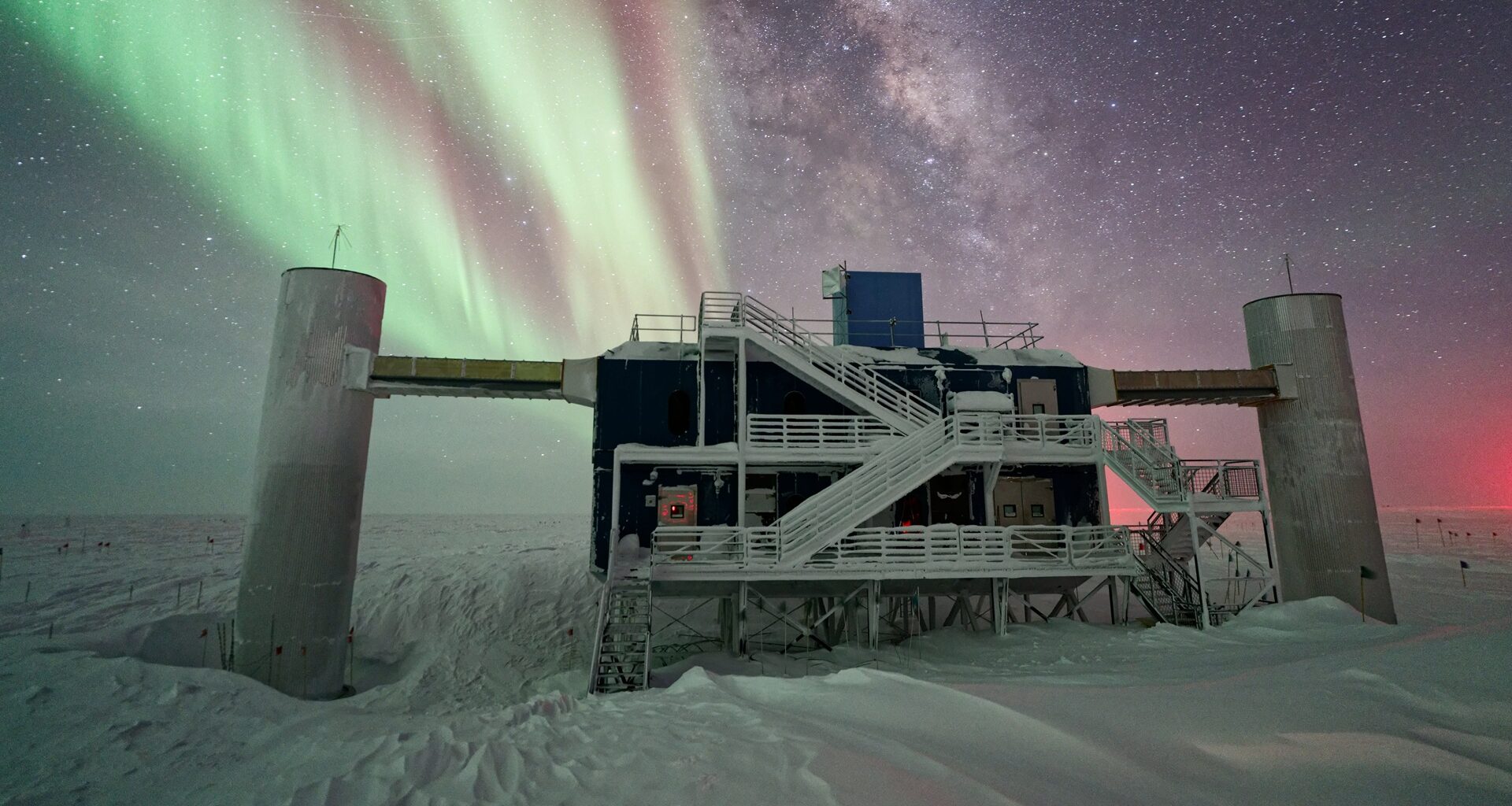
The world’s largest neutrino detector just got even more powerful after scientists successfully deployed six new strings of advanced sensors nearly 8,000 feet (2,400 meters) beneath the Antarctic ice at the IceCube Neutrino Observatory.
By embedding more than 650 modern photodetectors and calibration devices to the existing IceCube detector, the team consisting of 450 international scientists from 58 institutions across 14 countries, increased its sensitivity to the universe’s most elusive particles, neutrinos.
Located at the Amundsen-Scott South Pole Station in Antarctica, directly at the geographic South Pole, IceCube is a one-of-a-kind observatory. It spans a full cubic kilometer, making it the largest neutrino detector on Earth.
Marion Dierickx, PhD, NSF program director for IceCube, described the upgrade as a major engineering feat. “This upgrade will secure the nation’s continued leadership in neutrino physics for years to come, paving the way for new cosmic discoveries,” she said.
Unlocking cosmic secrets
IceCube consists of 5,160 basketball-sized optical sensors called Digital Optical Modules (DOMs), arranged along vertical strings. These sensors detect flashes of Cherenkov light produced when high-energy neutrinos from deep space interact with the atomic nuclei in the ice.
Neutrinos are difficult to detect and pass through most matter undisturbed. This makes enormous detection volumes and ultra-sensitive instruments essential for spotting them.
The photosensors amplify the weak flashes of light produced when neutrinos interact in the transparent Antarctic ice. These rare interactions generate charged secondary particles, which create the detectable signals captured by the detector.
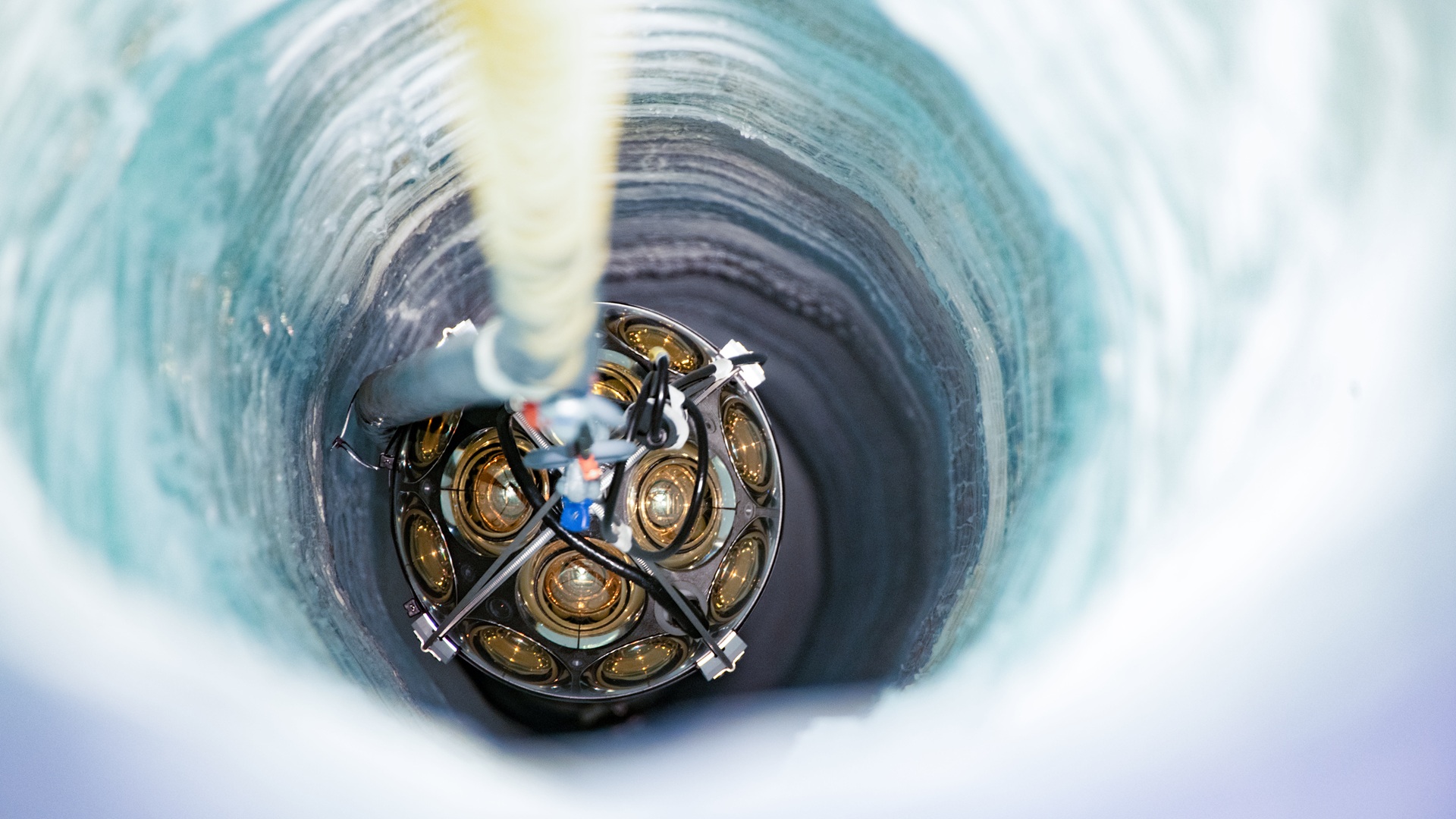 An mDOM is lowered into a borehole.
Credit: Yuya Makino, IceCube/NSF
As per Andreas Haungs, PhD, scientific director of the IceCube working group at the Institute for Astroparticle Physics at Karlsruhe Institute of Technology (KIT) the upgrade will deepen researchers’ understanding of the Antarctic ice itself.
“The novelty of the optical sensors in the upgrade is that they are equipped with photoelectron multipliers in all directions, allowing a 360-degree view into the ice,” Haungs said.
The new light amplifiers are housed in 15-inchs (40-centimeter), football-shaped containers known as multi-PMT digital optical modules, or mDOMs, alongside additional calibration sensors. Cable harnesses link the modules and measuring instruments into 4,921-foot-long (1,500-meter-long) vertical strings, resembling a pearl necklace.
A clearer view
Each string is lowered into a nearly 8,000-foot-long (2,400-meter-deep) shaft melted into the ice using a hot-water drill, a process that takes about two days per hole. Once the instruments are deployed, the shafts gradually refreeze, thus permanently embedding the detector components within the Antarctic ice.
The team carried out the upgrade between December 2025 and January 2026. The tighter spacing of the new modules improves resolution. This enables the extraction of more precise data about the particles direction, energy and origin.
“In combination with the new surface instrumentation, the upgrade also offers new possibilities for measuring high-energy cosmic rays,” Haungs reported in a press release.
Haungs further elaborated that the upgrade will sharpen measurement precision. Due to the higher instrument density, the experiment can now measure signals at lower energies that were previously unattainable.
“The upgrade will extend neutrino astronomy to lower energies,” Ralph Engel, PhD, head of the Institute for Astroparticle Physics at KIT, stated. “This not only opens a new window onto the universe, but also serves as a meaningful technology and practical test for the proposed expansion to IceCube-Gen2.”
The IceCube-Gen2 is a massive expansion of the observatory planned for 2032. It will reportedly detect high-energy cosmic neutrinos with 10 times higher rates and five times better sensitivity than the current detector.
Based in Skopje, North Macedonia. Her work has appeared in Daily Mail, Mirror, Daily Star, Yahoo, NationalWorld, Newsweek, Press Gazette and others. She covers stories on batteries, wind energy, sustainable shipping and new discoveries. When she’s not chasing the next big science story, she’s traveling, exploring new cultures, or enjoying good food with even better wine.