
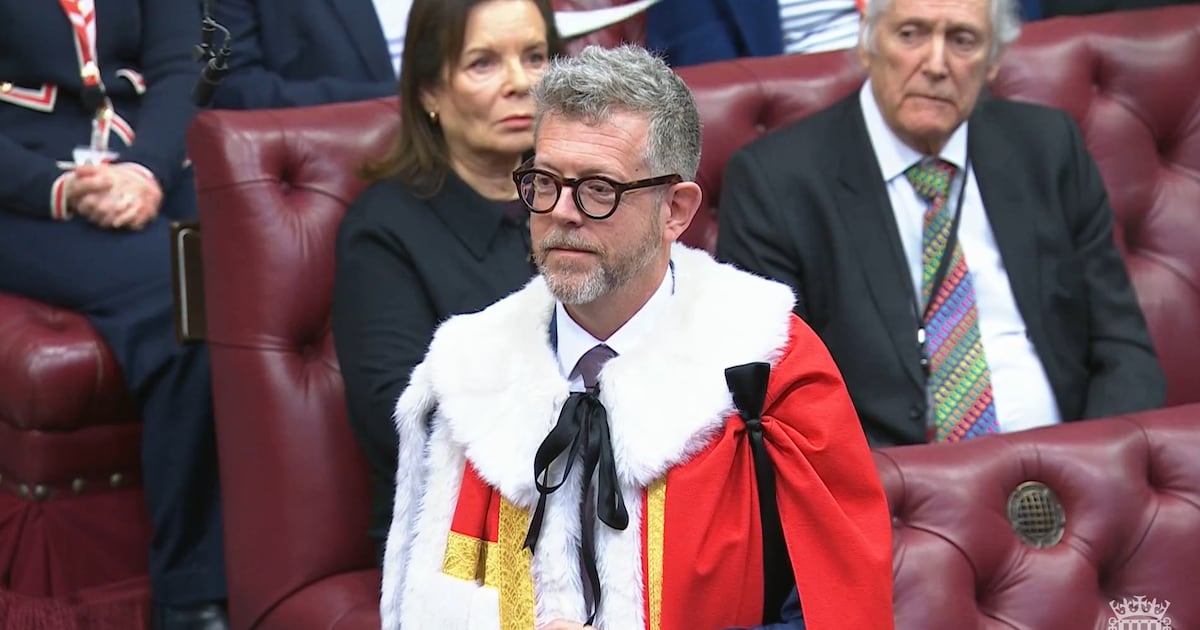
On the evening of December 10th, 2025, former Downing Street communications director Matthew Doyle strolled in to the ballroom of Ireland’s embassy in Belgravia.
It was the embassy’s Christmas press and political reception, but Doyle had his own reason to celebrate. Two hours earlier, UK prime minister Keir Starmer announced he was making Doyle (50) a peer, giving him a seat for life in the House of Lords.
A stream of people crossed the embassy ballroom to shake his hand. Doyle, whose grandparents hailed from Sligo, beamed as he took the plaudits.
Two months on, Doyle’s Lords appointment is the latest crisis to drain Starmer’s political authority. If his at-risk premiership ends up being killed by a thousand cuts, the Doyle saga will be seen as one that drew blood.
Unknown to Doyle’s embassy wellwishers, six days earlier Kate Watson, general secretary of Scottish Labour, had approached Irishman Morgan McSweeney, then Starmer’s chief of staff, at a fundraising event in Glasgow.
It had already been rumoured Doyle would get a peerage. Watson warned McSweeney that Doyle had personal links to Sean Morton, a former Scottish Labour councillor convicted of possessing child sex abuse images.
Downing Street questioned Doyle about his friendship with Morton. It was potentially explosive because another member of the Lords, Peter Mandelson, was sacked as the UK’s ambassador in Washington three months earlier for links to convicted sex offender Jeffrey Epstein.
Starmer now says that, when questioned, the “full facts were not given” by Doyle about his links to Morton. His peerage was allowed to proceed.
Two days after Christmas, the Sunday Times splashed with a startling story: “Matthew Doyle: aide given peerage by PM campaigned for paedophile.”
It revealed Doyle had actively campaigned in local elections for Morton, by then already kicked out of Labour and running as an independent, despite knowing he was charged with child sex offences.
Labour sources say the news story was the first time that Starmer learned Doyle had helped Morton politically, despite knowing he had been charged. Morton lied that he was innocent to friends, including Doyle, who posed with him in a “Re-elect Sean Morton” T-shirt. Later, however, Morton would admit his guilt in court.
Yet, despite learning the full truth of Doyle’s links to Morton, which implies he also knew Doyle had not given him “the full facts”, Starmer did not stop his peerage. Doyle was ennobled on January 8th.
The Doyle incident blew up on Tuesday, the day after Starmer was almost ousted over Mandelson. Doyle has apologised for his association with Morton, and condemned his crimes. He said he relinquished the Labour whip in the Lords, although Downing Street said it was removed. Doyle is suspended by Labour pending an investigation.
With the Mandelson stink still hanging in the air, the Tories eviscerated Starmer over Doyle’s appointment. The prime minister also faced the wrath of his own MPs. Emma Lewell, the Labour MP for South Shields, told the prime minister at a party meeting on Monday night that, after the Mandelson and Doyle scandals, “people are screaming at me in the street that I am a member of the paedo protectors party”.
Tories say they won’t let the Doyle issue go. It will dog Starmer further.
Abolition of the unelected House of Lords was a central plank of Labour’s election manifesto, meant to signify Starmer’s reforming zeal. Instead, the Lords has become the wellspring of scandals threatening his faltering premiership.
Could problems in the upper chamber lower Starmer’s stock enough to cost his job?
Mandelson has quit the Lords, but Starmer still plans legislation to strip him of his peerage and title. Doyle, meanwhile, sits as an independent for now.
Last week, UK Green Party peer Jenny Jones called for wholesale reform of the Lords. She said Starmer should draft a law to “throw out all the other rogues and idlers”.
While the Tories criticise Starmer over Doyle, that party was also notorious during its 14-year stint in power for ennobling allies and donors in acts of patronage and reward. Infamously, Boris Johnson appointed Russian-British newspaper owner Evgeny Lebedev to the Lords in 2020. He has since spoken in the Lords just four times.
The Lords has 875 members, the biggest parliamentary chamber in Europe. That includes 92 hereditary peers, set to be abolished this year. Starmer also promised to slim the bloated chamber. Yet at 96, more new peers have been appointed under his premiership than are set to be removed when the hereditary members go.
[ Explainer: What next for Keir Starmer and the Labour Party?Opens in new window ]
Rather than abolishing it, Starmer has stuffed the Lords with his allies instead.
There has long been unease in Westminster with the way a minority of Lords members mixed their lofty status with business relationships. “Need a lord on the board?” Mandelson wrote to Epstein, when he was seeking more work after exiting government.
The Guardian has reported that roughly 100 lords are paid by businesses to give political or policy advice. Lords must not lobby for paying clients, but the rules of association are looser than for MPs.
Charles Chetwynd-Talbot, the Earl of Shrewsbury and Lord High Steward of Ireland, has been suspended from the Lords twice in three years – once for paid lobbying and another for charging inappropriate travel expenses.
Lords do not get a salary, but receive £371 tax-free for each day they clock in or log in. Their travel to London to attend the chamber is also covered and, if their home is outside the UK capital, they get £103 per night towards accommodation.
But it is the prestige, which many use to generate work, that is most valuable. Critics say the rules need changing.
A new all-party parliamentary group is being set up to seek “wholesale” Lords reform. A government committee report on some reform measures is due in July, although it is assessing ideas far short of what Starmer promised before the election.
Paul Sinclair, a former Downing Street adviser, said on Friday that scandals involving peers are damaging Starmer. The Mandelson issue, in particular, is “the biggest political crisis of modern times for the UK”.
“The only thing keeping Starmer in power is that nobody wants to succeed him before [elections in] May,” he said.