
Researchers from China’s Dalian Jiaotong University and South China Academy of Advanced Optoelectronics have developed a graphene-based electrode for supercapacitors using a novel slit evaporation self-assembly process. The resulting freestanding sulfuric acid-treated reduced graphene oxide/commercial graphene (S-ATrGO/CG) films demonstrate excellent energy storage capabilities and durability, potentially benefitting graphene-enhanced supercapacitors.
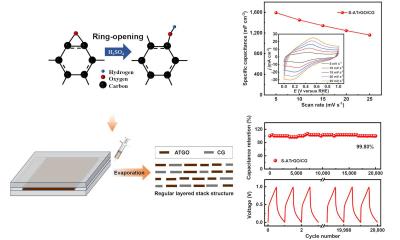
The team introduced a capillary slit-assisted self-assembly method that leverages narrow glass slits to guide the controlled stacking of graphene flakes during solvent evaporation. This process promotes highly ordered, laminated structures, reducing the common issue of flake restacking that limits ion transport in conventional graphene films. Capillary forces, combined with π–π interactions and electrostatic attraction, ensure that sulfuric acid-treated graphene oxide (ATGO) and commercial graphene (CG) align into continuous, freestanding films with high structural integrity.
A mild sulfuric acid treatment plays a crucial chemical role by converting inert epoxy groups on graphene oxide into electrochemically active hydroxyl and carboxyl groups. These active sites enhance pseudocapacitance, while subsequent thermal reduction improves electrical conductivity. The result is a finely balanced electrode material that offers both fast charge transport and robust chemical stability.
Electrochemical testing revealed impressive performance metrics:
Areal capacitance: 1,589.78 mF·cm⁻² at 5 mV·s⁻¹Volume capacitance: 132.48 F·cm⁻³Energy density: 0.22 mWh·cm⁻²Power density: 8.69 mW·cm⁻²Cycle stability: 99.80% capacitance retention over 20,000 cycles at 50 mA·cm⁻²
Compared with electrodes prepared by conventional drop-casting, the slit-assembled S-ATrGO/CG films demonstrate superior electron mobility, heat dissipation, and structural uniformity, all contributing to their enhanced electrochemical performance.
This study offers a scalable route for producing freestanding, high-capacitance graphene electrodes, advancing the potential of supercapacitors in flexible electronics, micro-energy devices, and next-generation sustainable energy systems.