
MORE CASH:
With many employers raising wages and a high-flying stock market pushing up disposable income, private consumption is expected to grow 2.51%
By Crystal Hsu / Staff reporter
Taiwan’s government has sharply upgraded its economic outlook, buoyed by easing trade uncertainties with the US and sustained powerful global demand for artificial intelligence (AI) hardware.
The Directorate-General of Budget, Accounting and Statistics (DGBAS) yesterday raised its GDP growth forecast to 7.71 percent for this year, more than doubling its November estimate of 3.54 percent in the largest upward revision on record.
DGBAS Minister Chen Shu-tzu (陳淑姿) said the adjustment reflects a convergence of clearer external trade conditions and powerful technology demand, adding that Taiwan is now poised to see GDP exceed US$1 trillion for the first time.
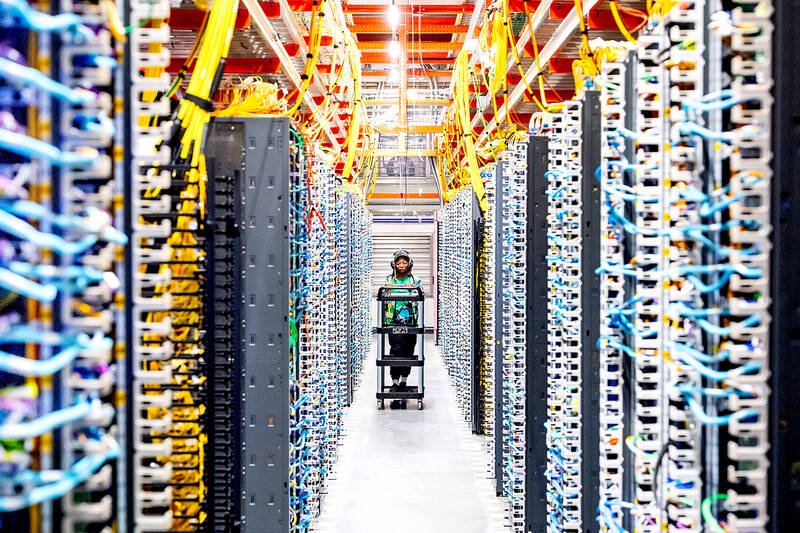
Photo: Amazon Web Services via AP
“The overall performance can be described as remarkable,” Chen said, noting that the economy is expanding from an already high base of an 8.68 percent growth last year, indicating durable momentum rather than a short-term rebound.
A key driver of the revision was improved clarity in trade relations with Washington, which had previously clouded prospects for Taiwan’s export-oriented manufacturing sector.
Earlier concerns about possible 100 percent tariffs on semiconductors prompted a cautious stance, but those uncertainties have largely receded, allowing companies to accelerate orders and investment planning, Chen said.
DGBAS statistics department head Tsai Yu-tai (蔡鈺泰) said export performance in the fourth quarter of last year far exceeded expectations, prompting the agency to reassess assumptions about global demand.
Semiconductor shipments and related technology products continue to benefit from strong procurement by hyperscale cloud service providers building AI data centers, driving demand for advanced chips, servers and networking equipment produced by Taiwanese firms, he said.
The agency now forecasts exports will grow 22.22 percent this year, up 7.84 percentage points from the previous projection, cementing their role as the primary engine of economic expansion.
Improved trade arrangements with the US, including preferential treatment for certain automotive components, are also expected to support traditional manufacturing industries by boosting their competitiveness abroad, Tsai said.
Investment for this year is projected to remain resilient despite a cooling property market. While major semiconductor makers continue expanding capacity overseas, a tight global supply of AI infrastructure is prompting them to scale up advanced processes and high-end packaging at home, with suppliers across the value chain following suit, he said.
Private investment is expected to rise 4.24 percent this year, while total capital formation is forecast to grow 4.08 percent, aided by public infrastructure programs and airline fleet expansion, the DGBAS projected.
Consumer spending is also set to strengthen, with private consumption forecast to increase 2.51 percent, as robust corporate earnings, wage growth and dividend payouts lift household incomes, the agency said, adding that wealth effects from equity market gains are expected to provide an additional tailwind.
Inflation for this year is forecast to remain contained, with the consumer price index projected to rise 1.68 percent, below the central bank’s 2 percent alert threshold, it said.
DGBAS officials characterized the outlook as one of “rapid growth paired with price stability,” positioning Taiwan to sustain expansion even as the global economy remains uneven.