
On the last night of athletics at the Paris Olympics, the hopes of a nation rested on the young shoulders of Cyréna Samba-Mayela. As Olympic hosts, France had yet to win a single medal on the track or field, and only Samba-Mayela could save their blushes.
For all those inside the packed Stade de France it appeared a formidable task. The 100m hurdles is a flat-out sprint with 10 barriers in the way, leaving zero room for error. At 23, and starting in lane one, Samba-Mayela was the centre of attention – with nowhere to hide.
Exactly 12.34 seconds later she dipped for the line to take the silver medal, a mere .01 away from Olympic gold, won by Masai Russell from the US. Defending champion Jasmine Camacho-Quinn from Puerto Rico was third in 12.36. Under intense pressure Samba-Mayela kept her head and perfectly relaxed stride.
Unquestionably the best women’s sprint hurdlers in the world, both Samba-Mayela and Camacho-Quinn are coached by John Coghlan, which means the Dubliner now has the full set of Olympic medals, in the same sprint event, on his coaching résumé.
Samba-Mayela had approached Coghlan a year out from Paris, realising her speed between hurdles was letting her down. With that she stepped out of her comfort zone and moved to Coghlan’s training group in Orlando, and the rest is French Olympic history. Coghlan broke down much of her sprinting technique, then built it back up again. So much of that pure speed may rely on natural talent, but there are some parts that can always be learned all over again.
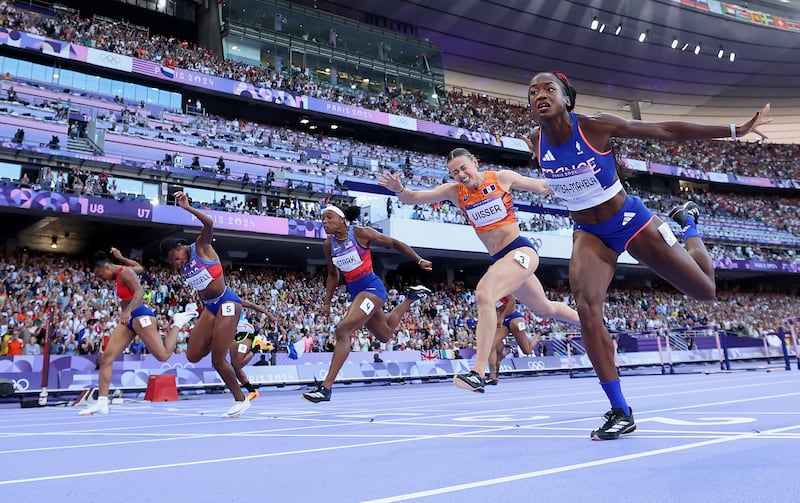 Masai Russell (second left) won the gold medal ahead of Cyrena Samba-Mayela in the women’s 100m hurdles at the Paris Olympics. Photograph: Patrick Smith/Getty Images
Fast forward 17 months and all those inside the Stade de France – and beyond – witnessed a similar display of French sprinting ability. Much of the comment among the rugby analysts was that Ireland’s 36-14 defeat in their opening Six Nations came down to their number of missed tackles, losing the aerial battles, their overly rigid structure compared to France, etc.
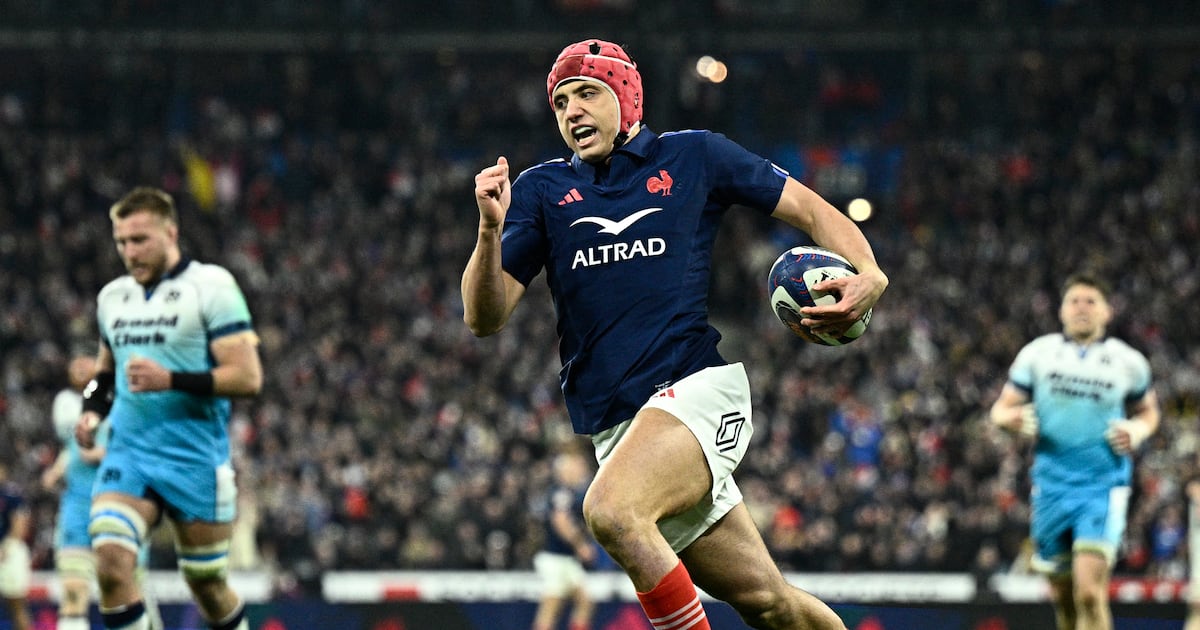
It looked to me like too many of the Irish players were simply caught for speed. The warning signs came early once Théo Attissogbe and Louis Bielle-Biarrey started testing their stride on the wings, and no one looked surprised when Bielle-Biarrey sprinted down the left touchline for his opening try after 13 minutes.
When he received the ball there were three Irish players within reach. Sam Prendergast did well with his tap tackle, but he was already too far behind, and Jacob Stockdale was simply too late. Under intense pressure Bielle-Biarrey also kept his head and perfectly relaxed stride, all while displaying the key components of proper sprinting style: slight forward lean, running with the legs, not on them.
Too often the Irish players were running upright and stiff in comparison. There was further evidence with Bielle-Biarrey’s second try after 47 minutes, when Thomas Ramos beat Tommy O’Brien, flykicking the ball forward for Bielle-Biarrey, who easily outsprinted Jamie Osborne. Prendergast also chased in late from the right, entirely in vain. Not just running on their legs, but legs half stuck to the ground.
Afterwards one French supporter on X posted the clip of Norway’s Olympic cross-country skier Johannes Klæbo, charging frantically uphill, under the caption “Sam Prendergast à la poursuite de Bielle-Biarrey”.
A tad unfair, perhaps, considering at age 22 Bielle-Biarrey is already considered the fastest man in world rugby. Although he’s not yet the finished article: he can still add more rhythm to his start, and he also swings his legs a bit too much.
At least that’s what he was told by French sprinting great Christophe Lemaitre, still the fastest white man in the world. They raced each other in a 50m challenge set up by French TV channel Canal+, two weeks before the start of the Six Nations, and Bielle-Biarrey’s astonishing turn of speed was plain to see.
Okay, Lemaitre hasn’t raced in over a year, the 35-year-old retiring in 2024 after missing out on the Paris Olympics. He’s still a serious speed merchant, a revelation in French sprinting since first bursting on to the scene at age 20, winning three gold medals at the 2010 European Championships.
In 2011, Lemaitre became the first white athlete to break the 10-second barrier in the 100m, running 9.98, before improving that to 9.92. He’s also got two Olympic medals, and still Bielle-Biarrey smoked him, hitting a rapid 38.5km/h, delighting his Bordeaux Bègles team-mates in the process.
“He’s doing well,” said Lemaitre. “Especially as he has roughly an identical build, and he’s able to generate speed in a very short space of time.”
UNE RENCONTRE DE CHAMPIONS ⭐️
Christophe Lemaitre, légende de l’athlétisme français, est allé à la rencontre de Louis Bielle-Biarrey pour partager ses conseils de course 🚀
Le sujet est disponible en intégralité sur l’appli @canalplus 📺 pic.twitter.com/brEOJ074GA
— CANAL+ Rugby (@CanalplusRugby) January 25, 2026
Andy Farrell is perfectly aware of all this, and when the Ireland head coach spoke about “lack of intent” after the French loss, he might well have meant lack of speed too. Either way, he’s dropped O’Brien and Stockdale for Saturday’s match against Italy, bringing back James Lowe, and reintroducing Robert Baloucoune, who is already considered one of the fastest men in Irish rugby.
[ Conor Murray: Here’s why the obituaries for Irish rugby are prematureOpens in new window ]
Baloucoune proved that with his startling try from the halfway line on his Ireland debut against the USA back in 2021, although he’s also a reminder that speed will only get you so far. “Everyone loves a bit of pace within the side, but it’s been a bit stop-start for him,” Farrell said on Thursday. “He just needs an opportunity like this to try and do it on the big stage again.”
The sooner Hugo Keenan gets back the better. Keenan has spoken before about his joy of juggling rugby with athletics throughout his schooldays, although older brother Robert was the star athlete in the family – and is still the Blackrock College 100m record holder.
Indeed, Irish players being caught for speed may be a more deep-rooted problem, given, in many cases, the increasingly early specialisation of schoolboy rugby players in this country. Not always the best way of progressing any natural speed.
There is ample sprinting expertise in this country, and even if the likes of John Coghlan had to move abroad to best ply their trade, it might be time to develop more of a crossover into Irish rugby. Because it’s never too soon or too late to start learning how to sprint all over again.