
When I first mentioned to my wife that I was thinking about getting involved with Dublin’s swing community, she put down her cup of tea, turned to me and said: “You’re thinking of doing what?!”
A swift clarification that I was talking about swing dancing saw her relax. “It still has the whiff of a man in the midst of a midlife crisis,” she warned.
Swing is an umbrella term for a variety of partner dance styles including Lindy Hop, Charleston, Balboa and Collegiate Shag, among others, that emerged around 100 years ago from the pulsating big band swing jazz and social dance scenes cultivated by the African American community in Harlem, New York. As per its name and origins, it’s at its most authentic when performed in front of a live swing jazz band. The problem with Dublin is that live jazz venues, never mind those with the additional space for a dance, are rare to non-existent. But members of the scene here have been taking matters into their own hands (and feet).
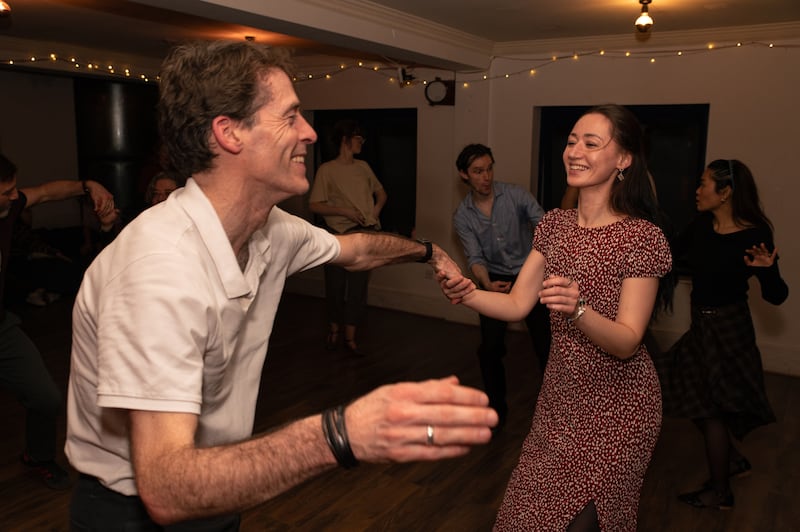 Swing dancers taking part in a social dance at Mind the Step cafe in Dublin city centre. Photograph: Natalia Campos
Martha Martinho moved from her native Portugal to Ireland in 2013. A contemporary dancer for 10 years, she fell “feverishly in love” with Lindy Hop the first time she saw it. She thought she hit the jackpot when she discovered Dublin was hosting a Lindy Exchange – a festival of social dancing and live jazz that rotates around the cities of Europe – on her first weekend in the capital, in the now much-missed ballroom of the Garda Club on Harrington Street. The woman selling the tickets on the door introduced herself as “Lindy” (Linda Jane Byrne, one of the stalwarts of the scene at the time).
“I thought I had landed in heaven,” says Martinho, now co-owner of Mind the Step cafe and dance studios off the north quays near the Millennium Bridge, which has become the beating heart of the city’s swing scene. But after that initial weekend, the community seemed to peter out. So, she set up her own classes, starting with Blues dancing. A steady home was impossible to secure and the dancers roamed from pub to function room like nomads. Social swing dancers tend not to drink much, if at all, so while venues were initially enthusiastic about a potential boost in revenues, they were swiftly moved on when reality hit. (Some dancers I spoke to highlight the lack of booze as a big attraction, including one recovered alcoholic who was desperately seeking a way to maintain a fun social life exclusive of Ireland’s ubiquitous social lubricant.)
[ Dancehall days: ‘He asked me to dance. Now we’re married 42 years’Opens in new window ]
Arthur’s Blues and Jazz Club in the Liberties is one of the few venues in the capital to host live music the dance community can swing to, courtesy of the Sunday night residency by Jawbone, an ensemble led by cousins Philip Christie and Phil O’Gorman, the former of O Emperor and The Bonk. When Jawbone started their residency in Arthur’s in 2015, the swing dancers followed the music.
Seán McKiernan had recently returned from London to Dublin to manage the family pub. Martinho approached him about using the upstairs room for her dance classes, offering a taster session to win him over. (She ended up winning his heart too. They started dating and now have a four-year-old son called Flynn. Seán still dances the Blues. Dublin and beyond is strewn with other swing dance couples and babies, they say.)
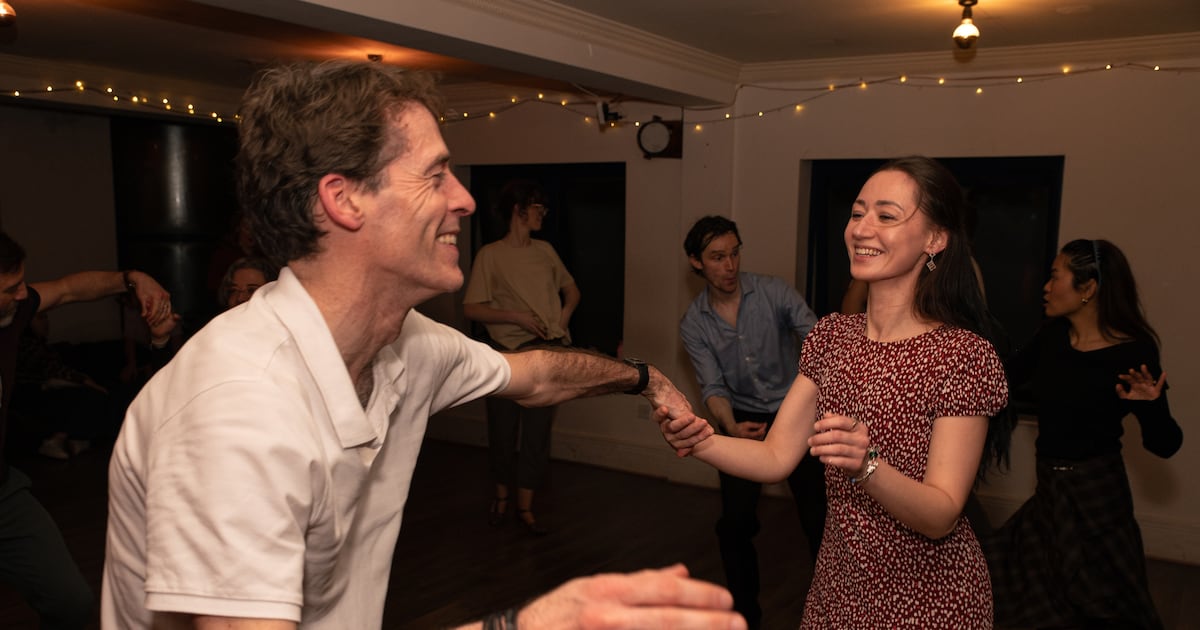
In 2019, the couple opened Mind the Step, a cosy cafe with two dance studios, which is also home to Martinho’s Full Swing Dance School. The Lindy Hop community gather there every Thursday night for a free social dance where they swing until the walls sweat. (The first night I attended, one of the dancers got down on his knee and proposed to his girlfriend whom he had first met two years previous at a Lindy Hop lesson. She said yes.)
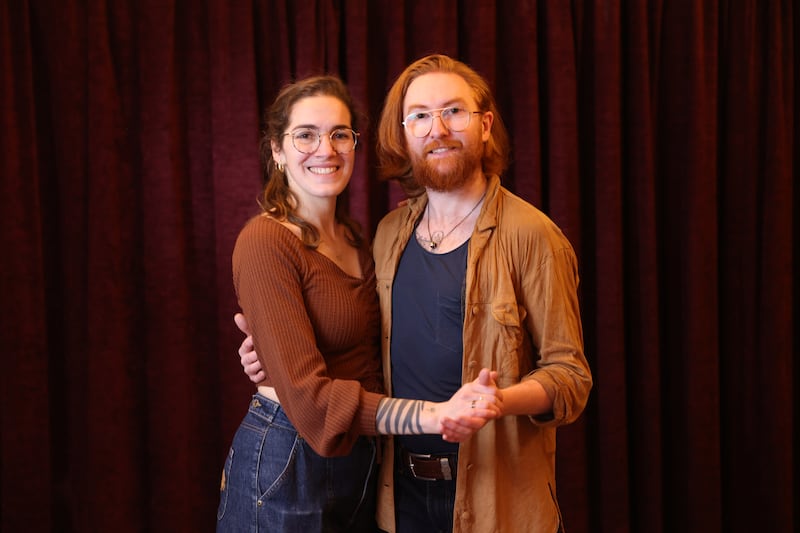 Marta Martinho and Seán Mc Kiernan, swing dancing at Mind the Step. Photograph: Dara Mac Dónaill
 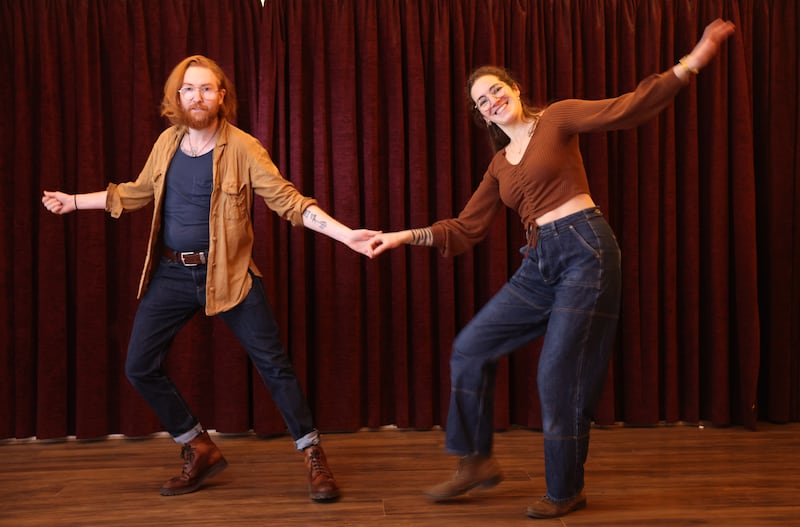 Marta Martinho and Seán Mc Kiernan, swing dancing at Mind the Step. Photograph: Dara Mac Dónaill
Another couple of Lindy Hop lovers were simultaneously taking steps to ensure Dublin was a city where they could pursue their passion. Kozue Kosha, originally from Niigata in Japan, and Michael, from Templeogue in Dublin, met as novices on a social dance floor in Vancouver in 2016 where the swing scene is so vibrant it regularly spills out of venues and into the parks and streets. The pair relocated to Dublin a year later and were disappointed at the lack of social dancing in a city brimming with musical talent. When they bumped into a band of musicians from Dublin City University’s centre for jazz performance studies one night in 2019, they asked if they’d be interested in playing live for some social swing dances. The Fáilte Hot Club, hosted monthly in the Leinster Cricket Club in Rathmines, was born.
“Some nights, if the band is good, the atmosphere can be really special,” Michael says. “You might get a spontaneous jam circle where people throw-down [where experienced couples bust their best moves as the rest of the dancers gather around in a circle, whooping and clapping, before taking their turn in the spotlight] in response to a fast song from the band.”
“When you hit the music with your partner at the same time and you both get the smile on your face, it’s really a unique experience,” says Kosha. “That moment makes me really high, you know. Now I just can’t stop dancing.”
Michael, a neurologist who admits he wasn’t a natural dancer and had to work hard to “learn the language”, testifies to the health benefits dancing offers.
“All exercise is good, but dancing is engaging from a physical and mental perspective, as you’re trying to remember all the moves, and from a social point of view. It gets you out and makes you switch off Netflix. You go to the class that you signed up for, or to the social dance that you promised your friend you’d join them at. There’s lots of very good data that shows people live longer when they have that social connection.”
The couple also established Fáilte Swing Dance School offering lessons; they share some teachers with the Dublin Swing Dance School, including Gabriel Rodriguez, a 35-year-old linguist from Spain who started swing dancing when he moved to Dublin a decade ago.
“People come to dancing for many different reasons. People come, like me, because you’re new to a country and you feel lonely. People can do dancing because they’re going through a bad time and they want to get out there. People want to meet friends. Some people want to meet a partner. Some people want to go on dates. [For] some people maybe it’s just an exercise thing. But I can always tell if they are going to stick with it,” he says.
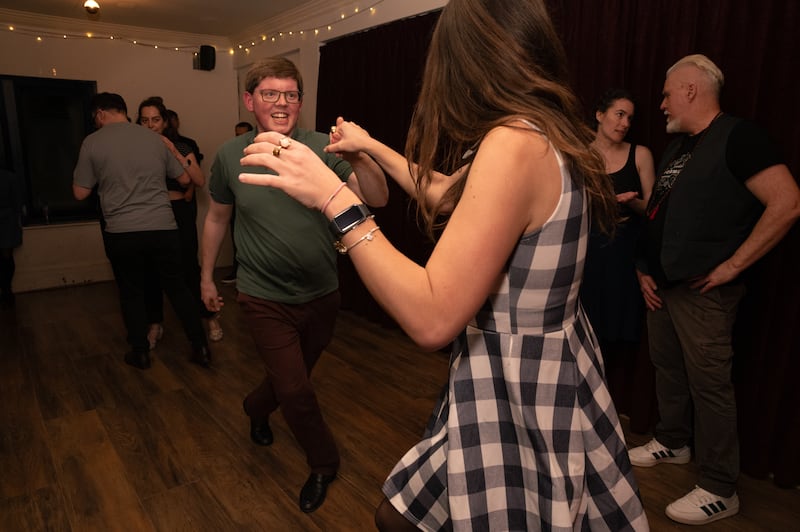 The Lindy Hop community gather in Dublin’s Mind the Step cafe every Thursday night for a free social dance where they swing until the walls sweat. Photograph by Natalia Campos for The Irish Times
 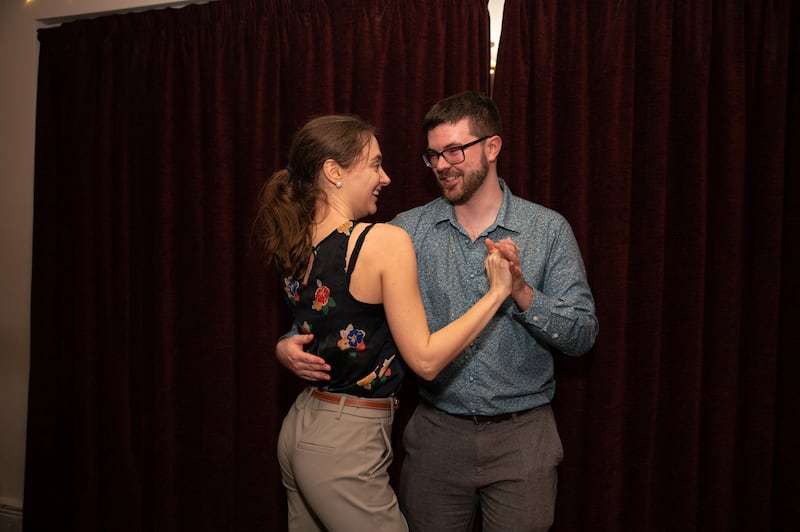 Lindy Hop is a partnered swing dance characterised by a conversation between a ‘leader’ and ‘follower’ dancer and the music. Photograph by Natalia Campos for The Irish Times
Rodriguez has given talks on his experience of being queer in the swing community. “I do see it as a safe space for diversity,” he says. “But I think we can do way more, because at the end of the day, swing dancing, maybe not in Dublin so much, it’s very heteronormative. There’s always the assumption that the man is the leader and the woman is the follower.”
Lindy Hop is a partnered swing dance characterised by a conversation between a “leader” and “follower” dancer and the music. “Leaders” initiate moves and structure, while “followers” interpret, respond, and enhance the dance, offering a creative contribution for both partners. Since I started dancing myself, I have seen many reversals of the gendered norms in Dublin. The swing community is also a safe space for that rare species of Irish male who is not only willing to dance without the crutch of alcohol, but will actively seek out the opportunity.
Brian MacDomhnaill (50) from Co Waterford works as a consultant for the United Nations. He has travelled the world, but currently divides his time between his hometown and Dublin. He sought out some dance classes to help fill the void as he aged out of competitive hurling and soccer.
“We’ve always been a family of dancers, the usual rock and roll stuff and some trad,” he says while taking a break from the busy social dancing in Mind the Step on a wet Thursday evening in January. “I’m also a survivor of the Cork rave scene in the 90s,” he laughs. He mentions that Lindy Hop classes have recently started in Dungarvan, adding to established communities in Kilkenny, Cork, Galway, Limerick and Belfast.
“I’ve been going to Fáilte Swing the past year and a half. It’s been brilliant. There’s few better things to make you feel alive. And I always remember my aunt telling me the only reason she first dated her husband was he was a good dancer,” he says.
I too have learned one year on that it’s never too late to start swing dancing, and whatever your motivation, the rewards are manifold. Not only has it accelerated my rehabilitation post serious back surgery, it has also provided me with a passport into a vibrant community in Dublin, both international and Irish, and no shortage of fun.
The Emerald Swing Festival takes place in the Pillar Room at the Rotunda Hospital in Dublin next weekend, with Lindy Hop and Bilboa classes and social dancing. See pobailstomp.dancecloud.com