
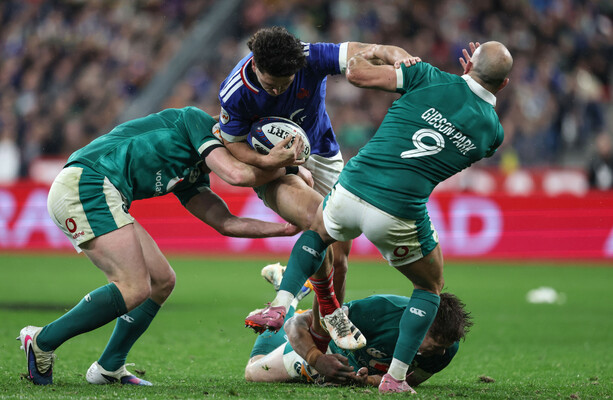
NOT ALL OF what we saw from Ireland in Paris last week was bad. Andy Farrell’s players could take heart in a solid scrum and lineout, despite the worries heading into the game given some of the individuals who were unavailable through injury. And while it went somewhat unnoticed on a night where the visitors were totally outplayed by their hosts, Ireland’s discipline was notably clean.
Ireland gave away just six penalties at the Stade de France. That is markedly improved on November’s return – 11 v New Zealand, eight v Japan, nine v Australia and 18 v South Africa – while they also received six yellow cards and one red card across those four fixtures.
As a result, cleaning up that discipline problem became a key focus heading into the Six Nations. Indeed, Andy Farrell identified it as the main area to address before the group went to Portugal for their pre-championship training camp.
“If you look back to our record in general, discipline-wise, it’s been a point of difference for us and making sure that it stays that way is something that we need to keep going over and addressing,” Farrell said.
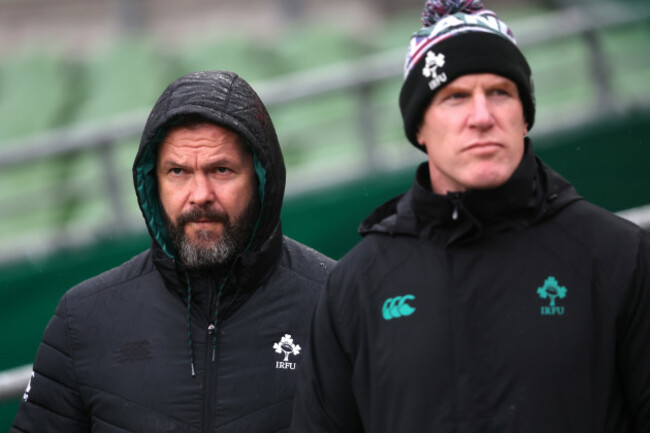
Andy Farrell and Paul O’Connell watch Friday’s Captain’s Run at Aviva Stadium. Bryan Keane / INPHO
Bryan Keane / INPHO / INPHO
“I think, as far as our penalty count, penalties were concerned in the Six Nations last year, it was pretty good, but obviously the game’s somewhat changing a little bit as far as penalties, cards, all of that, you know; you seldom see a game now where there’s not a card. So, the game has changed. We have to adapt to that and work with that.”
In Portugal, discipline was drilled hard. On paper, Ireland got the rewards with a much better return in Paris – Joe McCarthy’s misjudged ruck entry in the first half a rare poor decision.
Yet it could be argued that cleaner return came at a cost. Post-game, Farrell lamented Ireland’s lack of intent against France, admitting it was something he’d never thought he’d see from an Ireland team. Strong words for his players to swallow.
Ireland captain Caelan Doris was asked about those comments after yesterday’s captain’s run in Dublin.
“I think there’s probably a little bit of a feeling of not wanting to make a mistake, as opposed to going out to get it right and properly set down a marker last week,” said Doris.
So, did Ireland’s lack of intent and physicality owe something to the increased focus on discipline?
It’s not hard to draw a connection between the two. If players have spent much of the build-up focusing on making better decisions and not giving away costly penalties, it would be natural if that created moments of doubt or hesitation when it comes to competing in the air, on the ground, or making a tackle as the French flood forward in numbers.
A player might think twice about hitting a ruck with full speed and power when the coaches have been stressing the need to be clean in every action. Likewise when it comes to delivering a crunching tackle: Ireland missed 35 tackles in Paris, where 13 French players combined for a total of 18 dominant tackles; Jeremy Loughman was the only Irish player to make two dominant tackles, with six others making one each.
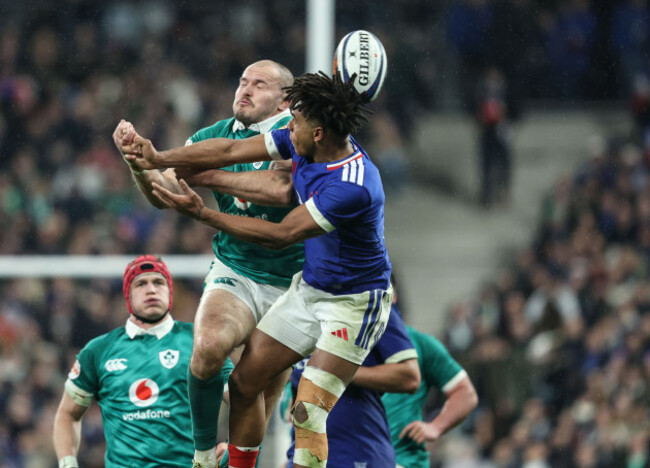
Ireland struggled in the air against France. ©INPHO
©INPHO
At the highest level, players constantly have to make split-second decisions, and it’s a tough balance to strike when it comes to bringing the required levels of physicality and intent for Test rugby. That only becomes heightened if players are being more cautious around discipline or execution.
Doris acknowledges the intent and discipline need to come hand in hand against Italy today.
“Yeah, it’s been a message throughout the week. There’s an awareness that one can’t go up and the other comes down. We need to have both, and that comes from building the right habits in training, being disciplined during the week, and hopefully that will pay off.
“It is something we’re aware of, the lack of intent last week but pretty good discipline, and it can’t be the reverse tomorrow. We need both.”
Earlier this week, Doris’s back row partner Jack Conan offered a slightly different take.
“There’s a balance to the two of them, isn’t there?” Conan told The 42.
“I think the penalty count was much more favourable on Thursday in comparison to how it had been, but you can’t… We want to be on the edge without being over it the whole time, and sometimes you’ll take it and you get things wrong and you give a penalty away, but you can’t let that take away from physicality and intent to get off the line, or whether it’s carrying the ball or to make a difference with every single action you do, whether you’re around the ball or not.
“I don’t think because our discipline was better, it’s not the causation why intent wasn’t good enough.”
That may be the case, but it’s hard to ignore that as one problem area improved against France, a new one surfaced.
Ireland go into today’s meeting with Italy looking for a reaction. It will be interesting to see if they can deliver greater physicality and intent while still keeping the penalty count down over the remainder of this championship.
And essentially, it’s only one part of an overall package which needs to improve across the board against the Azzurri.
Doris spent much of his week in leadership groups and meetings addressing what went wrong against Les Bleus, while the likes of Keith Earls, Cian Healy and Gary Keegan have all offered words of wisdom to the squad across the week.
“Thursday can’t derail us too much, and that has been a bit of a message during the week,” Doris says.
“There’s obviously an awareness that it was poor and it wasn’t good enough from us, but equally there were some signs of some very good intent in training, prior to France and again through the week this week.
“So yeah, we’re hoping to set a marker straight and being back at home as well, it makes it even more important.”