
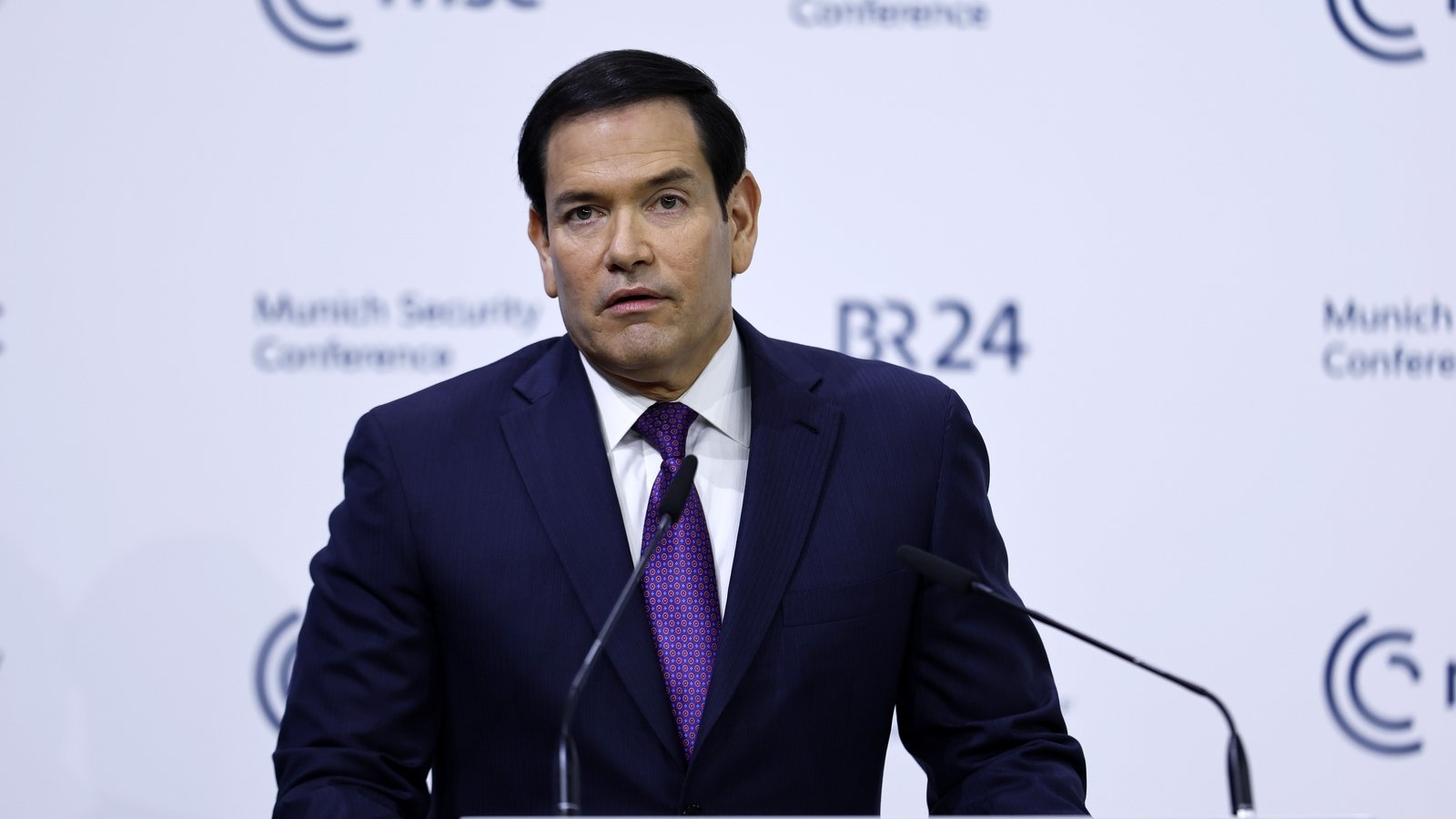
US Secretary of State Marco Rubio has sought to reassure a nervous Europe, saying that the United States wanted to “revitalise” the transatlantic alliance so that a strong Europe could help the US on its mission of global “renewal”.
Mr Rubio struck a markedly reassuring tone as he addressed the Munich Security Conference after months of turmoil in US-European relations sparked by US President Donald Trump’s vows to seize Greenland and his often derisive remarks about the US’s allies.
“We do not seek to separate, but to revitalise an old friendship and renew the greatest civilisation in human history,” Mr Rubio said. “What we want is a reinvigorated alliance.”
“We want Europe to be strong. We believe that Europe must survive,” Mr Rubio said, adding that the continent and the US “belong together.”
The United States will be “driven by a vision of a future as proud, as sovereign, and as vital as our civilisation’s past,” he said.
“And while we are prepared, if necessary, to do this alone, it is our preference and it is our hope to do this together with you, our friends here in Europe,” he said.
Mr Rubio’s speech marked a sharp contrast to that of US Vice President JD Vance a year ago, when he used the same stage to attack European policies on immigration and free speech, shocking European allies.
He reiterated the Trump administration’s stance that immigration is “destabilising societies” but otherwise largely avoided the MAGA flashpoint and culture war issues that, German Chancellor Friedrich Merz said yesterday, had deepened a “rift” between US and Europe.
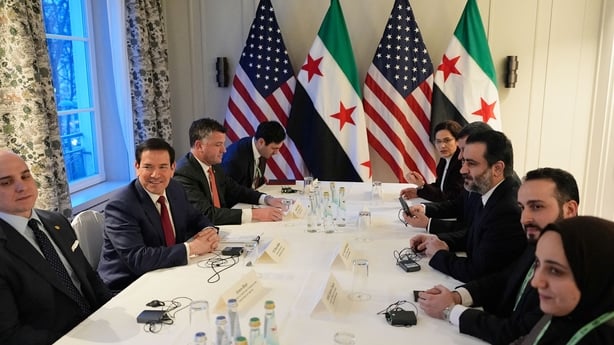
US Secretary of State Marco Rubio and Syrian Foreign Minister Asaad al-Shibani meet on the side lines of the Munich Security Conference
Mr Rubio also hit out at a “dangerous delusion” that every country has followed the international rules-based order and freed trade since the end of the Cold War, and criticised the “overused” phrase “the end of history”.
“This was a foolish idea that ignored both human nature and it ignored the lessons of over 5,000 years of recorded human history, and it has cost us dearly,” he said.
Mr Rubio acknowledged that “we made these mistakes together, and now together, we owe it to our people to face those facts and to move forward to rebuild”.
“Under President Trump, the United States of America will once again take on the task of renewal and restoration, driven by a vision of a future as proud, as sovereign and as vital as our civilization’s past.
“And while we are prepared, if necessary, to do this alone, it is our preference, and it is our hope to do this together with you, our friends here in Europe,” Mr Rubio added.
He said the United Nations had played “virtually no role” in resolving conflicts and called for global institutions to be reformed.
“The United Nations still has tremendous potential to be a tool for good in the world,” he told the Munich Security Conference.
“But we cannot ignore that, today, on the most pressing matters before us, it has no answers and has played virtually no role. It could not solve the war in Gaza,” he said.
Bruised by Mr Trump’s designs on Greenland and his often hostile comments about America’s traditional bedrock allies, European leaders gathered at the Munich Security Conference have pledged to shoulder more of the burden of shared NATO defences.
Key leaders have pushed the message that this is essential for Europe to counter a hostile Russia, with NATO chief Mark Rutte saying that “a strong Europe in a strong NATO means that the transatlantic bond will be stronger than ever”.
“This is the right time for a strong Europe,” said French President Emmanuel Macron, who stressed yesterday that the continent was “clear in the support of Ukraine” and “building its own architecture of security”.
“This Europe will be a good ally and partner for the United States of America,” he added.
British Prime Minister Keir Starmer is expected to tell the conference that Europe is “a sleeping giant” and must rely less on the United States for its defence.
“I’m talking about a vision of European security and greater European autonomy that does not herald US withdrawal but answers the call for more burden sharing in full and remakes the ties that have served us so well,” he will say, according to his office.
The Trump administration’s new National Security Strategy similarly launched an unprecedented attack against Europeans, charging that the continent is threatened with “civilisational decline”.
Ties plunged further last month when Mr Trump stepped up threats to annex Greenland, an autonomous territory of NATO ally Denmark, forcing European nations to stand firm in protest.
Ukraine war in focus
German Chancellor Friedrich Merz acknowledged a “rift” had opened up between Europe and the United States, fuelled by culture wars, but issued an appeal to the US, “Let’s repair and revive transatlantic trust together.”
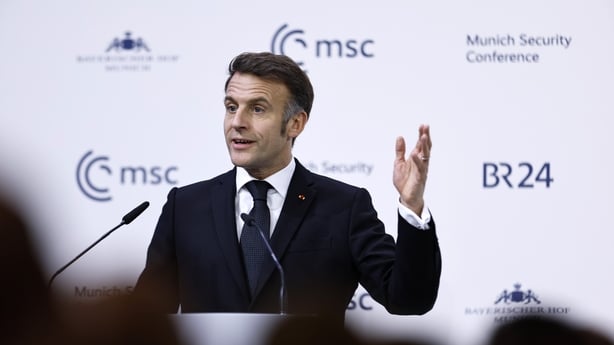
French President Emmanuel Macron said that ‘this is the right time for a strong Europe’
“In the era of great power rivalry, even the United States will not be powerful enough to go it alone,” said the conservative leader, who has ramped up defence spending in the top EU economy.
The high-powered Munich meeting of government leaders, diplomats, defence and intelligence chiefs comes shortly before Russia’s full-scale war on Ukraine is set to enter its fifth gruelling year.
Ukrainian President Volodymyr Zelensky, who has been in Munich since yesterday and meeting multiple allies, was expected to address the meeting today. No Russian officials have been invited.
At the White House, Mr Trump urged him to “get moving” to end the war. “Russia wants to make a deal. He has to move,” the US President said.
A German government source said Mr Merz and Mr Rubio met at the conference yesterday and discussed “Ukraine, the status of negotiations with Russia and further support for the country, particularly in terms of military aid”.
Read more: Merz eyes European nuclear shield in call for reset with US
They also discussed Europe’s role in NATO and “Rubio praised Germany’s steps to strengthen the alliance”, the source added.
Mr Macron said a new framework was needed to deal with “an aggressive Russia” once the fighting in Ukraine ends.
Kremlin critic Mikhail Khodorkovsky said he feared “a new cold war” between Europe and Russia in the coming decade, making reopening dialogue with Russia essential.
“If it makes sense to talk, we are willing to talk,” said Mr Merz, but he also said that “Russia is not yet willing to talk seriously”.