

In the second instalment of our two-part series, we talk to two more couples who have been together for decades. They share what helped them stay, what they had to let go of, and the advice they’d offer others hoping to go the distance.
John and Agnes
John (76) and Agnes (75) Carberry have been together for 66 years. They met as children at Jordanstown School for the Deaf near Belfast, during the Troubles, when most Catholic and Protestant communities lived firmly apart. Their story is featured in Garry Keane’s beautiful and sensitive new documentary A Quiet Love, which captures the remarkable love stories of three Irish deaf couples.
Agnes grew up in a Protestant Baptist family with deaf and hard-of hearing siblings. John grew up Catholic on the Falls Road in west Belfast, and lost his hearing at age five after meningitis. His family were advised to send him to the school for the deaf in Cabra, Dublin, where he learned Irish Sign Language. But when he moved back North at 12 and enrolled at Jordanstown, he found himself stranded again. “I realised their method of communication was totally different,” he says. “Everybody in school was using British Sign Language. So I really struggled to follow school.”
Luckily, the girl he fancied was happy to help. Agnes taught him “an awful lot”, he says, “to be able to fit in to school and be able to communicate”.
Asked what they first noticed about each other, they both laugh, still completely enamoured. “He was handsome, of course, and he was very cheeky, very witty,” Agnes says. John remembers it more viscerally. “My first reaction, whenever I saw her, was she was lovable, a really lovable person. It was just like the wind was crashing on me when I saw her. Just lovely.”
While Belfast was being torn apart by religious division and conflict, at school, labels dissolved. “I never saw somebody and thought ‘You’re a Catholic’ or ‘I’ll not talk to you’,” Agnes says. “We were all the same, regardless of religion.”
John agrees. “That was the first time I had ever in my life came across a person from the other side,” he says, admitting he’d grown up with suspicion. “I thought they’re bad, they’re troublemakers.” But Jordanstown changed his view of the world. “We’re one community, bonded by our deafness,” he says, wishing “the hearing world could learn a bit from the deaf world, because we’re way ahead”.
They were sweethearts throughout school, then drifted apart for three years before a chance meeting at the Deaf Club reunited them, and their feelings returned instantly, stronger than ever. “Oh my goodness, my eyes popped out,” Agnes exclaims, recalling seeing John again. “He’d grown into this tall, gorgeous man. He was so handsome. We chatted and chatted and chatted, and that evening, my life changed. From that, the rest is history.”
But dating during the Troubles was fraught. John and Agnes lived on opposite sides of the city, and travelling was dangerous. John says, “Some Catholic taxi drivers wouldn’t go into Agnes’s area.” The dangers facing the deaf community were heightened. “It was terrifying,” Agnes says. “You’re always looking over your shoulder because you couldn’t hear what was behind you.”
She remembers working near the Europa Hotel when a bomb went off, not realising until “glass from the window behind me came right through my hair. Suddenly there were police and fire engines, ambulances, soldiers everywhere. It was absolute chaos, I still think about it. It was terrifying, especially as a deaf person, because you’re reliant on people telling you what’s going on.”
 John and Agnes were childhood sweethearts at a school for deaf children. They feature in a new film called A Quiet Love. Photograph: Molly Keane
Exhausted by fear and restriction, they moved to London for three years. Even there, Agnes says, “I spent the first few weeks still looking over my shoulder. I was still in a state of high alert, it was hard to settle.” They married quietly, in Agnes’s hometown, but John didn’t tell his parents, fearing they would try to stop the wedding. “I have a little bit of regret that none of my family were there.”
Everything softened when they returned home with their first daughter. John remembers arriving at his parents’ door with baby Karen and seeing his mother’s face. “She was just overwhelmed,” he says. Agnes remembers John’s mother embracing her. “I thought she was going to rip my ribs, she held me so tight!”
Accepted, embraced and celebrated by their families at last, over the decades they built a life: five children, 10 grandchildren, and a home they’ve stayed in for decades. Love, they say, looks different now: quieter, stronger. Now in their 70s, they have more time together. “We go out, we travel, the more we spend time together, the love gets deeper,” says Agnes.
Their advice to couples wanting their love to last is simple and hard-earned. “Understand each other, be patient with each other, respect each other, ask, communicate,” says Agnes. And for any couple facing challenges, just keep going. As John says, “Love is the answer to everything.”
A Quiet Love is in cinemas now.
Zozo and Bobby Zozo recalls Bobby’s mother calling her directly: ‘Leave my son alone. He’s not your type’. Photograph: Enda O’Dowd
Bobby (41) and Zozo (40) are effervescent to talk to, laughing through the hard parts, finishing each other’s sentences, generous with praise. Originally from Nigeria, they’ve been together for 20 years and are now married with four children, including an 11-month-old. In the middle of all that noise and busyness, what’s striking is how openly they still adore each other.
They met through art. Both are multimedia artists, and when a cousin of Bobby’s wanted to collaborate with Zozo, he asked Bobby to come along too. The meeting immediately went off-script. “We got lost talking with each other,” Bobby says, while his cousin grew annoyed at their instant focus on each other, asking, “What is wrong with you?” They swapped numbers, and one Friday night, the connection deepened. “We spoke on the phone till morning,” Bobby says. “I had work in the morning and was exhausted, but it was worth it.”
[ Relationship experts on secrets to long-term loveOpens in new window ]
From the start, Bobby was sure. He began introducing Zozo as his wife before they were even engaged. Zozo remembers being half-amused, half-mortified, exclaiming “Dude, you’re not married to me yet. I have no ring on. Why are you calling me your wife?” His certainty wasn’t swagger though, but devotion.
That devotion mattered, because their love was immediately under pressure. Zozo is Igbo, from the east of Nigeria; Bobby is Idoma, from north central, and the expectation was clear. “Different people don’t marry outside their own in my place,” Zozo says.
Bobby explains the added weight on him from family and cultural expectations, saying “I’m from a royal family. I’m a prince. In our tradition, they picked the wife for you. My family already had a wife for me, without my consent.” Their relationship wasn’t just about falling in love; it was about rejecting a system where tradition and family control outweighed choice.
[ Tell Me About It: My fear of rejection is making a relationship impossibleOpens in new window ]
Opposition intensified as the relationship became serious. Zozo recalls Bobby’s mother calling her directly: “Leave my son alone. He’s not your type.” There were even attempts to pay her off. Zozo’s response was firm: “No amount of money is going to be able to buy the love I have for her son.”
Bobby was equally clear. “Honestly, I didn’t care if they were on board or not,” he says. “I had made up my mind. I knew this was it.” Zozo remembers grounding herself in that certainty, saying “I knew whatever his family was doing didn’t matter, because he was choosing me. And when someone stands by you the way he did, you don’t look back.”
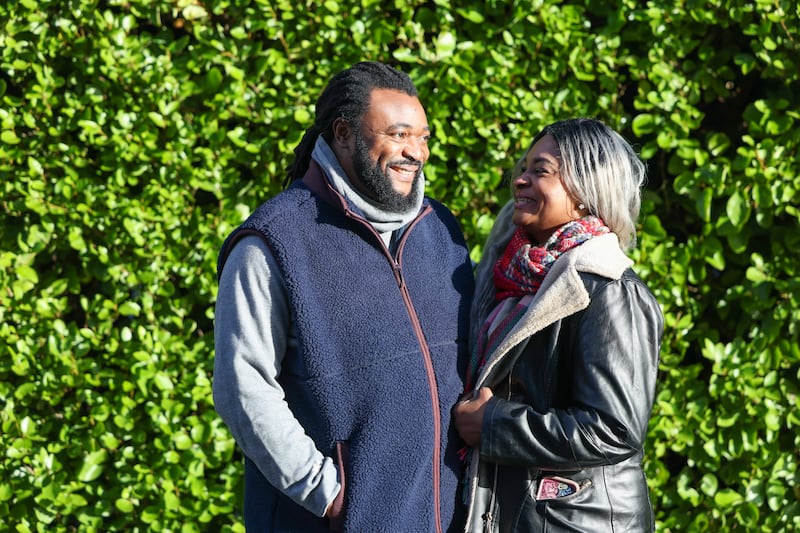 Zozo and Bobby’s advice to other couples is simple and unsentimental. ‘Honesty and communication,’ Bobby says. ‘No lies. Lies kill marriages.’ Zozo agrees. Photograph: Enda O’Dowd
Their wedding period was chaotic. Bobby says his family boycotted the traditional wedding entirely. “None of them came,” he says, alleging they even “sent thugs to come destroy the wedding”. Still, the couple stayed focused. “We just ignored all the drama,” Bobby says. “We wanted to get married.”
The pressure didn’t end there. When their first children born to them were girls, Bobby says hostility flared again. “My people believe it’s not until the wife has a son that she’s a wife,” he explains. “The female child is not really valued in our culture.”
The couple kept moving to gain their peace: firstly in Nigeria, then Dubai, Scotland, and finally Ireland. Starting over has been hard, but the distance from family hostility has brought calm (and to ensure it continues, Bobby and Zozo aren’t sharing their surnames). Zozo speaks warmly of Irish people and support from local community groups like Inchicore For All, saying “Dublin have been really nice people. Whenever there’s a need, there’s always someone ready to help.”
Their marriage is sustained by a shared commitment to optimism. “Negative words [are] not allowed in our house,” Bobby says. “No matter how bad things get, we always try.”
Their advice to other couples is simple and unsentimental. “Honesty and communication,” Bobby says. “No lies. Lies kill marriages.” Zozo agrees, adding, “We don’t do malice. We don’t let the sun rise with anger.” Bobby adds one final principle: “Wherever your partner has a shortcoming, you fill in the gap.” For them, long-term love isn’t the absence of pressure. It’s choosing each other so consistently that the pressure loses its power.