
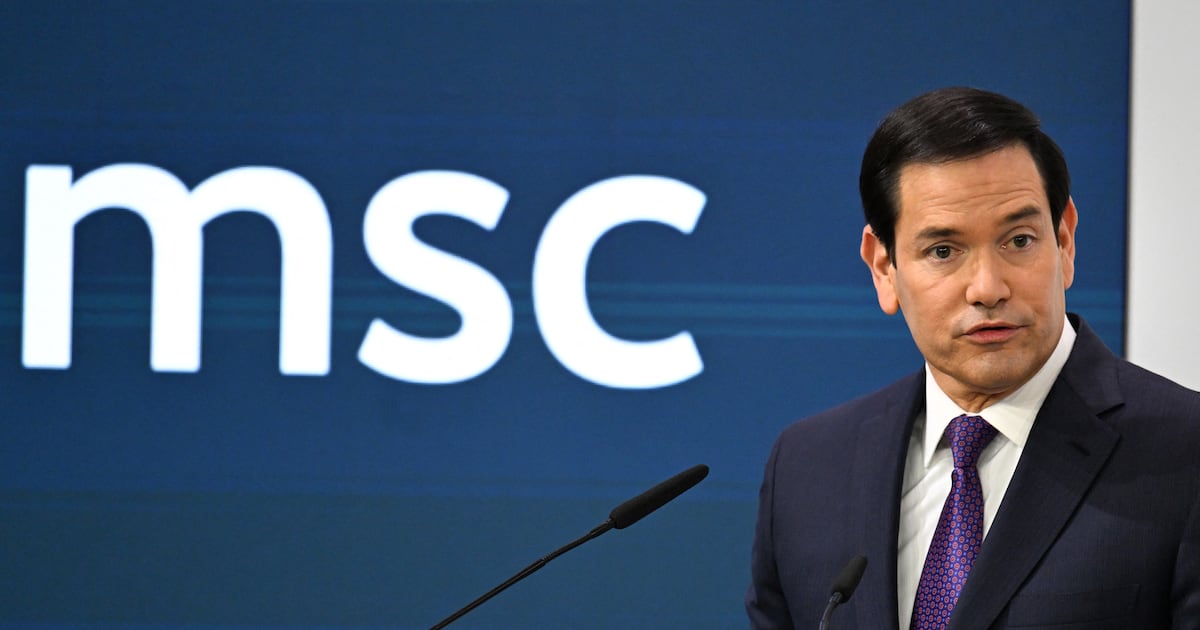
US secretary of state Marco Rubio has said Washington will retain Europe as a key partner if it reverses “foolish but voluntary” policies on security, trade, migration and a “climate cult”.
A year ago, US vice-president JD Vance upbraided European leaders at the Munich Security Conference for embracing what he called the politics of “civilisation erasure”.
On Saturday, Rubio repeated many of the same arguments but in a more upbeat language, insisting the destiny of the US “is and always will be intertwined with yours”.
A visibly relieved conference chairman Wolfgang Ischinger called it a message of “reassurance and partnership”.
But Rubio’s offer of transatlantic co-operation was conditional, reflected in EU leaders’ stony faces and uncertain applause.
While Europeans remained seated, US delegates gave Rubio a standing ovation, suggesting the strained transatlantic relationship is not yet off the critical list.
“We in America have no interest in being polite and orderly caretakers of the West’s managed decline,” said Rubio. “We do not seek to separate but to revitalise an old friendship and renew the greatest civilisation in human history.”
The chief US diplomat insisted that US president Donald Trump’s offer of co-operation in the 21st century hinged on Europe’s readiness to reverse post-1989 failings, in particular that the rules-based order, “an overused term, would now replace the national interest”.
This “dogmatic idea of free and unfettered trade” ignored, he said, the path of human history – on nation states and borders – and offered no solutions when others subverted the rules-based order to undercut western economies and create new dependencies.
“Deindustrialisation was not inevitable, it was a conscious policy choice, a decades-long economic undertaking that stripped our nations of their wealth, of their productive capacity and of their independence,” said Rubio.
As well as free trade, Trump’s chief diplomat challenged the prevailing western order that, he said, sacrificed its citizens’ economic welfare to “appease a climate cult”.
Trump’s America, he said, was not interested in such allies, nor would it work with countries trapped in a vicious circle of “bad policies and a malaise of hopelessness and complacency … paralysed by inaction and fear”.
“We made these mistakes together and now, together, we owe it to our people to face those facts and move forward.”
The Trump path ahead to control immigration, Rubio said, was “not an expression of xenophobia” but a “fundamental act of national sovereignty” and the failure on this front is an “urgent threat to the fabric of societies and the survival of our civilisations”.
A year into the second Trump term, Rubio said the US viewed itself as a “child of Europe”, built by Italian forefathers, German settlers and the “hardy clan from the hills of Ulster” whose descendants included Theodore Roosevelt and Neil Armstrong: “We are part of one civilisation, western civilisation. We are bound to one another by the deepest bonds nations can share.”
The Trump administration was interested in European allies that shared this pride in its achievements, added Rubio, not allies “that exist to operate a global welfare state and atone for the purported sins of past generations”.
He name-checked the United Nations as evidence of the West’s broken status quo: unable to solve crises in Gaza or Ukraine or tackle Iran’s nuclear proliferation until the US intervened.
“We cannot allow those who endanger our global stability to shield themselves behind abstractions of international law that they routinely violate,” he said.
After his address that was notable for what it excluded – Venezuela, the Middle East, Sudan – Rubio was asked whether he thought Russia was playing for time in peace talks with Ukraine.
In advance of a third round of negotiations next week in Geneva, Rubio said it was impossible to say for sure.
“I don’t think anyone in this room would be against a negotiated settlement to this war,” he said, “as long as the conditions are just and sustainable”.