
There was a grey, rainy sky stretching out in every direction above Alden Biesen castle in northeast Belgium where European leaders spent the day on Thursday.
Prime ministers and presidents were on a one-day retreat in the countryside in a castle that traces its history back to the crusading order of the Teutonic Knights.
European Union leaders were there to talk about how they might reverse a trend critics of the Continent say will eventually see Europe become a faded economic power, viewed more as a “museum” known for its cultural heritage than a global player.
The EU has to contend with an “America First” administration in Washington, DC that has shown little regard for the transatlantic relationship, with a war waged by Russia on its doorstep and with an insatiable Chinese economy keen to eat a larger portion of Europe’s lunch.
The bad weather outside probably aptly reflected a sense inside the room that the metaphorical storm clouds were gathering overhead.
“We are looking into some hard years,” Denmark’s prime minister, Mette Frederiksen, told reporters that morning.
The German economy, long seen as Europe’s industrial engine, has been stalling. France, the union’s second biggest power, is creaking under a mountain of public debt, a problem its succession of short-lived minority governments have been unable to rein in.
More broadly, leaders are concerned that without changing something, Europe will slip further behind the United States and China in a slow downward spiral.
“Everyone is in trouble, industry in Europe is certainly in serious trouble,” Belgium’s prime minister, Bart De Wever, said. Factories were shutting and industries shrinking.
If that decline continued, Europe would lose the manufacturing base that underpinned large swathes of its economy, he said. “Then you will no longer be able to produce anything yourself in Europe, then you will be at the mercy of large trading blocs.”
Opinions differ on how to turn things around. A debate has been taking place between different camps inside the EU for months about how to jump-start the union’s economy.
French president Emmanuel Macron has argued for a more protectionist approach that would involve actively aiding certain strategically important industries, such as the defence, automobile and steel sectors, and manufacturers of green technology.
A “European preference” plan championed by Macron would see strings attached to future EU funding and competitions for public contracts to ensure more money flowed back to European companies.
“Otherwise Europeans will be swept aside,” Macron told Le Monde and other newspapers in an interview this week.
Officials in Dublin are anxious about the approach. The Government is wary the move could be interpreted as the EU pulling up the drawbridge to the US and other trading partners.
In a worst-case scenario, that might spark a hostile reaction from the Trump administration, destabilising a shaky truce.
The Government believes any preference should apply to multinational firms with European bases, rather than be limited to European-owned companies.
Ireland has always been a big backer of EU rules that prevent governments from subsidising domestic industries or companies.
The belief is that loosening those state-aid restrictions would benefit governments with deeper pockets at the expense of smaller EU states. Ireland has allies on that front in the Netherlands and the Nordic and Baltic states.
A paper circulated by the Netherlands, Finland, Sweden and the three Baltic states in the days before the leaders’ huddle also warned that applying any European preference test too extensively would push away overseas investment.
In a sign of a potentially significant new alliance emerging in European politics, German chancellor Friedrich Merz and Italian prime minister Giorgia Meloni co-ordinated their positions.
Berlin and Rome said any deployment of a preference scheme should be limited to supporting “crucial and core strategic sectors”. It should also fit in with the bloc’s wider trade policy.
Speaking after the leaders’ retreat, European Council president António Costa, who chairs the EU summits, said he felt there had been “broad agreement” for European preference on the basis it was used “in selected, strategic sectors, in a proportionate and targeted way”.
Earlier, Taoiseach Micheál Martin said he felt recent protectionist impulses ran “somewhat counter” to a separate rush to strike a range of new free trade deals.
The one-sided import tariffs US president Donald Trump strong-armed the EU into accepting last summer shook European capitals. There has since been a re-evaluation of the EU’s reliance on the transatlantic trading relationship.
A full-blown trade war between Washington and Brussels would have been devastating to European carmakers, the pharmaceutical sector, chemicals producers, agri-food businesses and the wider economy.
Ireland would have been particularly exposed in the fallout.
The European Commission, the EU’s executive arm that leads on trade matters, views big free-trade agreements with the Mercosur bloc of South American countries and with India and others as the best way to offset the current turbulence in EU-US relations.
“Europe needs consistent economic growth to be able to do all the things it wants and needs to do from reducing dependencies on the US and China, tackling climate change, creating jobs,” said Rebecca Christie, a senior fellow at Bruegel, a Brussels-based economics think tank.
“Usually when we see a big watershed moment it’s preceded by a crisis,” she said.
We’re not in the middle of a financial crisis, or a pandemic, and leaders aren’t backed into a corner, Christie said.
However, EU officials have detected a pace change from national capitals and an appetite to do more together in pursuit of economic growth.
“We’ve been seeing a change in mood in terms of what the European Union needs, the urgency,” one senior official said this week.
The past 12 months have reignited debate about internal EU financial reforms – which have stalled for the past decade – to create a joined-up single market for capital.
Officials in Brussels say the changes would make it easier for investment to move across national borders.
The proposal has not got far since it was first floated in 2015. Governments are reluctant to sync up differing rules around insolvency, company incorporation and tax.
Ireland and Luxembourg are wary of moves to centralise the supervision of financial markets at EU level.
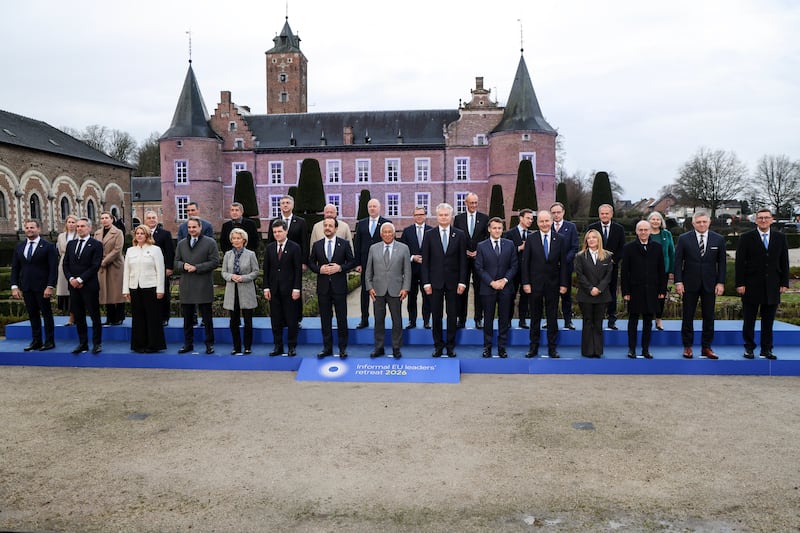 European Council president António Costa, centre, with EU leaders at the informal meeting. Photograph: Ludovic Marin/Getty
There are fears that handing more power over to the Paris-based European Securities and Markets Authority would create a pull factor, drawing firms away from financial hubs in Dublin or Luxembourg towards the French capital or wherever the EU regulator was housed.
“There are concerns around central supervision. We would have concerns about one single authority,” Martin said on Thursday. “We are a big player in respect [of] financial services and so obviously that’s something that we would be watching out for.”
The proposed reforms are part of a wider push to dismantle barriers that stop a business established in one EU state from expanding their operations into others. “It has to be like going from Arkansas to Alabama,” one Irish official said, referring to the US.
Separate proposals being drafted by European Commissioner Michael McGrath will create a new structure where companies can incorporate on an EU-wide basis, instead of having to register in multiple jurisdictions. The scheme, due to be proposed by him next month, will only be open to “innovative” companies.
European Commission president Ursula von der Leyen has made streamlining regulations facing businesses a plank of her second term leading the EU’s powerful executive body.
“Today it can take longer to permit a new factory than to build it,” she told a recent industry conference in Antwerp.
“A truck in Belgium can weigh up to 44 tonnes, but if you cross the border with France, it can only carry up to 40 tonnes. In June 2023, we proposed legislation to harmonise this.”
She said it was “still under discussion”.