
One of the temporary exhibitions in Rotterdam’s new Nederlands Fotomuseum is a mesmerising show about the city itself. It documents the 19th-century streetscape of tight, dark alleys and narrow houses — and then a flattened, apocalyptic cityscape of dust, with an occasional structure sticking up like a weed in a lawn.
The carpet bombing of May 1940 was intended to smash the fierce Dutch resistance to Nazi invasion. Ultimately, the devastation left the city as an experimental site for new urban planning, and its postwar history has been one of continual reinvention, of the application of modern architectural ideas one after another.
It may not be beautiful, but the city offers a fascinating survey of the evolution of modernism: first a low-rise, mid-century city of pedestrian malls and housing; then a central business district of massive anonymous blocks; now a hyper-dense city of towers, a reaction to the car-centred sprawl and urban freeways of the 20th century.
 The Santos warehouse in 1917, around 15 years after it was built © Graafland
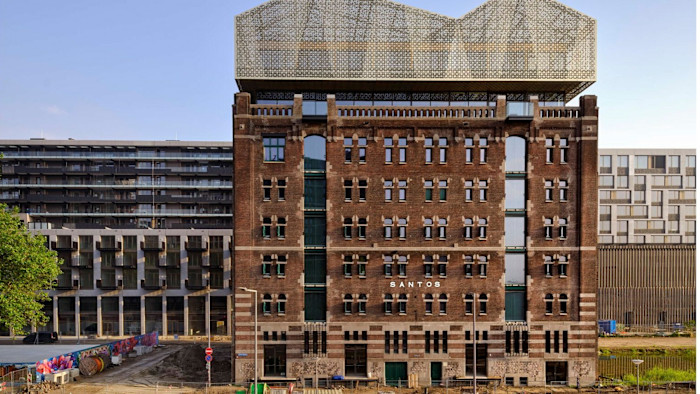
The museum itself is at the heart of the city’s next big thing, Rijnhaven, a former dockside industrial area that borders a deprived, diverse neighbourhood. The Santos is a monster of a building, a massive cube of brick and concrete which was once a coffee warehouse trading with the Brazilian port of the same name. At the moment it looks like a cliff rising above the post-industrial mess of a forgotten neighbourhood, a yellow supermarket, a car park, the elevated concrete tracks of the subway and a few banal apartment buildings indicating the quarter’s next iteration.
The Santos building’s seven substantial floors have been crowned by an anodised aluminium structure with the profile of a couple of irregular gables. Like a ghost of the city’s traditional housing forms, this is the residential section and its peaks recall the crane housings that once constituted the warehouse’s silhouette. As a motif it’s a little cliched, but it works well enough, glowing gently.
 The museum incorporate a new central stairwell . . . © Hans Wilschut
 . . . and a crown-like aluminium roof structure © Hans Wilschut
The new museum has two entrances because, apparently, nobody is quite sure which side will be the livelier in an uncertain urban future. One points to a large flattened site that is destined to be, rather optimistically on a fiercely cold and windy winter day, a sandy urban beach.
Once inside, the ground floor is lofty and generous, the smell of Brazilian coffee once more pervading the space. A hole has been brutally cut right through the middle of the structure, the concrete wounds caused by the intervention left raw and rough-edged. The hole allows for the insertion of a steel staircase that rises the whole height of the old warehouse and takes the visitor on a tour through the history of Dutch photography.
With a collection of 6.5mn items, this national collection is among the world’s largest. It concentrates on Dutch works, though it occasionally features pieces of relevance to the Netherlands by foreign photographers (there is, for instance, an unusual small city panorama by August Sander, known now almost entirely for his hugely influential portraits of ordinary people).
 August Sander’s panorama of Rotterdam, from around 1930
Most of the best photography collections are held in bigger, more encyclopedic institutions in which they can become a little lost. Here photography is firmly foregrounded for a culture increasingly drowning in images.
One floor is dedicated to the history of Dutch photography through 99 works, with many of the most familiar and fashionable names including Erwin Olaf, Rineke Dijkstra, Viviane Sassen and Anton Corbijn. Another floor is saturated with projected images, an endless and overwhelming mosaic of photos familiar from the contemporary online experience, but here a smart museographical device that also allows a huge number of pictures to be shown; striking, easy to update and curate.
The project was headed by Karin Wolf of WDJArchitecten, a specialist in the restoration of modern buildings, and Karin Renner of Renner Hainke Wirth Zirn Architekten, a Hamburg-based practice. Renner was responsible for the champagne-coloured perforated crown, which contains 16 apartments that can be rented or used for residencies and visiting scholars and curators. Wolf, who has worked on many of Rotterdam’s warehouses and industrial buildings, reimagined the space maintaining as much of the massive historic fabric as possible; the result is thoughtful, raw and rich in detail.
 A hold was cut through existing floors to accommodate the new stairwell © Iwan Baan
 The museum uses many shop-like glazed openings to display works © Iwan Baan
The old window shutters have been retained and kept closed with just a little light leaking out into the otherwise dark exhibition spaces. The traces of the building’s previous use are everywhere: chunky iron locks and fittings, balconies for lifting sacks, cranes, even a couple of holes in the old wooden doors that once allowed cats to wander through the spaces scaring off rodents.
There are also many glimpses into storage and archives, with exhibits set in glazed openings like shop windows, tracing the physical and chemical processes of photography through the ages. There is a darkroom in the basement and the public part of the building is capped with a panoramic restaurant sitting underneath the crown.
The building was purchased and restored thanks to a €38mn donation by the Droom en Daad (“Dream and Do”) Foundation, which was also responsible for the Fenix migration museum a little further along the docks. Rotterdam is as much a city in cultural flux as it is in urban development. The extremely expensive rebuilding and reimagining of the Boijmans Van Beuningen Museum continues and a new dance centre designed by Beijing-based MAD Architects (which also designed the Fenix) is scheduled for 2030.
The sheer, almost fortified mass of the old coffee warehouse, with its bands of stone and brick and huge old timber shutters, looks like it will create a secure place for photos both connected to and protected from that outside world of endless images. It is maybe the finest space dedicated to photography I have ever seen; solid, dark, varied and utterly engrossing.
nederlandsfotomuseum.nl; the ‘Rotterdam in Focus’ exhibition runs to May 24
Find out about our latest stories first — follow FT Weekend on Instagram, Bluesky and X, and sign up to receive the FT Weekend newsletter every Saturday morning