
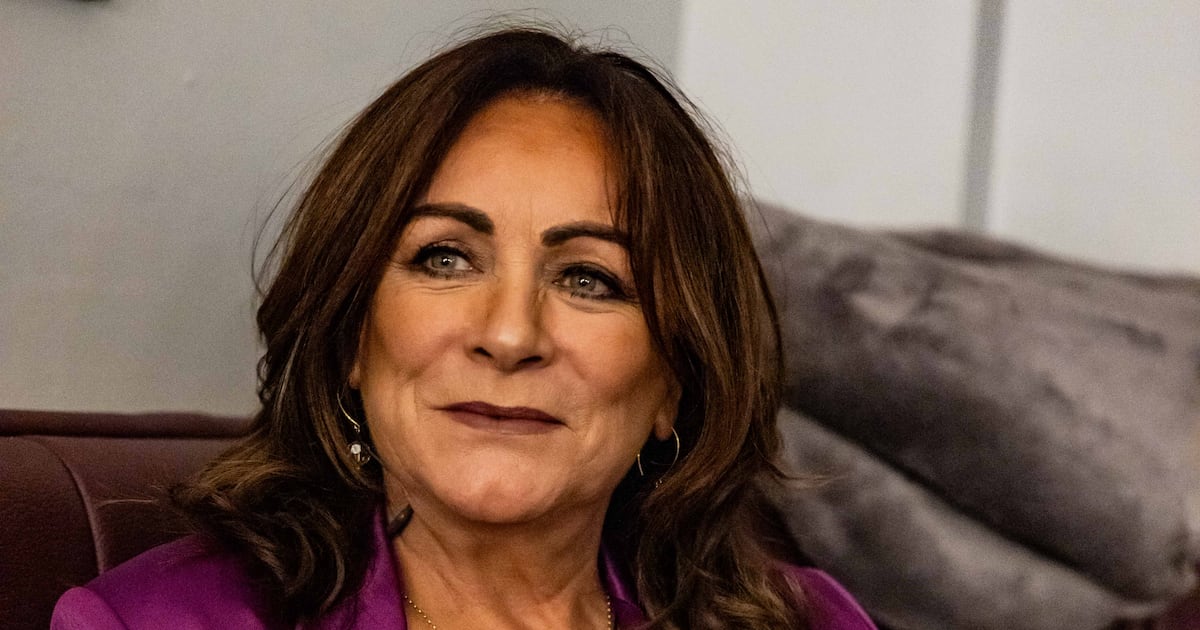
Behind her blue front door, in Dublin’s Harold’s Cross, Mary Black sits in an armchair recalling the twists and turns of her past. She’s been looking back a lot lately, poring through her extensive songbook, figuring out the set list for her upcoming Slán tour, a final goodbye to fans.
The high-ceilinged extension is spacious and bright, full of art and musical instruments – including the as yet untouched mandolin she was given for Christmas by her husband and manager Joe O’Reilly.
He’s in the kitchen making coffee while Black points to a ‘seomra’ in the garden built years ago so her three grown-up children – engineer Conor, The Coronas frontman Danny O’Reilly and the singer songwriter known as Róisín O – could study for exams.
“I’m not sure much studying got done in there,” she smiles, as Blue, the family’s deaf and blind Jack Russell, potters about. “A great old dog, never any trouble. She can’t even go for long walks any more, she sleeps mostly now.”
Age and the passing of time looms large over our conversation. It’s more than 40 years since the release of Mary Black, her first solo album in 1983. Now, Black has got the ‘urge for going’, as she sings in her captivating cover of that Joni Mitchell song. She said goodbye to international fans with The Last Call tour across United States, Japan and Europe a decade ago. This will be her last Irish tour. Is it an emotional time?
“Of course it is. I’ve had moments where I see myself taking that bow for the last time and I get emotional thinking about it. It’s been such a huge part of my life … I know it’s the end of an era.”
She has been surprised by the clamour for tickets, which meant they had to put on more gigs than expected – including an extra date at the National Stadium.
“Three Vicar Streets. Three Olympias. We usually only do one of each. It’s beginning to sink in that, Jesus, this is a bigger deal than I thought. It means something to people, the memories of the music. You know, even if you think back on a song when you were 10, you remember where you were, what holiday you were on … People come to me, saying, ‘I lost my husband, and that song helped me coming through the tough times,’ … the amount of people who have written to me and said those kinds of things. It’s the music. Music is healing. It’s healing for me as well.”
And yet, she knows it’s the right time to leave touring behind. “People think you just walk on stage and do two hours, but there’s also the build-up to it, there’s rehearsals, there’s me having to get my voice back in shape. I take it very seriously. I do exercises because if I don’t my voice won’t be good enough. It’s still not as good as it used to be, but with the songs I have and the arrangements and my amazing band it’s a great night. But you have to work towards that and it hangs over you for a while before you do the tour. So last year, I just said, ‘It’s time now.’ I turned 70. It was a milestone.”
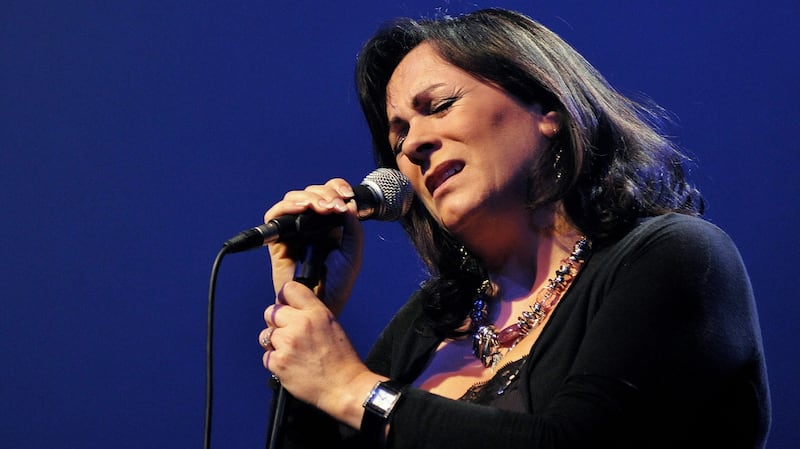 Mary Black performs in Brussels in April 2009. Photograph: Didier Messens/Redferns
She celebrated that milestone birthday last May with a party at home. Black does not look 70. “I work at it,” she laughs when I tell her how great she looks. Later, she and O’Reilly, who met 51 years ago, will head to their twice-weekly reformer Pilates session. She had her hair blow dried that morning; her acrylic nails are a regular indulgence. “That’s only to stop me biting them … otherwise I bite them right down to the quick, it’s bad.”
The couple have homes in Dingle and in northern Spain. She points out that while the nails cost her €60 in Dublin, the exact same treatment in Spain costs only €20. She’s elegant in black trousers, a sleeveless black jumper and monochrome blouse. Lately, she’s been shopping for a dress to wear for Róisín’s wedding in September and is busy with her four beloved granddaughters – especially the two youngest ones, who arrived within a couple of weeks of each other last year.
Mary Black, if we bothered with such notions in Ireland, is a national treasure. For more than four decades, she has been one of the defining voices of Irish music. The Black siblings grew up in a tenement house in Charlemont Street in Dublin’s inner city, two girls and three boys, steeped in traditional music. Their mother Patty, a passionate singer, came from Dublin’s Liberties, their father Kevin, a multi-instrumentalist, from Rathlin Island, Co Antrim. By the age of 12, encouraged and mentored by her older brother Shay, she already had a healthy collection of songs to perform at sessions around the kitchen table. By 14 she was singing in the pubs and clubs of the capital, a regular in Slattery’s on Capel Street.
Her professional career began in the band General Humbert and she sang later with De Dannan before stepping into a solo career. Albums such as By The Time It Gets Dark, No Frontiers and Babes in the Wood revealed an artist who could combine her American singer-songwriter influences – Billie Holiday and Sandy Denny were early muses – with Irish tunes, bringing writers like Jimmy MacCarthy and Noel Brazil to wider acclaim. Listening back to her music in preparation for this interview, what stands out is the outstanding clarity of her voice. Her song interpretations are emotionally intelligent, and always unforced. Her voice is transporting, she feels every word.
Like Christy Moore, Black has been the soundtrack to so many Irish lives. Even if you aren’t an ardent fan, you are familiar with songs like Katie and No Frontiers, you instantly recognise Carolina Rua and Song for Ireland or Past The Point of Rescue. You definitely did not manage to escape hearing A Woman’s Heart.
I just feel so grateful. And thanking them is going to be hard. What do you say? How do you say it? How do you show it?
— Mary Black on saying goodbye to her fans
I love the story of how that song came to be the title track on the all-female record, the biggest selling Irish album of all time. “Eleanor [McEvoy] had just written it and she was singing it backstage, she was in my band and only in her 20s, I heard her playing this song and thought it was brilliant.” But the record company thought McEvoy wasn’t well established enough to sing the song on the album. “So I said I’d do a duet with her,” recalls Black. The song and the album – featuring the likes of Shannon Shannon, Dolores Keane and Mary’s sister Frances Black – the senator and activist, took off.
In 1989, the huge success of the No Frontiers album made her name on the international circuit. Black has spoken a lot over the years of how difficult she found it constantly touring all over the world, the guilt of being away from her children and husband – Joe always stayed behind to look after the family. “Leaving my kids when they were younger wasn’t easy. There was hardship in that.”
She has also been open about the worst times in her life. She experienced postnatal depression and later, at the height of her career in the mid 1990s, she suffered with what she terms “ordinary depression”.
“I remember the feeling of not having anything worthwhile to say. I just kind of stopped talking, and there was just this terrible darkness, you know? The second time around, I knew immediately that I needed to go for help. That’s why I talk about it, to encourage people to go for help.”
She’s not keen to go into details, but within her band at the time she felt redundant, “stupid”, as though she had nothing to offer. “I felt I wasn’t really good at anything I did, it was a confidence thing. I felt I didn’t have anything interesting to say to anybody. Even in my introductions to songs on stage, I just lost the ability to talk, that was part of how it affected me.” She got help, and, supported by her husband, found a way through that difficult time. While she sometimes still has “fleeting” moments of darkness, she says happily that her mental health has been “very good” for the past 15 years.
Lately, as she looks back, she’s been texting Jimmy MacCarthy who in turn has been appraising his own back catalogue. The prolific songwriter will be among the guest performers during the Slán tour, along with McEvoy and others. She shows me a text she just got from him. “The way you inhabit and sing these songs is deep and profound … my pen and your voice may be older but we still have what really counts.”
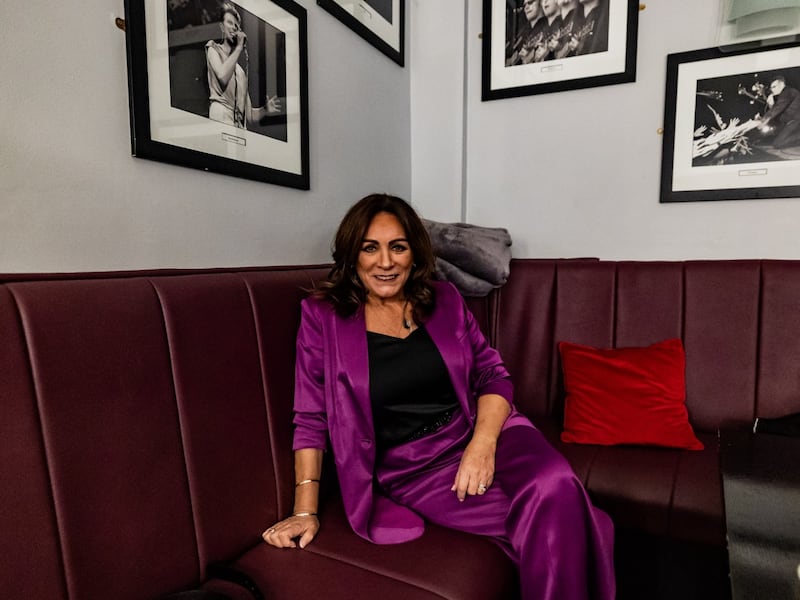 Mary Black: ‘Leaving my kids when they were younger wasn’t easy. There was hardship in that.’ Photograph: Glen Bollard
Part of what really counts is that relationship with her audience. The connection she has with “our little community” is real. Over the years she has made friends with some of her fans, women she’s known for decades, who have visited her home. Younger generations have discovered her too: at every Mary Black gig there are girls singing Bright Blue Rose at the top of their voices. “No Frontiers, Katie, all those songs mean something to their lives. They are happy memories, they come and they have a ball. And then there’s the older people like myself, but they get emotional in a different kind of way.”
[ ‘For hundreds of millions of people on TikTok, Jeff Buckley is still alive’Opens in new window ]
She thinks about how she will feel saying goodbye to them all. “I just feel so grateful. And thanking them is going to be hard. What do you say? How do you say it? How do you show it? And if you’re singing, you can’t be crying all the time, because that doesn’t work. I’ll have to put the blinkers on and just get on with it and think, ‘It’s just another gig,’ which it will be until the very last one, which is in Vicar Street on the 13th of June. That’ll be the toughest one. But look, it doesn’t mean I am never going to sing again. I might get up with Danny with his band, or with Róisín, and sing a song. I have to try and say that to myself. I’m not saying I’ll never be on a stage again. But the touring is finished.
“There has to be a change, but you’re always afraid. I mean, when people retire they always say, ‘Oh, stay busy.’ And we do have a busy life, we’re active, we have lots of energy in us, we want to have time to enjoy the next stage.”
There’s a mandolin waiting to be played, family holidays planned – a villa booked in Croatia for the children, their partners and the grandchildren. There’s a skiing trip in the offing, although she’s not sure whether she will ski again, after being knocked down by a snowboarder last year. “It was frightening,” she recalls.
On that holiday, Róisín got up to sing a new song, Magic, in a bar in the French Alps. To Black’s surprise, it was a song about her. As we say our goodbyes, I ask Black to send me the song. It arrives by text as I’m in the back of a taxi going home. The song has me in tears after a few lines, so I can only imagine what it must do to Mary Black. Listening to the song, it feels like something coming full circle, a daughter paying grateful homage to the extraordinary life and career of a mother, a woman, an artist who is about to take her final bow. The end of an era, indeed.
The Slán tour begins at the National Stadium on May 26th and continues until June 10th. Magic by Róisín O is out on March 6th