
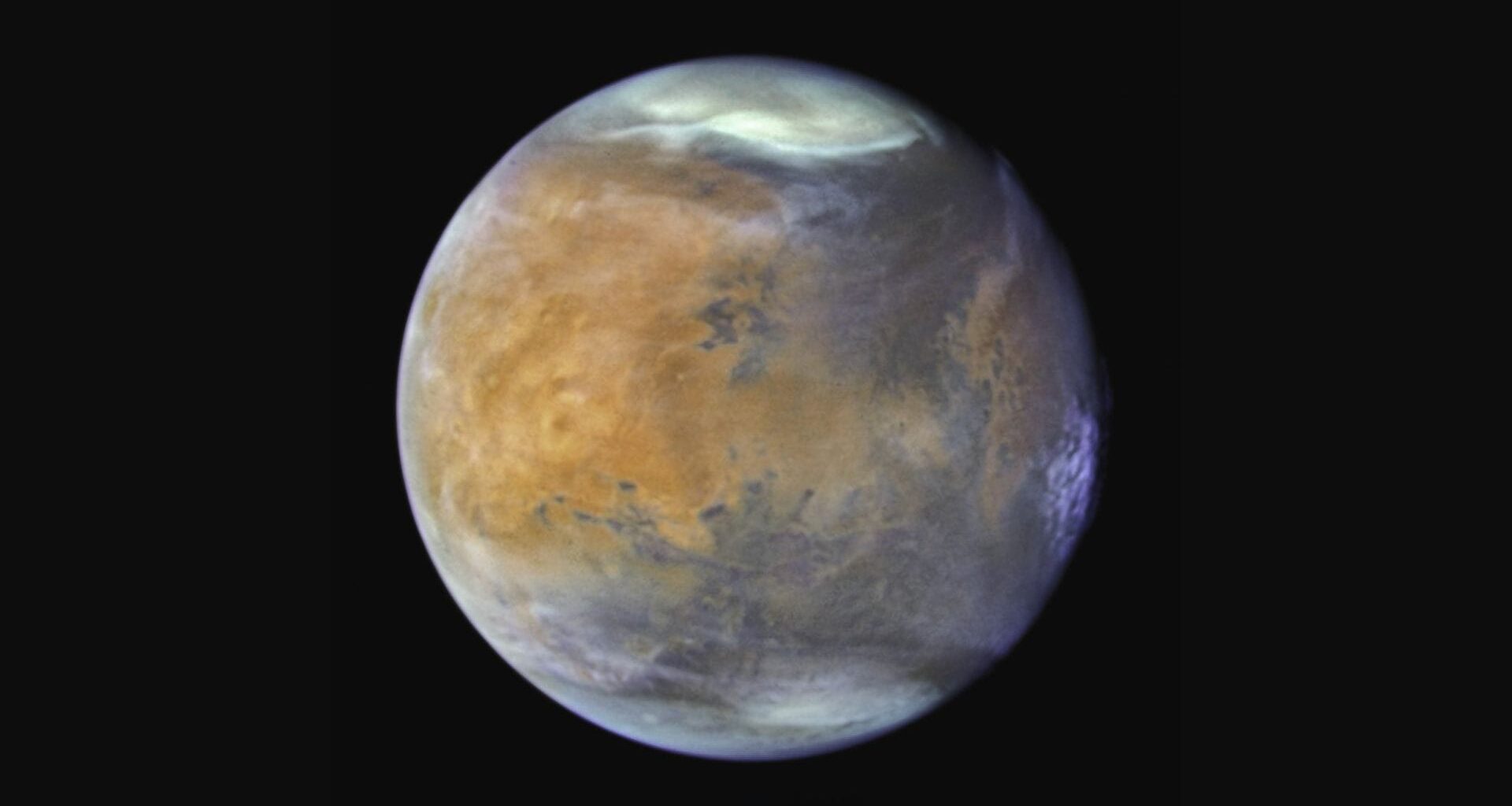
Scientists from Japan have observed an unusual dust storm transporting water to the upper layers of the Red Planet’s tenuous atmosphere. The research reveals the impact of dust storms on the climate of Mars.
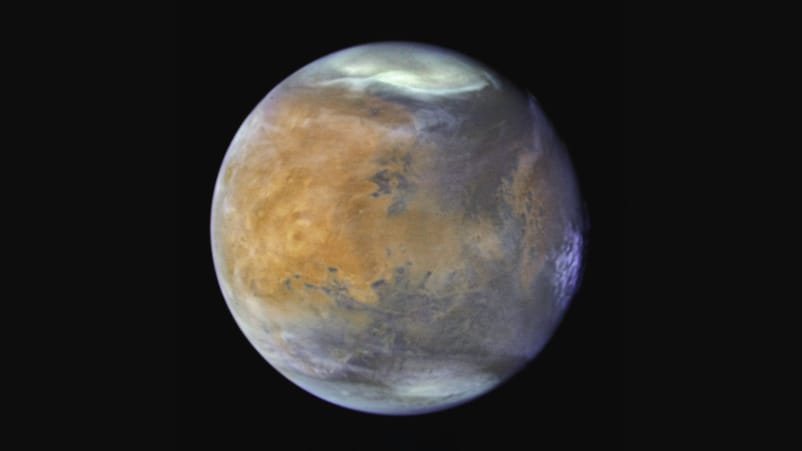
Thin clouds of water ice on Mars, captured by Hubble. (Image Credit: NASA, ESA, STScI).
New Delhi: While we have uncovered plenty of evidence that liquid water once existed on Mars, how much was there, where it disappeared to, when it disappeared and why have all remained enduring mysteries. Researchers from Tohoku University in Japan have observed an unusual, off-season dust storm transporting water to the upper atmosphere of Mars. The research indicates that Mars could have lost much of its ancient water through episodic dust storms, including regional ones that were previously overlooked, and not considered important for the climate of Mars.
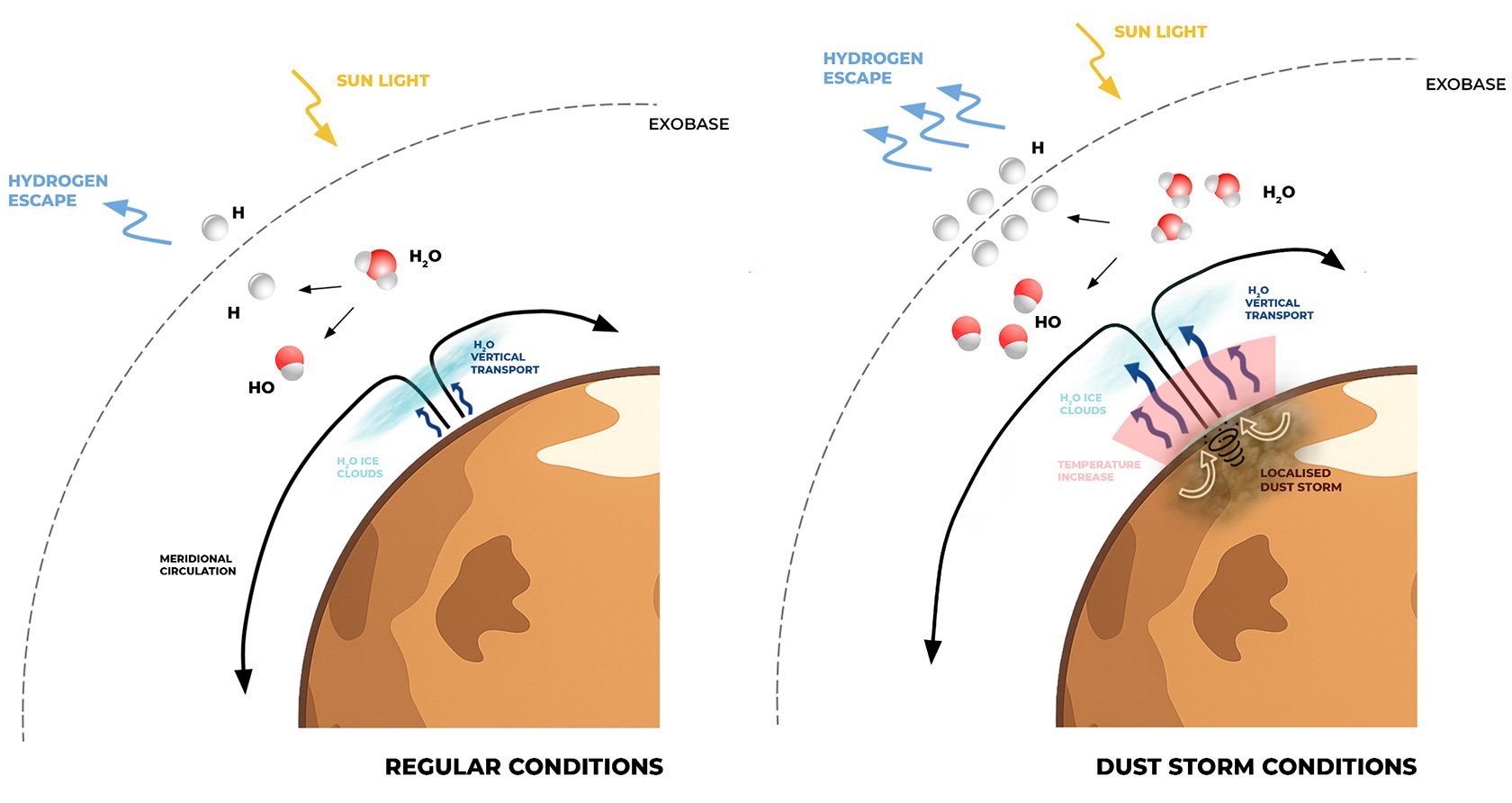
How dust storms cause the escape of water. (Image Credit: Brines, Aoki et al., 2026, Communications: Earth & Environment).
The surface of the Red Planet bears channels, water-altered minerals and geological traces that indicate that Mars was a wetter and more dynamic environment in the past. Reconstructing the disappearance of this water remains a major challenge in planetary science, as known processes can only explain part of the water loss. Dust storms have long been recognised as drivers of water escape into space. Past research focused on large, planet-wide dust storms, that occurred mostly in the warm southern hemisphere summers, when water loss peaks. The research demonstrates that anomalous, intense, localised storms can drive substantial quantities of water to the upper layers of the atmosphere, in the northern hemisphere in summers.
Dust storms play a relevant role in the long-term evolution of the Red Planet
Observations from 2022 and 2023 revealed an unusual surge in middle-atmosphere water vapour caused by a small, local storm in north-western Syrtis Major. The water vapour levels reached up to time times the normal levels at high altitudes, a phenomenon that was unseen in prior years, and defied the predictions of climate models. The high concentration of dust in the storm absorbed solar radiation, warming the middle atmosphere and enhancing the vertical circulation of water vapour. There was also a spike in hydrogen at the exobase, the atmospheric boundary with space, that serves as a proxy for water loss. A paper describing the research has been published in Communications Earth and Environment.

Aditya has studied journalism, multimedia technologies and ᚨᚾᚲᛁᛖᚾᛏ ᚱᚢᚾᛖᛋ. He has over 10 years experience as a science and technology reporter, with a focus on space, AI, videogames, cybsersecurity and fundamental research. He is usually found playing with age inappropriate LEGO sets or sedentary games both new and old.
Follow us on social media