
There are times — not often — when my heart goes out to curators and I feel the urge to hug them and tell them: “Never mind. You tried.” So it is with the creators of Lucian Freud: Drawing into Painting at the National Portrait Gallery.
You can tell from the title that it has been an effort. “Drawing into Painting” is one of those exhibition calling cards, like “Works on Paper”, that constitutes a white flag run up a pole. Someone has been frying their brains trying to come up with a twist that is original and sexy, and couldn’t. So Drawing into Painting it is.
The complication here is that after Freud’s death in 2011 the NPG was given a fabulous stash of the aforementioned “works on paper” — sketchbooks, studies, letters, prints — in lieu of government taxes. As documentary evidence it was a treasure. But, like Turner’s huge bequest to the Tate, the size and range of the gifted holdings also created stumbling blocks.

Portrait of a Young Man (1944)
© THE LUCIAN FREUD ARCHIVE. 2025/BRIDGEMAN IMAGES. PHOTO © NATIONAL PORTRAIT GALLERY, LONDON
How to turn the fabulous stash into a fabulous journey? Because so much of it was not portraiture, how should the National Portrait Gallery make productive use of it?
The present event has met this curatorial challenge valiantly, with bursts of true excitement, but also with creaks of effort. From the start the alchemy here is tricky. The opening niche is filled with drawings of plants and animals — a prickly thistle, a dead monkey — that the accompanying texts advise us to see as portraits. Freud’s own words back up this wonky notion.
• Bella Freud on Lucian: ‘I never had a row with my dad’
But drawings of monkeys and thistles are not portraits. And no amount of curatorial flimflamming can stifle an opening impression that this is going to be an event riven by complications. And so it turns out.
The first time we see Freud himself is in an unfinished self-portrait. He produced many of them and admitted that painting himself was difficult. The example shown here makes clear that a key reason for the many drop-outs is that getting a likeness, the basic essential of portraiture, was not one of his strengths. As a draftsman he was effortful rather than fluent, minute rather than broad. And at the centre of his journey was a tussle between ways of seeing.
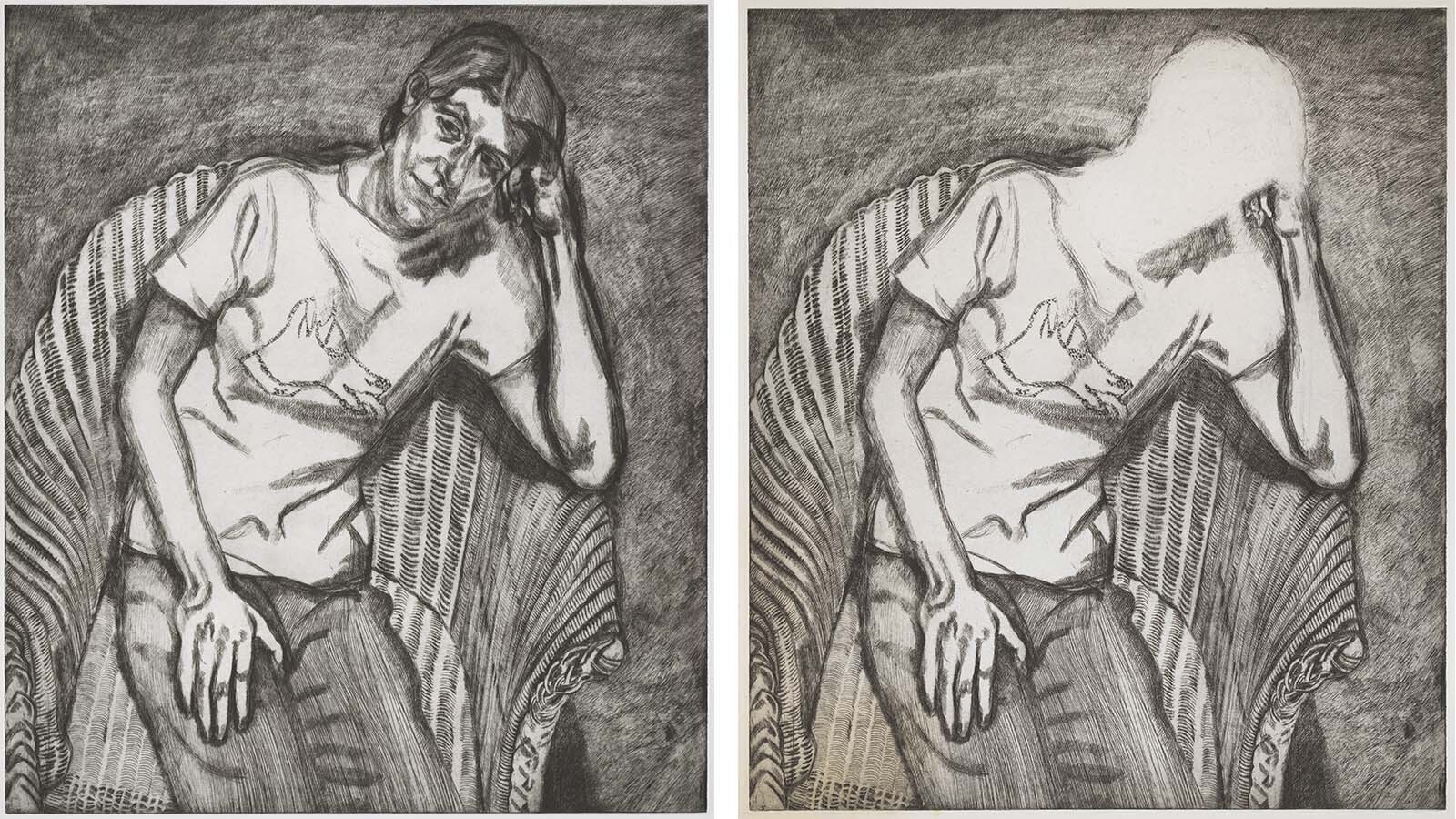
Bella in her Pluto T-Shirt (1995)
© THE LUCIAN FREUD ARCHIVE. 2025/BRIDGEMAN IMAGES. PHOTO © NATIONAL PORTRAIT GALLERY, LONDON
Staring so intently at something that he saw through to its prickly strangeness was his default approach. Turning details into breadth was his struggle.
Thankfully, the opening note of uncertainty is drowned out in the next batch of rooms where the show returns to the basic task of grouping Freud’s portraits and introducing us to his rich cast of sitters. From Stephen Spender to Lord Goodman, from Francis Bacon to John Craxton — he knew and drew a fabulous bunch.
• Kate Moss and Lucian Freud — the supermodel reveals her side of the story
But when it comes to submerged prickliness there is not much in British art that can match Freud’s portraits of his lovers. The key players in his early love life, Kitty Garman, with the feline eyes, and Caroline Blackwood, with the delicate English beauty, are treated to shows within a show that provide this unrolling with its most gripping stretches.
In both women’s cases, Freud’s portraits are projections, not descriptions. If you look at photos of Garman she is unrecognisable from the human feline fantasised by Freud. Girl with Roses, from 1947-8, is a secular Annunciation, a sly rethink of an old master subject, with the pregnant Garman as a Mary who has swapped a gentle lily for a thorny rose. The attending angel is implied brilliantly by the light-filled reflection of a window in her eyes.
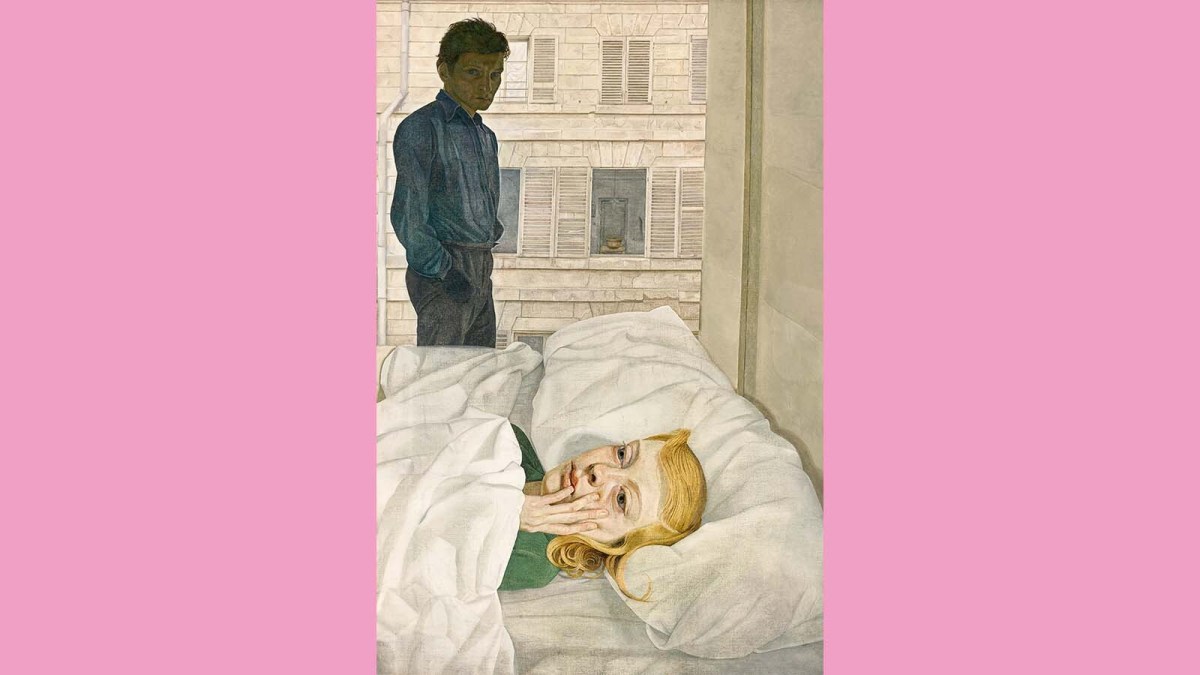
The key painting of Blackwood shows her fretting in bed in a Paris hotel while a shadowy and creepy Freud looks on. As a couple they could hardly be more separated. Reality is being jigsawed.
• Lucian Freud’s daughter defends his naked portrait of her
Hotel Bedroom is significant for other reasons because it is usually said to be the last picture Freud painted while sitting down and using fine sable brushes. From then on he would stand before an easel and work broadly with thick hog hair. Drawing was being frogmarched into painting.
It’s here that the show starts to lose its way. In real life Freud the painter grew larger, bolder, crazier. But the show is unable to tell that story, and there’s a strong sense of missing examples. Put bluntly, there are not enough paintings and too many works on paper.
The giant Leigh Bowery, the mountainous Sue Tilley, his dying mother, all feel as if they are underrepresented. His crowded masterpiece, Large Interior, W11 (after Watteau), has tons of context, but the finished picture is absent. Lenders are loath to lend. The NPG’s holdings are being foregrounded.
With too few telling examples available to dramatise the switch from drawing to painting, we are left with a mass of etchings, many of which are interchangeable, and a sprinkling of paintings that don’t quite get there.

David Hockney (2002)
© THE LUCIAN FREUD ARCHIVE. 2025/BRIDGEMAN IMAGES. PHOTO © NATIONAL PORTRAIT GALLERY, LONDON
As if to prove how difficult it was for him to achieve a fluent likeness, his feeble portrait of Queen Elizabeth II has been lent by the royals and remains a defeat in scale and touch. The one of Picasso’s biographer John Richardson was being painted while I was making a television series with him about Picasso, so I have some personal experience of its creation.
Every morning Richardson was late to filming because he’d been on the phone to Freud, who loved to gossip. For months Richardson badgered Freud to do his portrait. When it finally happened, the result was the size of a cigarette packet and deeply disappointing.
Richardson did his best to cover up his dismay and wrote some flannel, quoted here, about Freud capturing his “apprehension” and “fear”. The truth was that it was a poor likeness. And Freud was always another kind of a painter.
Which exhibitions are you looking forward to this month? Let us know in the comments below
Lucian Freud: Drawing into Painting is at the National Portrait Gallery, London, to May 4