
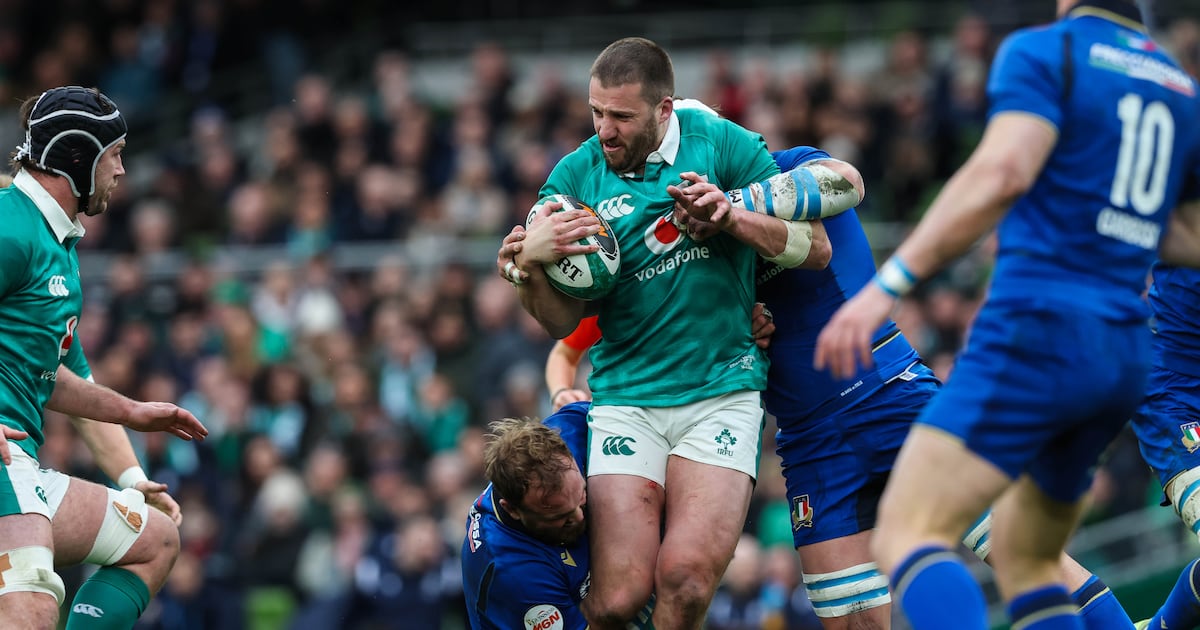
Stu McCloskey doesn’t have much time to reflect these days but if he did, he might allow himself a wry smile. It’s about 10 years and change since he made his Ireland debut against England at Twickenham, a venue to where he will return next Saturday afternoon.
It must seem like a lifetime ago. His first four caps for Ireland were separated by 21 months, 12 months and two years, matches against Fiji, USA and Georgia. The following summer he went on tour to Japan and the USA, won two more caps and scored a try in each of the Tests.
On Saturday he celebrated his 25th appearance for Ireland, a standout performer in a victory that was hard fought. The 33-year-old is now a staple on the team sheet; selectorial discussion centres on who will partner him.
Where once, in an Ireland context, his offloading game was viewed with suspicion, a parlour trick that was too risque, it is now a point of difference that he’s refined to where he has few peers in the Test arena.
It is only one part of his armoury in an array of skills. McCloskey gives Ireland a different dimension in attack, at times employed as a human blunderbuss to scatter opponents, on other occasions, possessing the dexterity to unlock space for team-mates.
He’s worked hard on his sleight of hand. “I mess around in the gym with the ball in one hand. I play rugby with the ball in one hand a lot. It was a nice dry day. You can offload a lot more when it’s dry like that. You have a bit of control.”
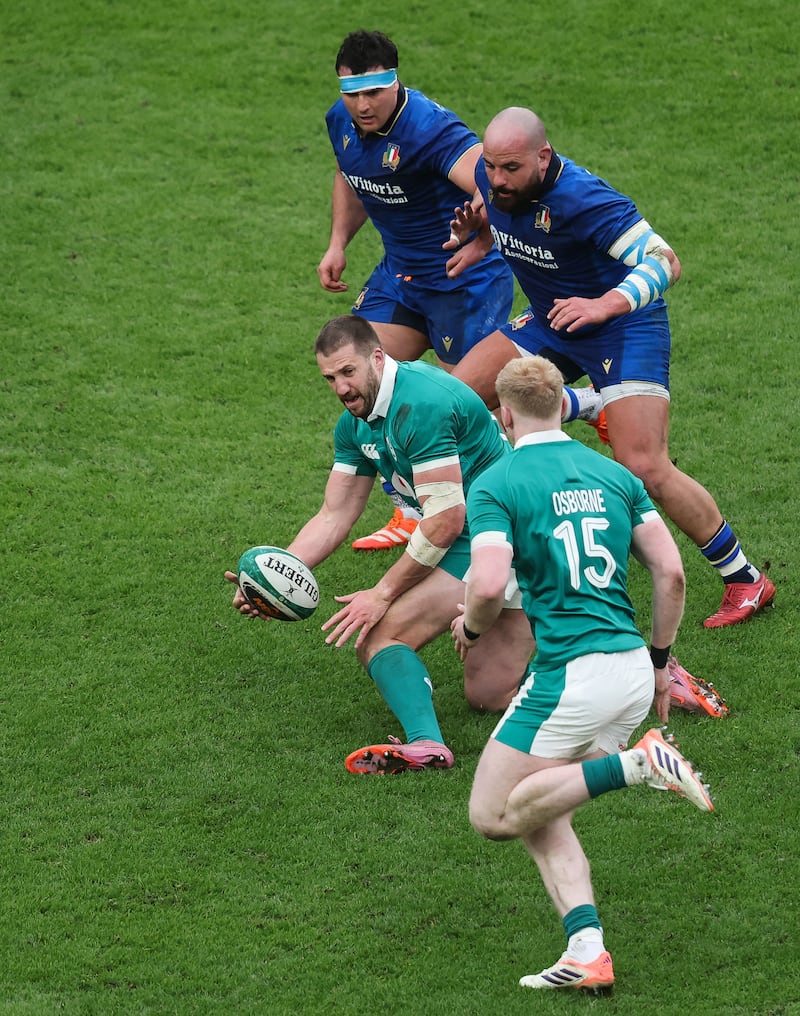 Stuart McCloskey passes to Jamie Osborne during the game against Italy. Photograph: Inpho
Two of Ireland’s three tries were as a direct result of his capacity to play out of the tackle. While he gave a scoring pass to Jamie Osborne after he pirouetted out of a tackle and freed his hands in the one movement, McCloskey had been responsible less than 60 seconds earlier in prising open the Italian defence.
He carried three opponents as pillion, four metres past the initial collision and tangle of limbs, to create a ruck inside the Italian 22. In the process he established a beachhead from which Andy Farrell’s side launched a prolonged pummelling that eventually led to Osborne’s try. McCloskey’s instincts and timing of the pass were pivotal to the outcome.
His role in Rob Baloucoune’s try was even more flamboyant. Ireland appeared to have run out of space, time and ideas when replacement outhalf Jack Crowley charged McCloskey with finding a solution. He borrowed from a quarterback’s playbook, his dinked screen pass, set Baloucoune free and the wing finished in predatory fashion.
While those were marquee moments, McCloskey was diligent and equally effective in less high-profile duties. Fullback Jamie Osborne (15) was a team leader in carries with McCloskey (14) his closest pursuer, while in defence, the Ulster centre (14) trailed only number eight Jack Conan (18) in terms of tackles.
One stood out. In first-half injury time, Italy won a penalty, and outhalf Paolo Garbisi kicked to the corner. After working their way infield, Italian side centre Leonardo Marin bore down on the Irish line, only to be met by McCloskey, who enveloped his opponent in a bear hug before he ripped the ball from Marin’s grasp.
A pile of bodies hit the floor as referee Hollie Davidson shouted “maul”, mere seconds before blowing the whistle for half-time. Moments like those have a seminal effect. Ireland headed for the dressingroom with a little more pep in the step on the back of a positive impact, while Italy briefly pondered the folly of not taking three points.
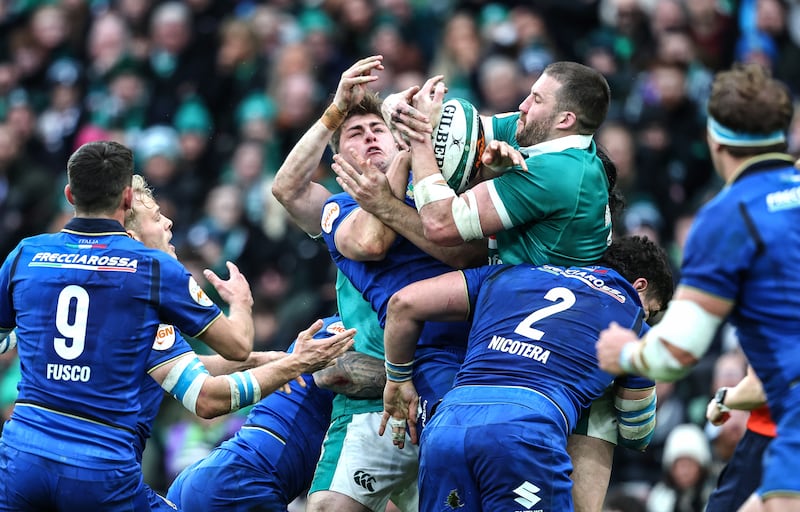 Stuart McCloskey contests for a high ball with Italy’s Leonardo Marin. Photograph: Inpho
No sooner had the second half started than he mopped up a loose pass and fought hard to get to ground, denying the Italians a turnover. The hits kept coming, on Monty Ioane, Garbisi, Paolo Odogwu, Marin and Tommaso Menoncello. A challenge that was communicated to him at one point in his career was to be more physical in defence. McCloskey has fulfilled that remit in quality and quantitative terms.
His judgment in when to offload on Saturday played the percentages; it was risk averse. That wasn’t always the case but like other aspects of his game it’s been refined by experience of playing regular Test match rugby.
Farrell has trusted McCloskey, championed the person and player and that faith has been repaid. Robbie Henshaw and Bundee Aki have both been sidelined but even when they do return McCloskey deserves to retain the playing rights to the 12 jersey.
He is correct in asserting that
“I think I’m playing my best rugby. I have been playing my best rugby over the last two or three years so touch wood, stay injury free and get a good run at it,” he said.
It’s an assertion that’s hard to argue against. McCloskey has come a long way from the wide-eyed 23-year-old that strode on to the Twickenham turf just over a decade ago. Where once a follower, he is now a leader, a role that sits comfortably these days.