
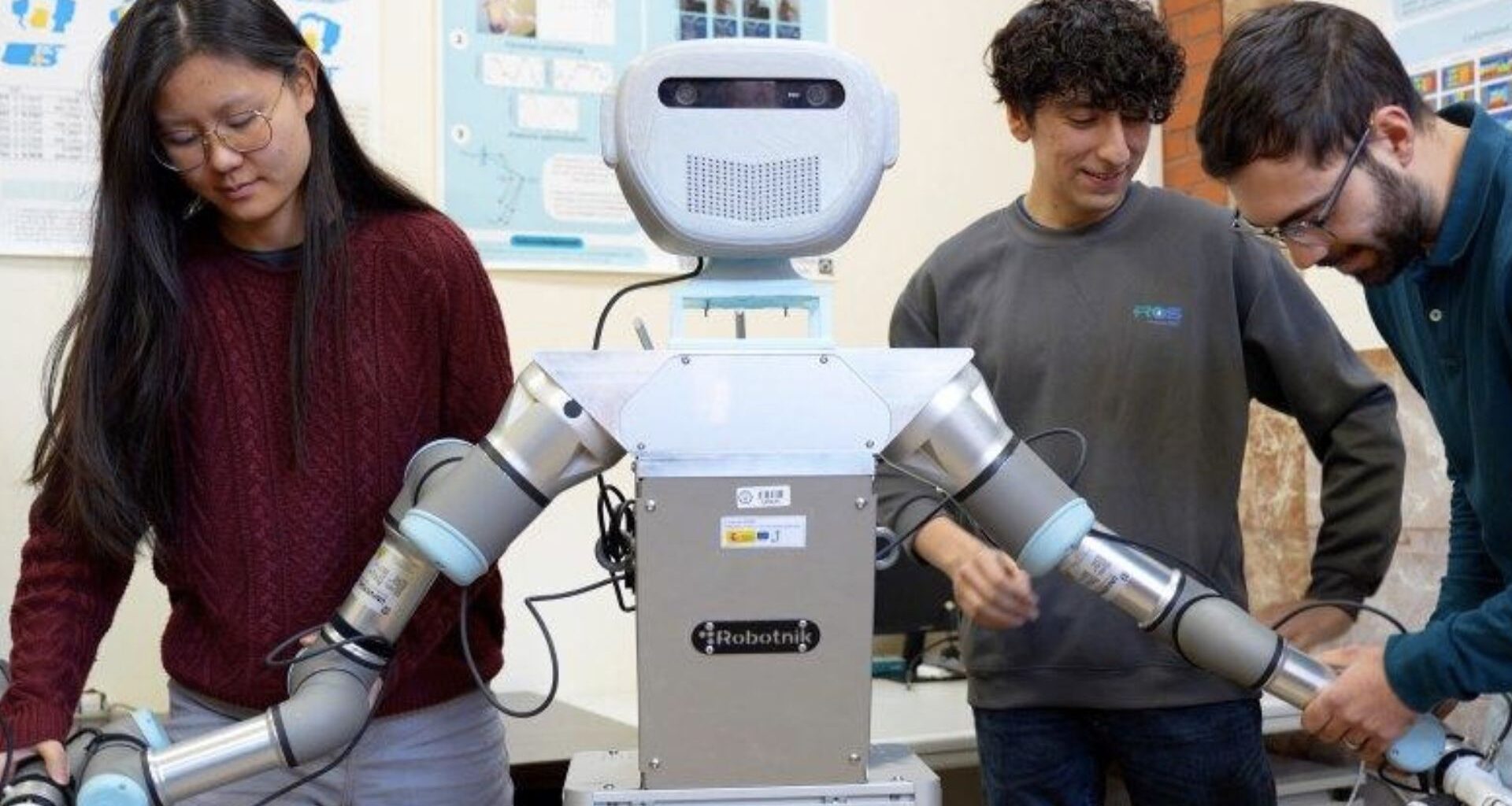
A new methodology is helping robots to move its arms autonomously. Researchers combined a type of observational learning with intercommunication between its limbs to boost robots’ flexibility.
This breakthrough, achieved by researchers at Universidad Carlos III de Madrid (UC3M), represents a further step towards achieving more natural and easily teachable service robots capable of performing assistive tasks in domestic environments, such as setting and clearing the table, ironing, or tidying up the kitchen.
Autonomous Domestic Ambidextrous Manipulator robot
This research addresses one of the most complex problems in current robotics, the coordination of two arms working together. At UC3M, they are achieving this using the ADAM robot (Autonomous Domestic Ambidextrous Manipulator), which is already capable of performing assistive tasks in home environments, according to a press release.
“It can, for example, set the table and clear it afterwards, tidy the kitchen, or bring a user a glass of water or medication at the indicated time,” said Alicia Mora, one of the researchers from the Mobile Robots Group at the UC3M Robotics Lab working on this line of research.
“It can also help them when they are going out by bringing a coat or an article of clothing.”
ADAM is currently an experimental platform
The research team also pointed out that ADAM is currently an experimental platform, with an approximate cost of between 80,000 and 100,000 euros, the technology is considered mature enough to suggest that, within a timeframe of 10 to 15 years, robots of this type could live with us in our homes at a much more affordable cost.
Beyond the technical advances, this work highlights the role of robotics as part of the solution to population aging, a growing challenge in the society.
“Every day there are more elderly people in our society and fewer people who can care for them, so these types of technological solutions are going to become increasingly necessary,” said Ramón Barber. In this context, “assistive robots are emerging as a key tool to improve the quality of life and autonomy of people.”
ADAM has been built to help elderly people with their daily tasks inside their homes or in care facilities.
“We all know people for whom simple gestures, such as someone bringing them a glass of water with a pill or setting the table for them, represent a very significant help. That is the main objective of our robot,” said the director of the Mobile Robots Group, Ramón Barber, a professor in the UC3M Department of Systems Engineering and Automation.
Teaching a robot to perform daily tasks
Researchers highlighted that teaching a robot to perform daily tasks remains one of the great challenges in robotics. Traditionally, programming a robot implied writing thousands of lines of code to define every movement. In contrast to this approach, imitation learning proposes a more intuitive alternative: that the robot learns how a person does it by observing and replicating human actions.
In this paradigm, the human demonstrates the task (by directly moving the robot’s arm or recording themselves performing an action) to teach it, for example, to serve water or organize a shelf. However, simply copying a movement is not enough. If the robot learns to pick up a bottle in an exact position and the bottle is shifted slightly, a system that only imitates will repeat the original gesture and fail. Therefore, the true goal of robotic manipulation is not mechanical repetition, but adaptation and the understanding of movement, according to researchers.
The techniques developed by these researchers address this problem by making the learned movements behave like a “rubber band”: if the target changes position, the trajectory deforms smoothly to reach it, maintaining the essence of the action. Thus, the robot can adapt to new situations without losing key properties of the movement, such as keeping a bottle vertical so as not to spill the contents, as per the press release.