
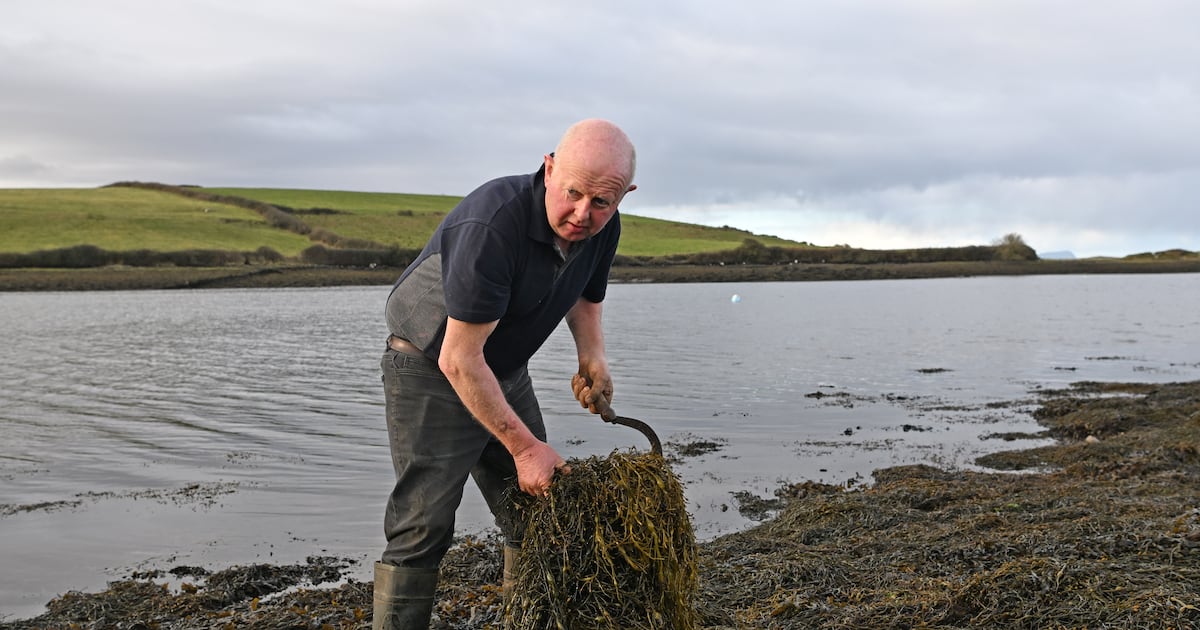
The challenge by big corporations to the traditional rights of seaweed harvesters along the west coast has been brought into focus once again through a social media campaign that garnered some 4,000 signatures within 10 days of its posting on February 2nd.
The main focus of the Uplift campaign has been on one-time semi-State company, Arramara Teoranta, which was bought for an undisclosed sum by the Canadian global corporation Acadia Seaplants in 2014. Before the purchase a decade ago, Arramara made an application for planning permission to facilitate harvesting over a huge geographical area encompassing foreshores from Sruwaddacon Bay in north Mayo to Black Head in north Clare.
The complexities inherent in the application led the then officiating junior minister Damian English to suspend the process and refer it to the attorney general for clarification. Ultimately, his examination of the quagmire involving traditional foreshore rights led to the establishment of Mara (Marine Area Regulatory Authority) in 2023 through the Maritime Area Planning Act (2021), which replaced the Foreshore Act of 1933.
As a result, Arramara has submitted a significantly revised application to harvest seaweed on an industrial scale at five specific bays on the Co Galway coastline, as well as an application covering the intertidal areas.
The present application is for Cashla Bay, Kilkieran Bay, Greatman’s Bay, Bertrabuoy Bay and Mace Head.
“Arramara Teoranta made revised applications to Mara to harvest Ascophyllum nodosum [knotted wrack] and Fucus vesiculosus [bladder wrack] at five bays in Connemara in October 2024,” explained Jim Keogh, Europe director of the company, which is based in Connemara.
He told The Irish Times that this was after extensive work by the company over the past decade to distinguish between unencumbered areas of the foreshore and those with appurtenant rights. This was carried out with the support of Tailte Éireann, the State’s property registration service.
Keogh explained there were 2,500 folios in Co Galway alone with seaweed appurtenant rights but subdivision of lands over the decades significantly increased this number. In the case of Co Mayo there are about 1,500 such folios.
Keogh confirmed that the revised application to Mara omits any areas where there are appurtenant rights and that this research showed this was about 50 per cent of the relevant coastline area.
He added that “the public consultation process would begin once Mara is satisfied that the application is ready to process”.
Asked whether the company planned to expand the number of applications in the future, he said: “Arramara’s application for licenses are in the areas closest to the processing factory in Cill Chiarán, where traditionally it procures most of its seaweed. Other areas may be considered in the future, if necessary.”
He added that any future applications would “be based on excluding foreshore with appurtenant rights”.
Keogh also referred to a statement made for a public meeting of seaweed harvesters held in Ros Muc on February 2nd: “Arramara’s activity generates at least €4 million directly to the local economy. The purpose of the applications is to secure a sufficient supply of seaweed going forward so that the processing plant at [Cill Chiaráin] can operate efficiently and effectively, thereby ensuring that the employment of more than 20 people and the contribution to the local economy will continue. To ensure this employment presently and in the future Arramara must be able to satisfy its worldwide customer base.”
The statement further explained that all future harvesting or collection of seaweed would require a maritime usage licence, with the deadline for applicants, including those with appurtenant rights, being July 17th, 2028.
A Mara spokesman declined to comment on individual applications and referred to its website for more details on the license.
Joe Mortimer has been harvesting seaweed along the shoreline of his farm on Clew Bay since he was 10 years old.
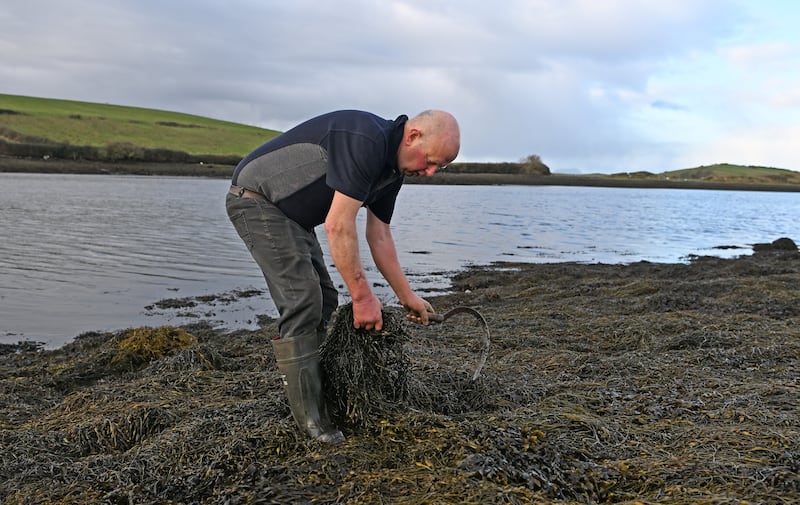 Joe Mortimer at work in Rosmoney, Clew Bay, Co Mayo. Photograph: Conor McKeown for The Irish Times
“I started with my father and have been selling to Arramara Teoranta since 1999 when its factory was based in Donegal. I find the company very straight and they even brought eight of us from Mayo and Connemara to the Acadian plant in Canada, where we were treated very well,” he said.
“However, I am committed to our traditional rights and call on the Government to ensure these are protected.”
“If I could talk to those in charge, I’d say give us all our individual licences for our pieces of the shoreline and do not leave us having to fight off the big companies. There is a similar application with Mara by the Kerry company BioAtlantis for harvesting around Clew Bay.
“This is very worrying for our group, particularly since we manage the shore very well, with regrowth very good. It is also very positive that there is a big rise in young people cutting seaweed here since Covid.”
He was unable to attend the seaweed harvesters meeting in Ros Muc earlier this month. It was organised by local Independent Ireland county councillor Noel Thomas, a candidate in the upcoming by-election in west Galway.
Speaking to The Irish Times, Thomas said: “There were about 300 harvesters at the meeting and they are united in their concerns about the corporate takeover of their livelihoods. Some of them are disputing the designations of the unencumbered shorelines and obviously the onus is on the applicant to prove their cases.”
He also said a delegation met members of the Mara executive team and they agreed to appoint a liaison officer, which was a positive step.
“However, these applications are effectively planning by stealth and it is now past time that the harvesters band together and get proper value for their work. Just look at the price of seaweed products on the shelf and how much they are paid per tonne,” Thomas said.
The present price per tonne of harvested seaweed is €100, according to harvesters.
A key question for Saoirse McHugh, environmentalist and campaigns director of the Uplift platform, is “how will these licences be regulated?”.
“How can our Government’s agencies consider giving licenses to such companies as Aramarra Teoranta and BioAtlantis when there appears to be no monitoring body to oversee the amount of biomass taken? What negotiating power will the traditional seaweed cutters have when selling to these companies?” she asked.
She added that the fact the original application made in 2014 by Arramara Teoranta was still on the Department of the Climate, Energy and the Environment’s website – and, indeed, recently, updated, – until it was removed last week did not engender trust.
“It is unacceptable that information would be so misleading on the department’s own website. This sort of misinformation only further breeds distrust between communities and the department. Especially around handing over seaweed-harvesting rights to large corporations, which has been a contentious issue on the west coast for years. There are certainly large-scale questions still to be answered,” McHugh says.
A spokeswoman for the department said the original application by Arramara “was not under active consideration with the department” and referred to the new legislation.
[ From Famine to feast: the Irish seaweed revivalOpens in new window ]
The global seaweed industry is projected to reach €22 billion by 2028. It is estimated Irish harvesters earn about €10,000 per year, with the overall value to the wild harvesting sector being approximately €2.7 million annually.