
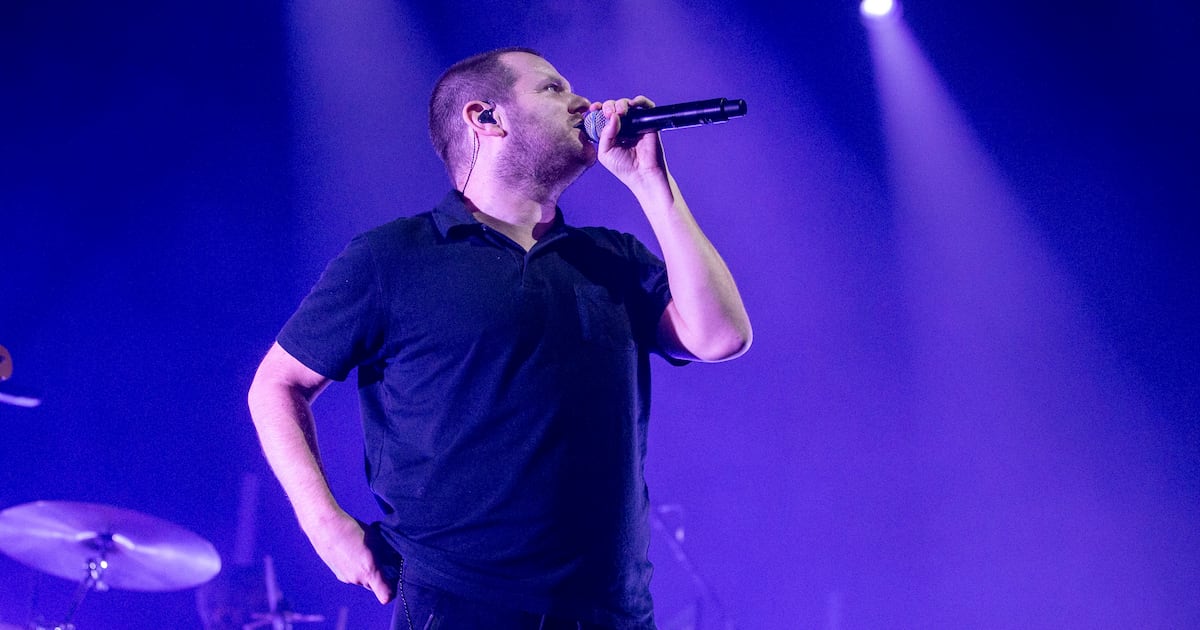
The Streets3Olympia, Dublin★★★★★
By the time Mike Skinner tells us a story about his first show in Dublin – which comprises a house party, missed lift, borrowed money, train to Belfast, and further chaos – we are so deeply immersed in his worldview that we are unsure if this is actually a narrative from one of his songs.
Skinner’s work weaves together a social realism that traces a line from Raymond Chandler to Ken Loach to Shane Meadows, engaging themes like the dashing of ideals, the conflict between the rural and the urban, the baying mood of the suburbs, and the hubbub of the underclass. What Skinner doesn’t engage in is small talk – yet his songs resemble small vignettes on steroids, with an almost Homeric approach to the everyday.
Over what is ostensibly supposed to be an evening that faithfully renders A Grand Don’t Come For Free, Skinner’s 2004 follow-up to the dazzling Original Pirate Material, we get a richly layered, partly theatrical, but always playful exploration of the eternal broken dream that is England.
It Was Supposed to Be So Easy is all verve and swagger, like so much of his work. Blinded by the Lights brings a floaty elegance, leavened by the bouncing, irreverent Fit But You Know It, and Could Well Be In plays out beautifully at the bus stop that forms the major part of the set design.
Later Skinner literally takes pause at a brightly lit lamp-post on stage, which amplifies the wistful regret on Dry Your Eyes. In this particular moment, he fully embodies the character of The Streets; conflicted and defeated, but still looking skyward while bearing the weight. He deftly floats in and out of his long-held musical references all night, as ska, 2-step, garage, hip-hop, and drum and bass all make well-considered cameos.
Skinner’s band is collaborative and stellar, and as two vocalists trade gorgeous harmonies, he bobs and weaves among them, like the Tyson he references on Has It Come To This?, which forms part of the mammoth encore section. As the familiar strain of strings announces Turn the Page with its sense of faded empires amid instinctive modernity and Skinner being “45th generation Roman”, the crowd seems fit to erupt, buoyed by his relatable poetry.
When he physically folds himself into the audience, it’s like he’s returning to his kin, that everyman who anchors the spirited Let’s Push Things Forward and the frantic Don’t Mug Yourself, with the gospel-infused Never Went to Church as one of many highlights.
Part of the beauty of The Streets has been in Skinner’s ability to walk a line between confidence, vulnerability and a kind of nuanced masculinity. This is never better expressed than on Weak Become Heroes – an ode to rave culture amid a derelict political climate, it has evolved into a persuasive plea for tenderness. His work continues to resonate because it is equally rooted in dismay and wonder, never surrendering to the leaden, preaching pessimism of many of his contemporaries.