
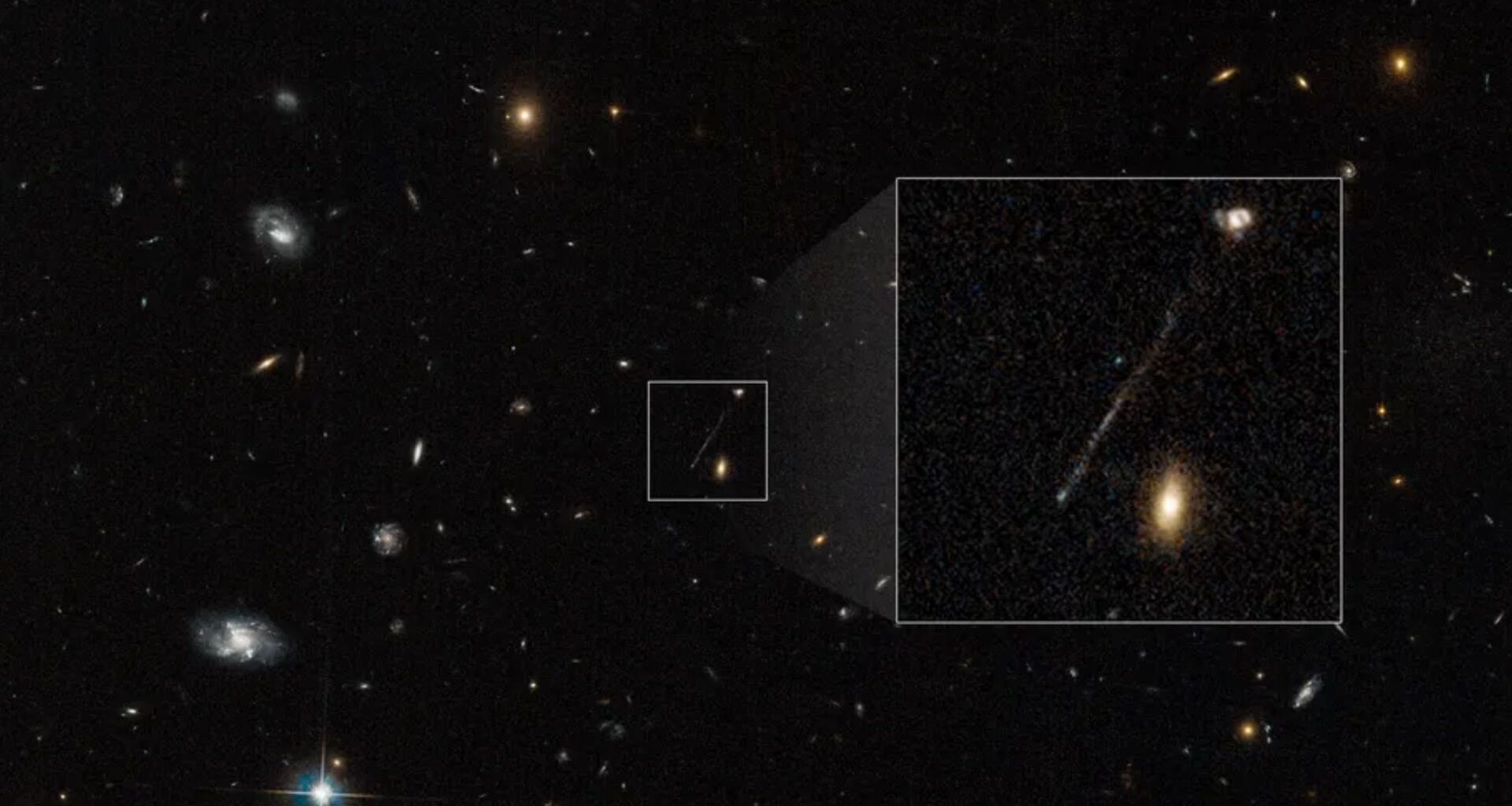
Astronomers have caught a supermassive black hole sprinting away from its home galaxy at about two million miles per hour.
Behind it, a 200,000 light-year trail of young stars marks a galaxy suddenly missing its central black hole.

New observations reveal the shockwave that proves this cosmic escape is real.
A shockwave signature
At the tip of the star trail, the James Webb Space Telescope (JWST) recorded an arc that looked squeezed and heated.
By tracing that arc, Professor Pieter van Dokkum at Yale University linked the signal to a black hole in flight.
Van Dokkum’s team used the arc’s shape and motion to estimate a top speed near 2.2 million miles per hour.
That kind of shove fits only rare events, such as close encounters between multiple giant black holes in a merging galactic core.
From Hubble to Webb
A paper analysis of archived Hubble images revealed a faint, ruler-straight streak cutting across space – a feature too ordered to dismiss as a camera flaw.
Follow-up data showed the streak contained young stars and glowing gas, leading the Yale team to infer that a black hole roughly 20 million times the Sun’s mass was powering the trail.
Because that scene played out when the Universe was about half its 13.8 billion-year age, the evidence had to be indirect.
Fresh JWST observations promised a sharper test, since infrared light can pick out warm gas that older images barely showed.
Ship-like waves in space
A preprint reported gas speed changing abruptly at the tip, over a span of only about 3,000 light-years.
In one interview, the team tied that abrupt jump in gas speed to a bow shock – a compressed wave of gas that forms ahead of a fast-moving object.
“It’s a bit like the waves created by a ship,” said van Dokkum.
Because that wave front sits ahead of the black hole, it confirmed motion even when the black hole stayed unseen.
Stars in the trail
Fresh stars formed along the path behind the black hole, showing that its passage pushed ordinary gas into dense pockets.
As the black hole traveled through the circumgalactic medium, its shock compressed and heated the gas beyond the galaxy’s stars.
Cooling then let that gas collapse into clusters, and star ages increased step by step farther from the tip.
Over time, the line of young stars also mixed with older material, so the wake should gradually fade into the background.
Kicks and slingshots
Only extreme encounters can throw a black hole out, and they usually start when galaxies collide and their central black holes meet.
A paper showed that gravitational-wave recoil can propel the merged object away, driven by uneven gravitational-wave emission.
Three-body scuffles can also eject one black hole, because the tightest pair steals energy and flings the third outward.
Either route leaves one galaxy without its biggest anchor, and it can also send a fast black hole into intergalactic space.
When galaxies lose cores
Most big galaxies keep a supermassive black hole in the middle, so an escape leaves a rare kind of gap.
A review summarized evidence that these central black holes track with galaxy size and stellar bulges.
Without that central mass, gas may settle differently during mergers, and the galaxy could build stars and clusters on a new timetable.
Because the runaway black hole keeps moving, it carries its gravity elsewhere, where it can disturb gas clouds far from any galaxy.
The Cosmic Owl debate
Elsewhere, the system nicknamed the Cosmic Owl sits about 11 billion light-years away and hosts more than one bright galactic center.
Between those centers, observers have reported a third black hole sitting in a gas cloud, and its origin has stayed contested.
Researchers argued that the black hole more likely formed by direct collapse, when gas falls inward without first forming stars.
That disagreement matters because it sets a caution flag: a black hole out of place does not automatically mean it escaped.
Finding more runaways
Wide-field surveys are essential because the streaks are rare and faint, and JWST cannot scan the whole sky quickly.
The Roman Space Telescope mission is designed to map enormous areas of the sky in a single sweep, capturing vast numbers of galaxies at once.
The European Space Agency’s Euclid space telescope should also help by scanning wide regions of the Universe, even though its images are less detailed than those from JWST.
“The obvious next step is to look for more examples,” said van Dokkum, and larger surveys now make that search realistic.
Proof with limits
Peer review still stands between a dramatic image and a settled discovery, so the team described the work as provisional.
Cross-checking JWST data against earlier Hubble and Keck observations showed the same structure in different kinds of light.
After studying the JWST image, the object was described as extraordinary in nearly every respect, with each new layer of data reinforcing that impression.
More sightings will show how often black holes get kicked free, and whether their star trails keep forming in other galaxies.
What this changes
A black hole can leave its galaxy, carve a visible scar in gas, and trigger star birth far from any center.
Future surveys should turn single examples into a census, sharpening theories about black hole mergers and the kicks that follow.
The study is published in The Astrophysical Journal Letters.
Image credit: NASA, ESA, Pieter van Dokkum (Yale)
—–
Like what you read? Subscribe to our newsletter for engaging articles, exclusive content, and the latest updates.
Check us out on EarthSnap, a free app brought to you by Eric Ralls and Earth.com.
—–