
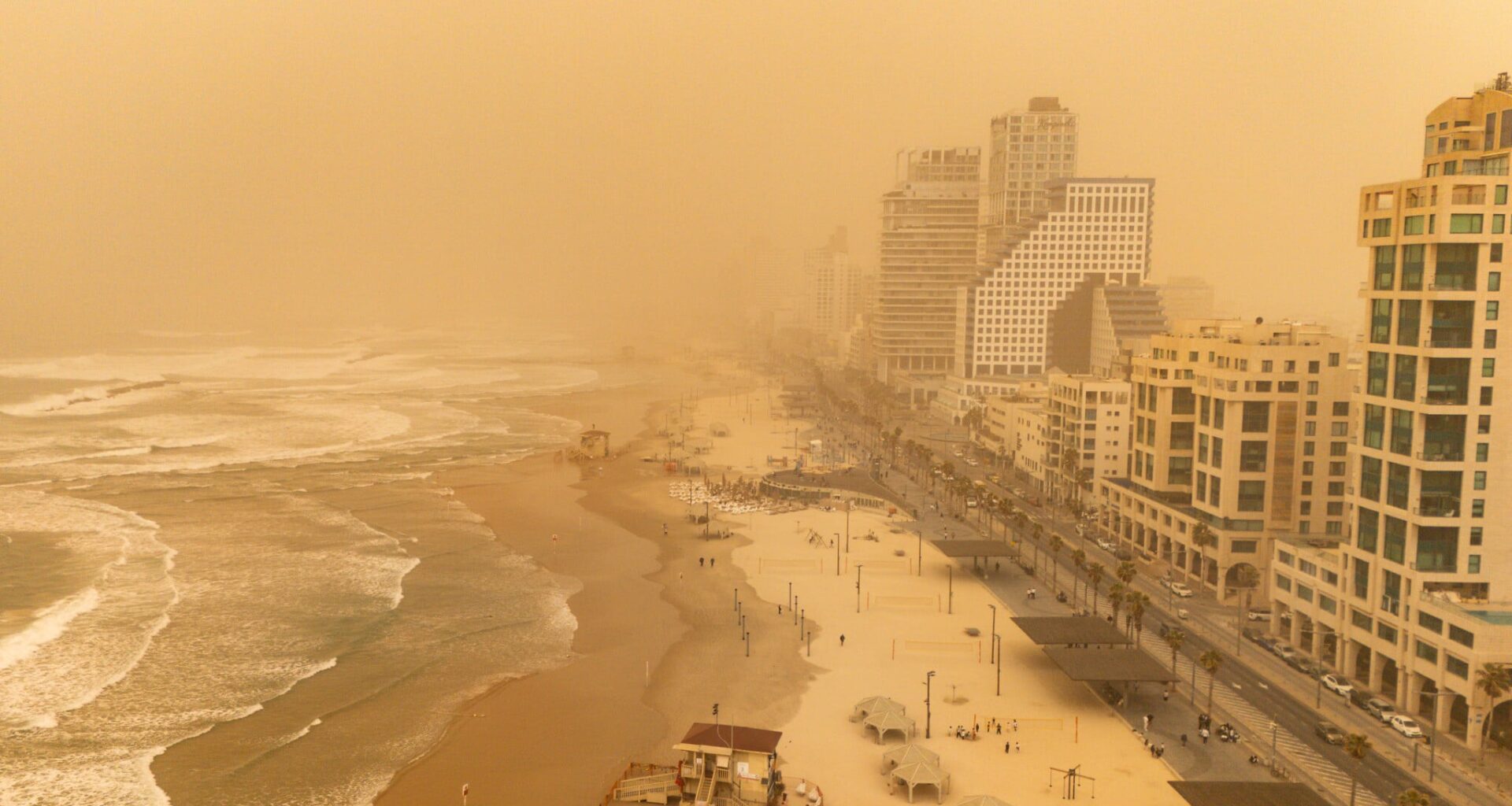
A Hebrew University expert warned Monday that dust storms like those that carpeted Israel over the weekend are likely to become more common and start earlier as a result of climate change.
Assaf Hochman, who researches climate, extreme weather and forecasting at the university’s Earth Sciences Institute, said that Saturday’s severe haze, which sent Tel Aviv and Jerusalem to the top of the global pollution index, resulted from a storm near Libya in the southern Mediterranean, which lifted sand from North Africa and Egypt and transported it at least 2,000 kilometers (1,240 miles) to Israel as part of a phenomenon known as a sharav cyclone.
This is a “low-pressure” system that forms over North Africa and travels east along the Mediterranean coast. While winter storms bring rain, these dry cyclones bring searing, dusty air from the desert.
“These dust or sand-related storms happen every year, usually between March, April, and May, or in the fall, in September and October,” Hochman said, referring to transitional periods during which Israel’s weather is often unpredictable.
“This year, it was earlier than usual,” he went on. “With dry conditions and enough wind, [the dust or sand] can travel great distances and get to higher elevations — under certain atmospheric conditions, it can reach around 5,000 meters above ground where there are very strong winds from west to east.”
Get The Times of Israel’s Daily Edition
by email and never miss our top stories
By signing up, you agree to the terms
He added that similar storms elsewhere can take dust from Africa to Europe, while nearly every year, dust from the Sahara Desert flies over the Atlantic Ocean and reaches the US.
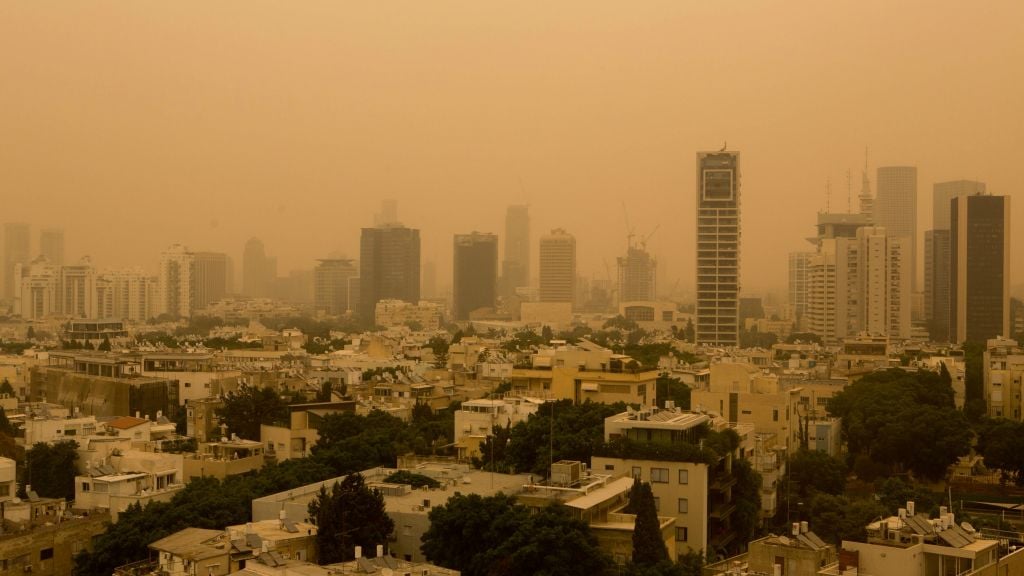
View of the Tel Aviv skyline during a dense sandstorm, September 08, 2015. (Miriam Alster/Flash90)
Hochman said that while Saturday’s storm was intense, it was not unprecedented. He recalled a sandstorm in 2015 that turned the country yellow. The Environmental Protection Ministry dubbed that storm the worst that the state had ever endured.
Hochman said he and his colleagues at the Earth Institute were researching how rising atmospheric carbon dioxide concentrations, mainly driven by burning fossil fuels, affect the length of the seasons, and that they expected winters to become shorter and summers to lengthen.
“Spring is expected to start earlier, with events like the dust storm we just saw becoming more frequent, ” he continued. “The Mediterranean area is drying so that there’s more exposed sand and dust. Furthermore, the land is heating up faster than the sea, and we expect more of these Sharav cyclones as the difference between land and sea temperatures grows.”
He added that these earlier, more frequent storms would have implications for Israeli agriculture, public health, and more.
Is accurate Israel coverage important to you?
If so, we have a request.
Every day during the past two years of war and rising global anti-Zionism and antisemitism, our journalists kept you abreast of the most important developments that merit your attention. Millions of people rely on ToI for fact-based coverage of Israel and the Jewish world.
We care about Israel – and we know you do too. So we have an ask for this new year of 2026: express your values by joining The Times of Israel Community, an exclusive group for readers like you who appreciate and financially support our work.
Already a member? Sign in to stop seeing this
You appreciate our journalism

You clearly find our careful reporting valuable, in a time when facts are often distorted and news coverage often lacks context.
Your support is essential to continue our work. We want to continue delivering the professional journalism you value, even as the demands on our newsroom have grown dramatically since October 7.
So today, please consider joining our reader support group, The Times of Israel Community. For as little as $6 a month you’ll become our partners while enjoying The Times of Israel AD-FREE, as well as accessing exclusive content available only to Times of Israel Community members.
Thank you,
David Horovitz, Founding Editor of The Times of Israel