
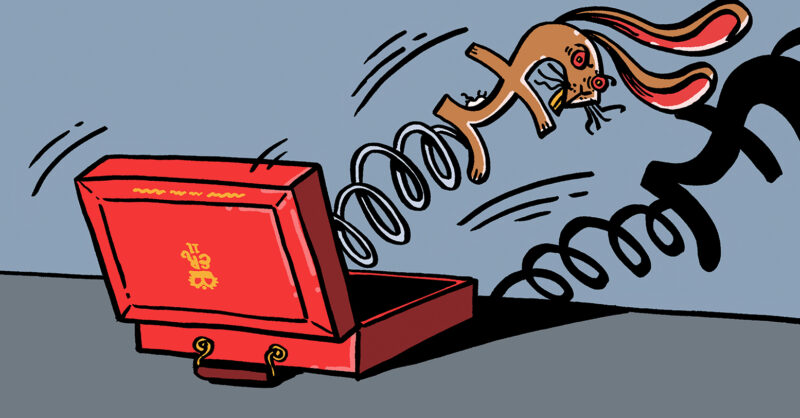
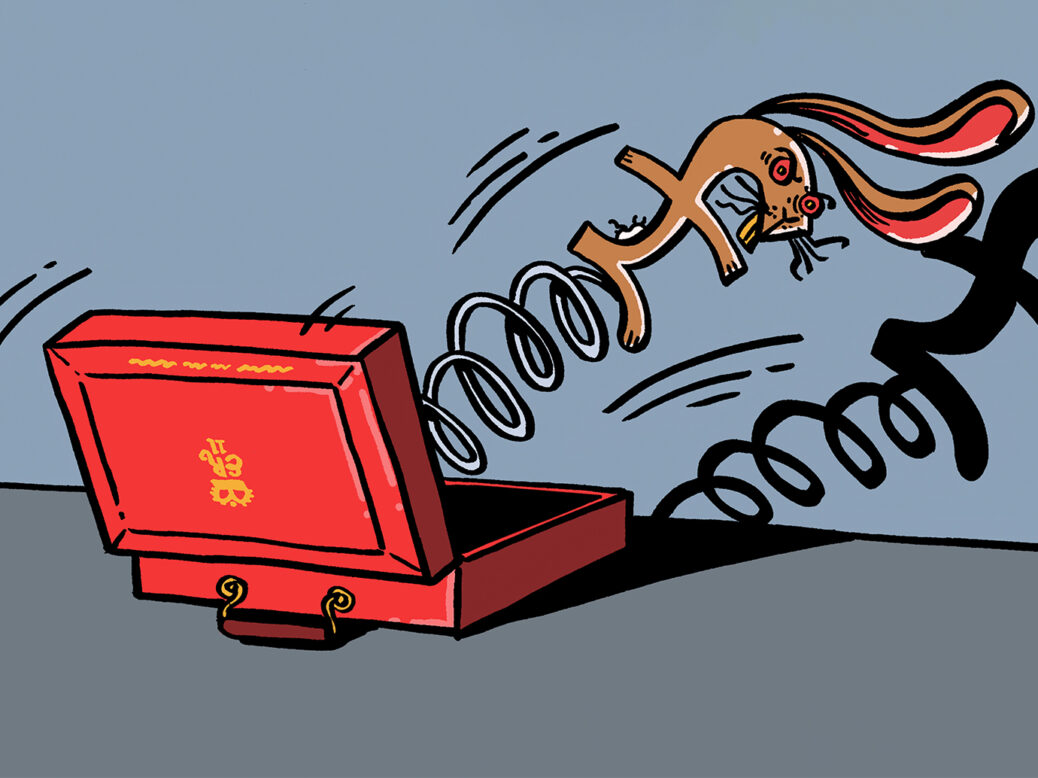
Illustration by Dom McKenzie / Ikon Images
A country in which a consumer rights’ watchdog has become a national treasure clearly has something wrong with it. Martin Lewis’s latest campaign focuses on student debt, with him labelling Rachel Reeves’s adjustments to repayment rules “not a moral” move. But this is just his latest rearguard action to defend a demographic from financial insecurity. His public affection has risen inversely to the immiseration of the general public, which is itself the result of some blunter economic trends (confirmed by the latest growth figures for the final quarter of 2025, a total of 0.1 per cent). Put another way, this a country where incomes fail to keep pace with costs, and the certainty of earning those incomes diminishes. In that equation, the toxic insecurity that smothers British life is revealed.
Student loans are just our latest cause célèbre. Currently, two thirds of graduates are not meeting the loan interest due on their debts, which continue to accumulate. A graduate in work will need to earn about £66,000 a year to begin repaying their debt – enough to start losing their child benefit, which is reduced from £60,000 before disappearing at £80,000. At £100,000, support for nursery places begins to be withdrawn, creating the peculiar situation where a parent earning £95,000 is likely to be better off than one on £140,000. This isn’t anything like poverty but as universal benefits are withdrawn, the ability of younger earners with few savings or other assets to provide for their financial security is perversely reduced.
If it’s hard to feel sympathy for graduates – bearing in mind that they’re now a third of the population – it may or may not be reassuring to learn that the rest of the country is in a worse position. For the poorest, the last 15 years have been particularly hard, as a combination of austerity and then the pandemic hammered living standards. The National Institute for Economic and Social Research has showed that the poorest 10 per cent of households saw their real incomes fall by an average of some £4,600. The Universal Credit uplift in 2020, and then substantial increases in the National Living Wage over the following years cushioned some of this shock, but were not enough to absorb it. Latest official figures show that, after price rises and taxes, average household incomes fell once again over 2025.
But it’s the creep of this economic pain up the class system that is particular to the last two decades. This isn’t the Eighties, when the middle class could be (and were) bribed with tax cuts. The student loan squeeze is part of a larger failure to reward aspiration, and the sharp decline in living standards at the bottom hides a deeper insecurity further up the income scale. New data shows that a household earning up to £60,000 in 2024 had a one-in-three chance of sinking into the poorest 40 per cent, and a one-in-ten chance of ending up in the poorest 20 per cent – and so quite likely falling, claim the researchers, below the poverty line. This instability arises from the increasing insecurity of employment. While unemployment has fallen pretty consistently since 2005, research by the think tank Autonomy shows that employment insecurity has worsened by any measure, whether temporary contracts, unstable incomes or the spread of freelancing.

Subscribe to the New Statesman today for only £1 a week.
Hospitality is the worst affected sector, but, strikingly, more traditionally “middle class” occupations like academia have also seen startling increases in employment insecurity. Whether it’s junior lecturers or more-established academics, the response of universities to financial insecurity has been to push it downwards to their staff – and threatened redundancies at Essex, Sheffield and elsewhere are only the most painful example of the spread of precarity. To train as a doctor might once have been seen as a fast-track to middle class respectability; now, as the repeated strikes by resident doctors since 2016 demonstrate, the real pay and conditions of the recently qualified have eroded.
When the economist Guy Standing coined the term “precariat” back in 2011, he was addressing a minority. He estimated around a quarter of the population in the richer economies: living and working precariously, in short-term contracts, and without easy recourse to savings or other, public forms of social protection. Standing described them as the “new dangerous class”, unmoored from traditional sources of social stability, whether work or community. In this context, the precariat could be susceptible to “neo-fascism” (in Standing’s phrase) – or, alternatively, to transformative visions of social justice.
This volatile, growing “dangerous class” helps explain the great turmoil of the 15 years since he was writing. Societies across the world, in rich countries and poor, have been beset by waves of political and social unrest, from the Arab Spring to Occupy, and Brexit to Trump. The figure of the young, downwardly mobile graduate has become almost a cliché by this point, whether sparking revolts in Cairo or campaigning for Bernie Sanders. But Standing rightly pointed to the insecurity not only of the young and educated, but that of another group: the older, asset-poor worker, who also has limited savings and also faces an unstable job market. A section of this latter demographic has since formed the social base for the modern radical right, from Maga to Reform.
Standing thought the precariat would continue to grow, fuelled by the destructive march of neoliberalism through the world’s labour markets – employers cutting costs and switching stable, long-term employment contracts for the misery of insecure work. The reality over the last decade, despite rhetorical guff from governments claiming to be prioritising workers, is that growing numbers in the richer economies find themselves pushed further into forms of precarity.
There are progressive solutions to this. But they stretch well beyond what the Westminster parties would find acceptable. We are approaching the point where the only fair solution to student debt is a generalised write-off. Universal childcare was one of New York Mayor Zohran Mamdani’s top five pledges in last year’s election – and he has already taken steps to implement it, citywide. And basic income could provide a robust form of fundamental security by making guaranteed payments to all.
This is quite separate to the alleged threat to jobs from AI, whatever the new technology minster might think. What we need is a form of personal income that is shielded from either society-wide shocks, whether financial crises, geopolitical upsets, environmental calamities or simply the day-to-day insecurity of fragmented labour markets. A thoroughgoing tax reform, including a wealth tax, could be used to iron out the peculiarities of the existing system, redressing the balance between the taxation of wealth and that of work – while looking to lift revenues substantially.
These solutions address bigger, more fundamental questions than Britain’s political system can apparently tackle. Neither Tory nor Labour have proved capable in government of properly addressing them, even if occasionally they try to speak to a “squeezed middle” or the “just about managings”. Labour’s original plans for more robust rights at work were watered down for the manifesto, then diluted still further in government. They now barely touch the sides of the broader problem of precarity.
The result is to create a direct line from the insecurity and turmoil of people’s personal lives to political instability, now fuelling surging support for the Greens and Reform. The Gorton and Denton by-election is poised to become the first trial of a new kind of politics in England. Two competing parties promise a radical break with the old, with two radically different visions of a more secure future. Street by Manchester street, door by door, we are witnessing the first great electoral battle for the souls of the precariat.
[Further reading: The great lie about the British welfare state]
Content from our partners