
Frank Gehry died on December 5, 2025, at the age of 96. Some of his buildings, the New York Times’s architecture critic Nicolai Ouroussoff has written, “are evocative of the messiness of human life.” Gehry knew about that messiness firsthand.
His career has been portrayed, in obituaries and reminiscences, as a series of triumphs: the Pritzker Prize (1989), the Guggenheim Bilbao (1997), the Walt Disney Concert Hall (2003), the Louis Vuitton Foundation (2014), and others. Yet there were as many setbacks as successes. Gehry’s real life, in fact, is a study in overcoming disappointments by going back to work and trying harder. Neither a “temperamental artist” nor the mad genius seen on The Simpsons, Gehry was endlessly industrious and, for an architect of his stature, surprisingly willing to compromise to bring worthwhile projects to fruition.
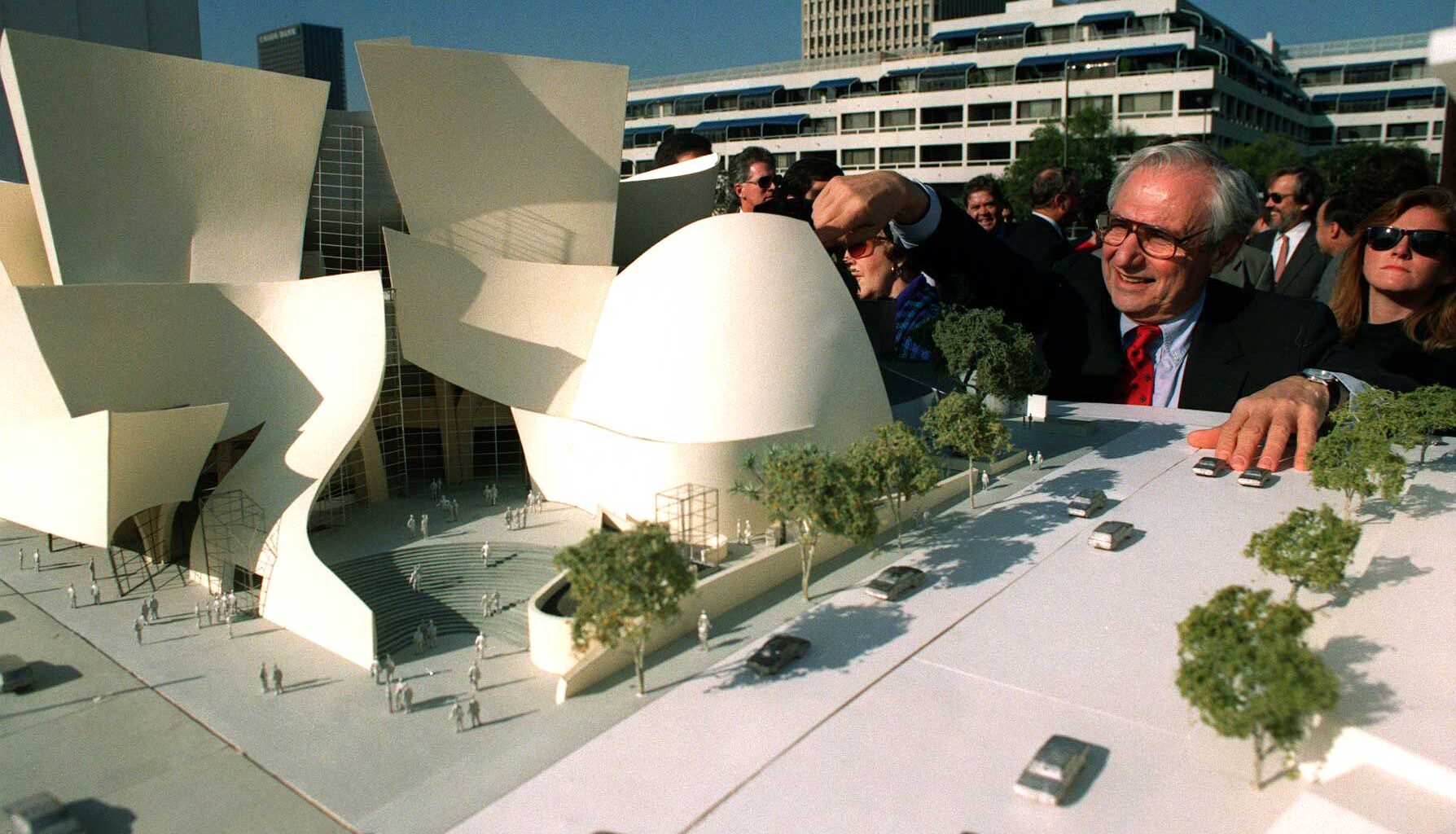
Some of the biggest setbacks occurred in the city he called home and to which he gave so much. In 1988, Gehry was chosen to design the Walt Disney Concert Hall, meant to be a symbol of Los Angeles’s cultural coming of age. But Gehry, nearly 60 at the time, was offered the job on the condition that he let another firm translate his intricate designs into construction drawings. He believed that the arrangment would diminish the quality of the finished building, but nonetheless spent years trying to make it work. But in 1994, with construction of its underground garage already underway, the project was halted for lack of funds, amid talk that it was unbuildable. Gehry’s first impulse, Paul Goldberger wrote in Building Art, his 2015 biography of Gehry, “was to leave town.” He stayed in L.A., but for years he was known there as an architect whose most important building might begin and end with a basement.
Around the same time, he designed a house for the philanthropist Eli Broad. Impatient with Gehry’s tendency to fiddle before finalizing his designs, Broad had another architect complete the house “in the style of Gehry.” Appropriately, Gehry refused to visit the house and considered his design unbuilt.
Then insult piled atop injury: In the late 1990s, in an effort to get the Disney Concert Hall back on track, Los Angeles Mayor Richard Riordan ordered Gehry to work alongside the same Eli Broad who had betrayed him. Gehry consented, but within months Broad was circumventing him again. Gehry walked away from the project in protest, telling Joseph Giovannini of The New York Times, “They don’t want to listen to me because I’m the creative type. They dismiss me because I’m the ‘great genius.’” He added: “I’ve been geniused to death.”
To restart the project, Diane Disney Miller, insisting that the Disney family wanted a real Gehry building, not a knockoff, brokered a compromise, using the Disney name and wealth as leverage. For his part, Gehry changed the main exterior material from stone to steel, which saved millions of dollars but also, according to his longtime partner, Edwin Chan, actually improved the building. One reason Gehry was willing to compromise, Chan says, “was that he had an ability to transform challenges and constraints into opportunities.”
The concert hall opened to thunderous applause when Gehry was nearing 80, 15 years after he started working on it.
In 2001, he was asked by a board member to sketch some ideas for revitalizing Lincoln Center, the performing arts complex on New York’s Upper West Side. One of his sketches showed a glass dome over the center’s famous plaza. Gehry hadn’t even endorsed the idea, but when the sketch was circulated in 2002, so many board members disliked it that, Goldberger wrote, they “ended up not only rejecting the plan but deciding that [they] no longer wanted to work with Frank at all.”
Meanwhile, Thomas Krens, the ambitious director of the Guggenheim Museum, had Gehry design a vast Guggenheim outpost for lower Manhattan. His drawings and a room-size model of the twisted metal structure were shown publicly in 2000. Thrilled with what the building would do for the city, Herbert Muschamp, then the architecture critic for The Times, declared: “Here comes architecture.” But the Guggenheim never found the money to build it.
In 2003, the developer Bruce Ratner hired Gehry to design an arena and a cluster of apartment buildings over the Atlantic Yards in Brooklyn. After six years of work on what would have been the biggest project of his career, Gehry was fired. The developer, who had used Gehry’s name and reputation to gain support for the 22-building project, gave the commissions to less-seasoned architects, leaving the impression that Gehry’s buildings (and perhaps his services) were overpriced.
Then came an even more embarrassing dismissal. At the behest of the Lower Manhattan Development Corporation, Gehry spent ten years designing—and redesigning—a performing arts center at the World Trade Center site, his contribution to the post-9/11 reconstruction. But in 2012, the arts center hired a new director. Two years later, she fired the architect, without even bothering to tell him. Gehry learned of his dismissal from a New York Times reporter seeking comment. Gehry told the reporter, “I don’t want to go where I’m not wanted.” The center then hired an architect 40 years his junior.
But Gehry ended up giving New York three superb, and very different, structures. His rippling aluminum apartment tower near the Brooklyn Bridge; his cloudlike white-glass IAC Building, across the street from Chelsea Piers; and his ingenious, mostly plywood interior of The Pershing Square Signature Center, a theater complex on West 42nd Street, are all spectacular successes.
His bad luck continued in Washington, D.C. In 1999, after two years of design work, the Corcoran Gallery approved plans for Gehry’s swoopy addition to its Neoclassical building. It publicized the project widely, creating the impression that Gehry would soon have an important building in the capital. Six years later, the museum, citing lack of funds, put the plan on hold. (It later ceased operating altogether.) Then, in 2009, Gehry was commissioned to design a memorial to Dwight D. Eisenhower, which he conceived as a series of murals made of metal mesh and raised on pylons in a parklike setting. Gehry knew there would be criticism. But Susan Eisenhower, the president’s granddaughter, compared Gehry’s design to missile silos, ugly roadside billboards, and the Iron Curtain. Most devastating to Gehry, who was Jewish, were suggestions by Eisenhower family allies that it resembled the fences surrounding Nazi concentration camps. Sympathetic members of Congress blocked funding for the project. Gehry’s design was pronounced dead.
But Gehry kept going, redesigning every aspect of the memorial several times and regularly taking red-eye flights to Washington for meetings. Eventually he had a design that satisfied the Eisenhower family without sacrificing his initial concept. The memorial opened in 2020, when he was 91. As I wrote in a review that year: “Gehry’s design should win over even his most hardened critics.”
For more than half a century, Gehry lived with disappointments but carried on. His formally complex work was saved by technology (particularly software that made it easier for a small firm like his to produce construction drawings for buildings of almost baroque complexity), but it was Gehry who understood the system’s potential and embraced it.
Even with his once-in-a-century talent, it was determination, as much as inspiration, that gave the world Frank Gehry.
Fred A. Bernstein is the winner of a 2023 award from the American Academy of Arts and Letters for exploring ideas in architecture and the 2009 Oculus Award from the New York chapter of AIA for excellence in architecture writing.