
Most massive stars end their lives in spectacular supernova explosions that briefly outshine entire galaxies. But astronomers are now seeing evidence that some stars skip the fireworks entirely, collapsing inward so quietly that the only sign of their death is a gradual fading glow.
Researchers studying a massive supergiant in the Andromeda Galaxy, named M31-2014-DS1, found that the star disappeared without any visible explosion, leaving behind only faint infrared traces of dust and heat.

The observation offers one of the clearest records yet of a “failed supernova,” a direct collapse in which a star’s core falls inward and forms a black hole without blasting its outer layers into space.
The finding suggests that astronomers may be undercounting how many black holes form in the universe because these silent deaths are far harder to detect than brilliant stellar explosions.
Archives reveal silent death
One of the clearest examples comes from a well-known supergiant that first brightened in infrared light and then steadily dimmed until it dropped from view.
Tracing more than a decade of telescope images, Dr. Kishalay De at Columbia University linked the star’s sustained fading to the moment its core collapsed and a black hole formed.
Visible light from the star fell by a factor of 10,000 while no supernova ever appeared, marking a death that unfolded in silence rather than in spectacle.
Normally, a dying massive star blasts its gas into space, but this one appeared to fall inward without a flash. Once the core ran out of fuel, gravity crushed it, the outward explosion that usually tears a star apart never occurred, and most of the star’s material fell back onto the collapsing core.
With little light escaping during this direct collapse, astronomers must reconstruct the event from faint afterglows and the subtle traces left behind.
M31-2014-DS1 as a failed supernova
Normally, a dying massive star blasts its gas into space, but this one appeared to fall inward without a flash. Once the core ran out of fuel, gravity crushed it, and the outward explosion that usually rips a star apart never occurred.
Without a strong outward shock, most of the star’s material fell back, and the crushed core became a black hole. Because little light escapes during this kind of direct collapse – black hole birth without an explosion – astronomers must search for faint afterglows instead.
One of the clearest clues came from newly formed dust surrounding the star. Fresh dust trapped starlight and reradiated it as infrared radiation, light just beyond red that we experience as heat.
Decades ago, theorists predicted that a collapsing star could puff off a small amount of material that later cools into dust. Beginning in 2014, astronomers watched the object brighten in infrared light for about three years, then dim sharply while a lingering dust shell remained.
That slow brightening provided a timeline for when the outer layers drifted outward and cooled enough to form dust.
Star M31-2014-DS1 vanishes
The star, located in the Andromeda Galaxy about 15 quintillion miles (roughly 2.5 million light-years) away, was close enough for astronomers to follow its final years in unusual detail.
Powerful stellar winds had already stripped away much of the star’s hydrogen, leaving a massive object with unusually thin outer layers before its core gave out.
Early in life the star weighed about 13 times the mass of our Sun, but by the time of its death it had dwindled to roughly five solar masses. Such dramatic mass loss can shape a star’s final moments, because less outer gas means there is less material for a powerful explosion to lift.
As the star faded, NASA’s NEOWISE spacecraft, an all-sky telescope that monitors infrared, heat-like light, repeatedly scanned the same region of the sky. By 2023, visible-light images showed no bright star remaining at that location, even when the Hubble Space Telescope looked.
Instead, only a faint reddish source appeared in the near-infrared, consistent with leftover gas and dust continuing to cool as it slowly drifted outward.
Quiet collapses went unnoticed
Most sky surveys are designed to catch sudden explosions, so a star that quietly fades can slip past automated alerts.
Even in publicly available NEOWISE archives, this disappearance went unnoticed for years because no bright supernova ever triggered a warning.
“This has probably been the most surprising discovery of my life,” said Dr. Kishalay De. Overlooking these slow stellar deaths can distort estimates of how many massive stars collapse directly into black holes instead of exploding.
Astronomers had seen hints of such events before. In 2009, another massive star flared and then vanished in the galaxy NGC 6946, an object later designated N6946-BH1.
Because that system lay farther away and left only faint signals, its interpretation remained debated. The new disappearance, supported by years of detailed observations and sharper follow-up, strengthens the case that some stars truly end their lives through silent collapse.
With two similar fade-outs now documented, researchers increasingly view this pathway not as an oddity but as a genuine route to black hole formation.
Failed supernovas force rethink
For decades, many models assumed stars around this size always explode, so a collapse without a supernova forces a rethink. Inside a dying star, gravity pulls inward while hot gas pushes out, and the balance can tip one way.
“The dramatic and sustained fading of this star is very unusual, and suggests a supernova failed to occur, leading to the collapse of the star’s core directly into a black hole,” De said.
More collapses like this would mean some black holes form without flinging material into space, changing how galaxies recycle elements.
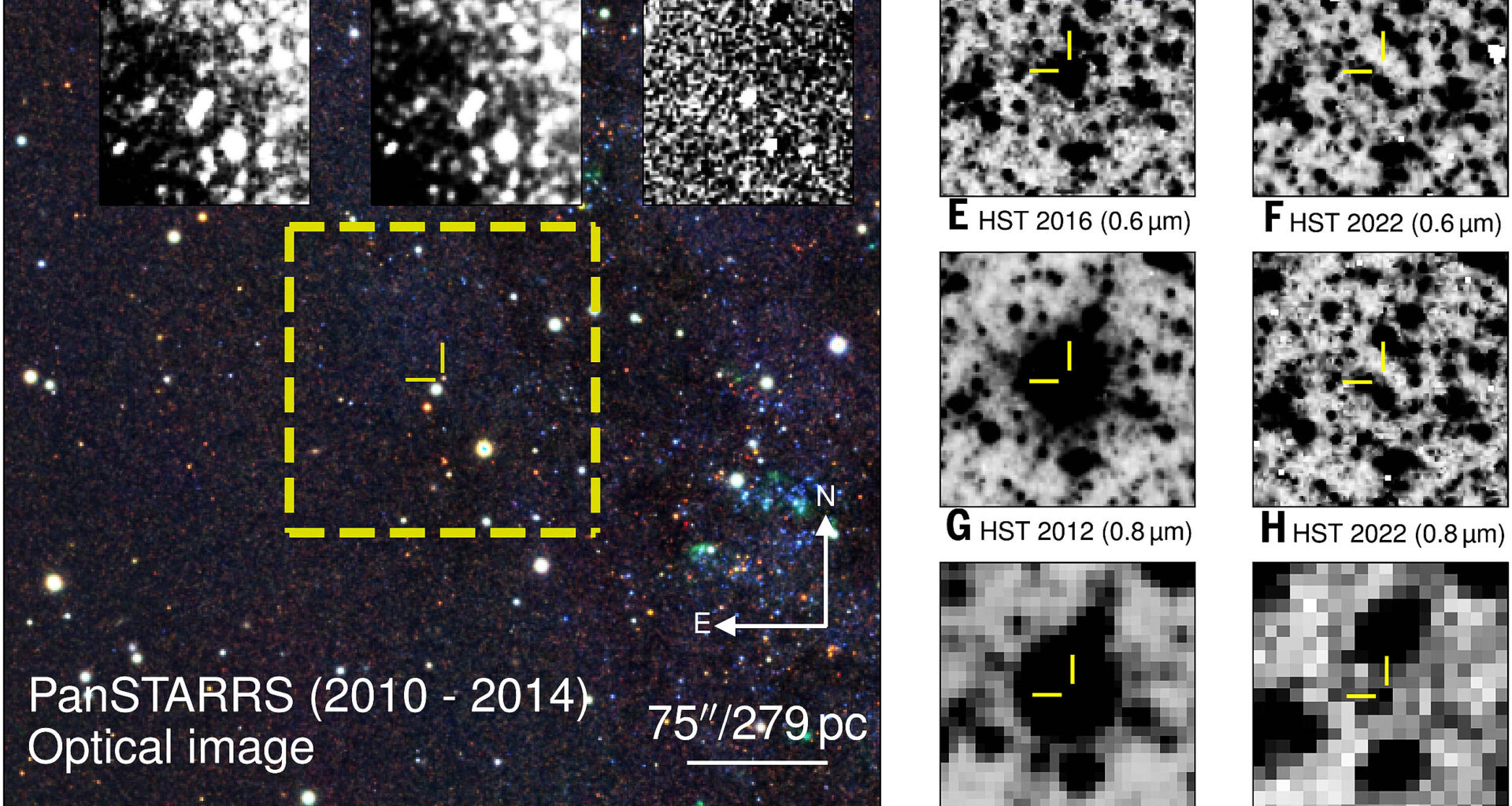
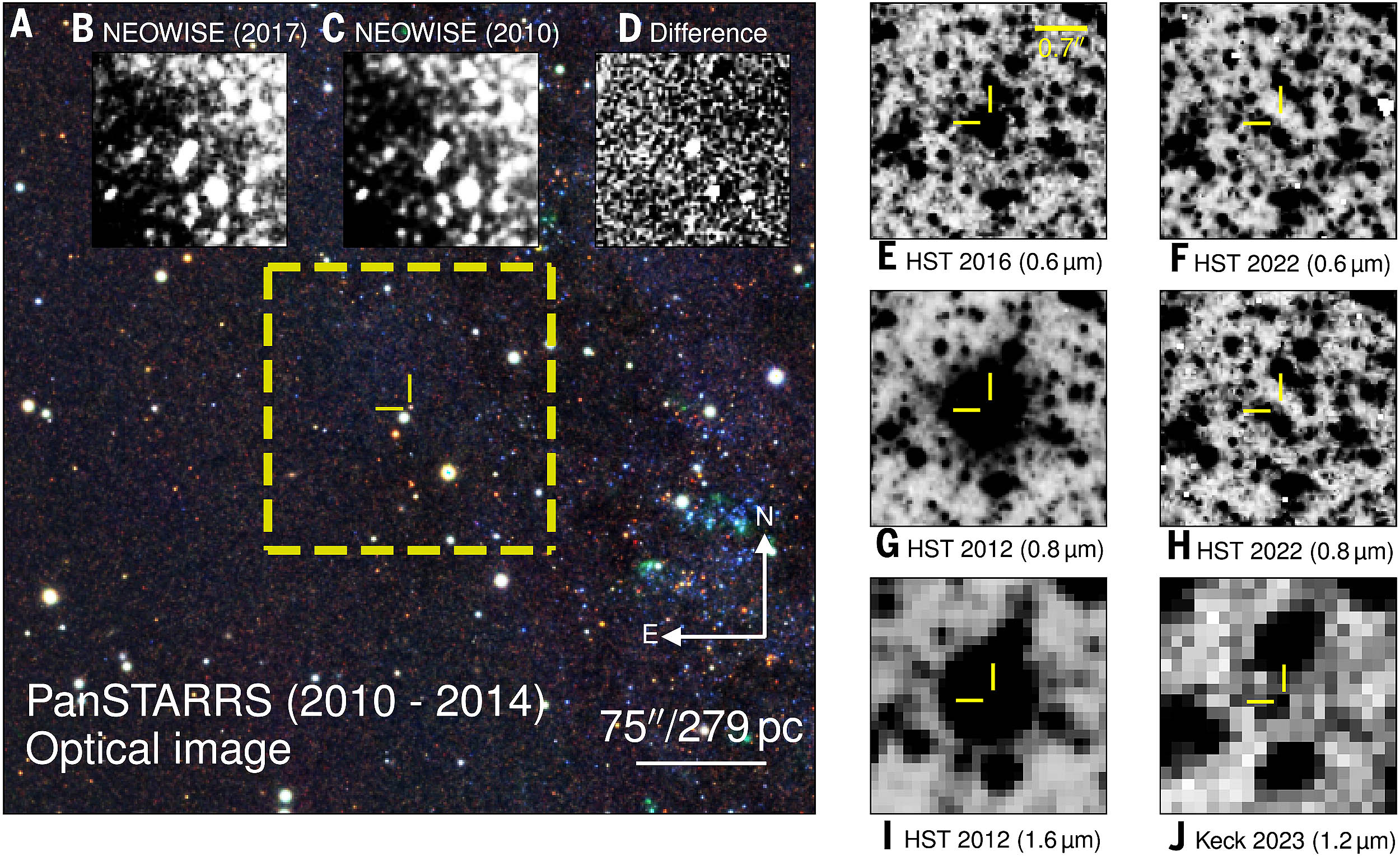 Location and disappearance of massive star M31-2014-DS1 from the Andromeda Galaxy. (A) Optical color composite image of the field, taken from the Panoramic Survey Telescope and Rapid Response System (PanSTARRS). (B) NEOWISE (20) MIR image taken in 2017. (C) NEOWISE image in 2010. (D) The difference between (B) and (C). (E to J) Zoomed-in images of the star (inverted grayscale) taken in the labeled years: (E) to (H), optical HST images; (I), NIR HST image; and (J), NIR Keck image. Credit: Science. Click image to enlarge.Lessons from star M31-2014-DS1
Future searches will rely on long-running sky maps and patient monitoring because direct collapse does not light up the sky.
By trawling NEOWISE archives and matching them to visible-light catalogs, researchers can flag stars that brighten in infrared and then vanish.
Cross-checks with other telescopes can confirm whether a star truly shut down or whether dust simply masked it for a while.
Finding more disappearances would help link black hole masses to their parent stars, not just to gravitational waves – the space-time ripples from black hole mergers.
Reading a slow fade across many telescopes has already turned a missing star into a concrete record of black hole formation.
Continued long-term monitoring in both infrared and visible light will test how common these silent failed supernovas are, even though such events may remain easy to miss.
The study is published in Science.
—–
Like what you read? Subscribe to our newsletter for engaging articles, exclusive content, and the latest updates.
Check us out on EarthSnap, a free app brought to you by Eric Ralls and Earth.com.
—–