
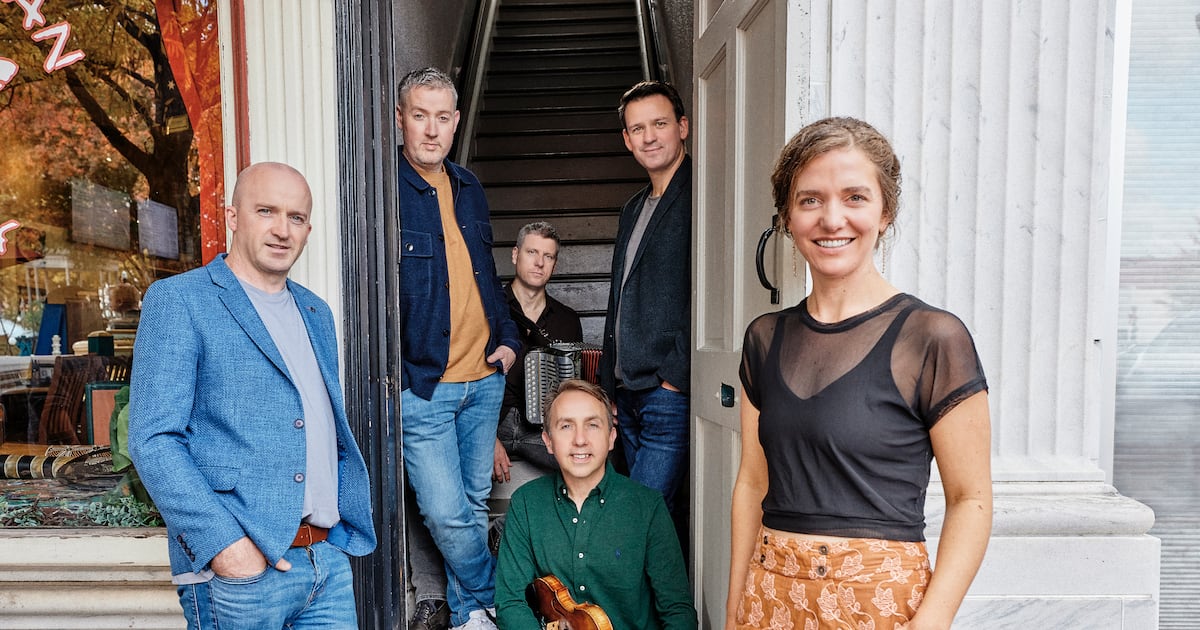
From performing at the Rainforest World Music Festival in Malaysia to gigs in Zimbabwe, Australia and Canada, Téada have never let the grass grow under their feet. The traditional group from Sligo, who are celebrating their quarter-century with a performance with the RTÉ Concert Orchestra this month, are anchored in the fiddle playing of Oisín Mac Diarmada and the bodhrán of Tristan Rosenstock. The musicians are both meticulous in their approach to their music and still in its thrall. They have been mulling over their Kerouacian education and 25 of the things they’ve learned on the road over the past 2½ decades.
Traditional Irish music always goes down well at world-music festivals
“Having performed from Borneo to Taiwan, you get to see where Irish music sits in the context of a global musical family,” Rosenstock says. “As soon as Irish traditional music is heard, people’s faces light up. We have such a range of emotion in Irish traditional music that resonates with different audiences, and it’s amazing to see that reaction.”
The live experience is what matters most
“There’s nothing like making a connection at a live concert,” Mac Diarmada says. “Music is a great way of breaking down barriers and bringing people together.”
The reach of Irish music extends well beyond the diaspora
“People with no connection to Ireland come to hear Irish music, love it and learn it,” Mac Diarmada says.
You don’t have to be Irish to play Irish music to a very high standard
“We’ve heard people playing the music to an extraordinary level in places like Japan, in North America and all over Europe.”
Many places still know nothing about Ireland
“We always try to introduce ourselves in whatever language is spoken locally, and forge some sort of a connection,” Rosenstock says.
But the things other countries know can take you by complete surprise
“Sometimes a connection is the last thing we might expect,” Rosenstock continues. But in Japan, he says, “They’d all read Gulliver’s Travels, which meant they had Jonathan Swift as a reference point.”
In Taiwan, audiences make a trad band feel like rockstars
The demand for after-show selfies is like nothing that Irish traditional musicians would experience at home.
It only takes one committed person to light the spark and help build a community of music listeners in an area
Téada says they’re indebted to the many people who have helped touring musicians like them reach audiences around the world, giving both their time and their hospitality. “Looking back, you think of the people who give a little bit of encouragement,” Mac Diarmada says. “There was a great lady called Mary McPartlan, who invited me to put together a band for a TG4 series called Flosc in 2001. Looking back 25 years now, we’re very thankful for that, because it can be the luck of the draw whether little opportunities like that come your way over the years.”
Culture Ireland deserves huge credit for helping artists promote Irish culture around the world
“When we started off, other countries supported artists better,” Mac Diarmada says. “Culture Ireland made it much easier for Irish art forms to reach audiences across the world.”
Arts centres and other Irish venues have come on hugely
“When we started touring you’d see a huge deficit in Ireland compared to venues in other countries,” Mac Diarmada says. “That has completely changed in the last 20 years.”
Bringing a book on tour is often pointless
“Whatever it is about a tour, it just sucks you in,” Mac Diarmada says. “In a way we’re living in a parallel universe. You might be reading the news about Ireland, but you’re in your own little bubble.”
Bringing work on tour is even more pointless
“We’ve all brought work with us on tour, and typically it never gets done,” Mac Diarmada says. “But there’s huge value in living in the now, because we’ve been to beautiful places. We’ve met the most amazing people, and life often doesn’t bring you back, so you have to enjoy that moment while you’re there.”
Téada began at a great time for Irish music
Téada began life in the decade that followed Riverdance, “which really elevated traditional music all over the world”, Rosenstock says. “TG4 also brought an incredible confidence. There was a golden period when traditional music was in demand all over the world, and we were so fortunate that we could ride that wave and walk through those doors that were opened by so many other Irish bands,” The Chieftains, Altan, Dervish, Lúnasa and Danú among them.
It’s not a battle of the bands
“Each band warms up the room for the next touring band. If an audience has a great night with an Irish act, they’re more likely to go to see the next Irish act that’s touring nearby. We’re all just holding the door open for the next band,” Mac Diarmada says. “We look back on Irish music’s golden moment in the 1920s and 1930s, and we’re very lucky that the musicians back then made the best of it, and we’re still feeding off that. Hopefully this new wave of musicians will sustain the music for another few decades.”
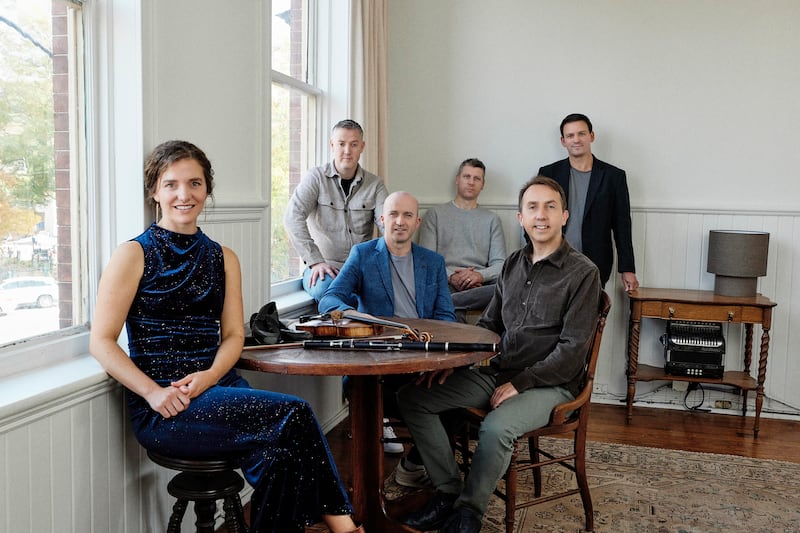 Téada. Photograph: Brian Hall
Giving workshops is a great opportunity to reflect on your own playing
“With classical music there’s a right way and a wrong way of doing things,” Rosenstock says. “With traditional music, people tend to develop their own quirks. I’m self-taught, so if a student asks me about how or why I’m playing in a certain way, I have to really think about that, because there’s no right or wrong way to play this music.
The older you get, the more weight punctuality carries
“Touring is a job,” Rosenstock says. “You want to pull together, and that becomes more important the older you get.”
Americans will travel for hours to see a band they love
“We’ve played in cities in the middle of America and a person might have travelled three hours to the concert,” Mac Diarmada says. “When people have a passion for an artist, they’ll do it.”
Gaeilge is a global language, and not only among the diaspora
“We were in Japan,” Rosenstock says, “and we were invited to the Irish Embassy, where there was a table quiz as Gaeilge. The questions were about Ireland, and a room full of Japanese people were all over it. It was astonishing.”
The album will make a comeback
“Vinyl was dead – and now it’s made a comeback,” Rosenstock says. “I think that people will get bored of the endless streaming choices and want to get back to listening to an album from start to finish.”
Traditional musicians have a unique connection with their audience
Many people who’ve been to see Téada over the years have become close friends, according to the band. “It’s always lovely when you revisit a place and meet the same people again,” Rosenstock says. “These are people who might come to see us 15 times, and it’s great to be able to show them around our home place too.”
Friendship is crucial for a band’s longevity
“If you’re doing something that will last for 25 years, then it has to be grounded in something really important,” Rosenstock says. “Friendship is the key to our longevity, without a doubt.”
You don’t always need a set list – Séamus Begley always ignored them anyway
“When Séamus was on stage, the audience would be in the palm of his hand. He would have them in tears of laughter,” Rosenstock says of his late bandmate. “There was never any point in having a set list if he was there. It made the concerts all the better.”
And three final, self-explanatory lessons from the road:
Shirts that don’t need to be ironed are a musician’s best friendSingle beds are just not comfortableBaz Luhrmann was right: wear sunscreen!
RTÉ Concert Orchestra Presents: Téada at 25 is at the National Concert Hall, Dublin, on Thursday, February 26th