
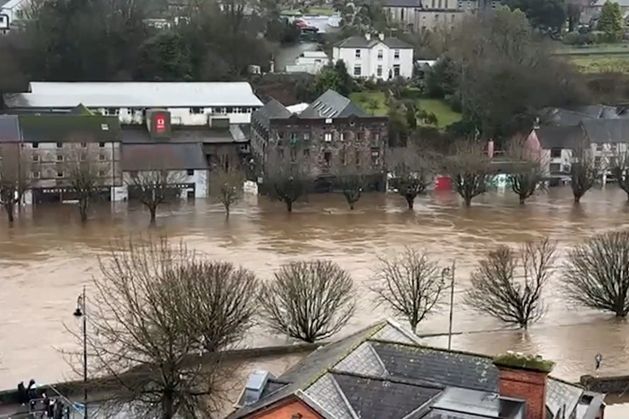
Met Éireann has issued three separate yellow warnings for rain, wind and snow across 18 counties in the southeast.
Following a meeting this afternoon, the NDFEM said spells of heavy rain and strong winds are forecast tonight and tomorrow, and there is the possibility of some snow in the northwest and over high ground in Wicklow.
“Following recent rainfall, many rivers remain close to or above bank-full levels. As heavy rainfall is expected tonight and throughout Wednesday – with the highest totals forecast for the south, east, northeast, and midlands – this additional rainfall may trigger further flooding, given current ground and river conditions,” it said.
‘Flooding is a risk across the country due to the current conditions. Whether or not a yellow rain warning is in place for a county, all areas will remain at risk of flooding.”
A Status Yellow wind warning was issued for Dublin, Wexford, Wicklow, Meath and Louth.
This warning will come into force at 11pm on Tuesday and will remain in force until 1pm on Wednesday.
Met Éireann has advised of possible wave overtopping, fallen trees and loose debris, as well as difficult travelling conditions in these counties.
A separate Status Yellow rainfall warning has been issued for Cork, Waterford, Cavan, Monaghan, Tipperary, Waterford and Leinster – Dublin, Carlow, Kildare, Kilkenny, Laois, Longford, Louth, Meath, Offaly, Westmeath, Wexford and Wicklow.
This warning will also be in place from 11pm on Tuesday until 11pm on Wednesday.
The national forecaster has warned of flooding, poor visibility and difficult travelling conditions in those areas.
A Status Yellow rain and snow warning was issued for Donegal from 2am on Wednesday until 2pm. The national forecaster has warned of heavy rain turning to sleet or snow.
The good news is that the rainfall will herald milder weather with overnight temperatures climbing above freezing after the Arctic weather of last weekend.
After historic levels of rainfall in January, February is also poised to threaten new precipitation records with indications Ireland is nationally up to 20pc above normal rainfall averages.
The first week of February saw some parts of Ireland receive over 200pc their normal level of rainfall.
Areas of Wexford and Wicklow received over 220mm of rainfall in just a fortnight between late January and early February – downpours which, combined with the fall-out from Storm Chandra, resulted in the worst flooding witnessed for years across Enniscorthy, Inistioge, Graiguenamanagh, Thomastown and parts of Dublin including Rathfarnham.
Forecaster Aoife Kealy said weather will remain unsettled for the next week.
“It will be cold on Tuesday with frost and ice lingering at first,” she said.
“It will prove a dry day for most with sunshine to start but clouds will thicken from the southwest through the day with rain and drizzle gradually spreading across Munster, possibly falling as sleet on high ground with highest temperatures of just 2C to 6C.”
We need your consent to load this Social Media content. We use a number of different Social Media outlets to manage extra content that can set cookies on your device and collect data about your activity.
Please review your details and accept them to load the content
“Tuesday night will become wet and rather windy with rain spreading north eastwards, possibly turning to sleet for a time with snow possible on higher ground. Lowest temperatures will be of 0C to 5C.”
“Wednesday will see a wet start with rain, possibly falling as sleet in parts of the north and northeast at first. Rain will linger in the east and north for much of the day but elsewhere will turn brighter with scattered showers.”
Meanwhile, Thursday will start off cloudy as the rain moves across the country towards the northeast, followed by drier and brighter conditions from the southwest.
Temperatures will range between 5 and 10C on Thursday, remaining the coolest in the north, and mildest in the southwest.
Met Éireann added that the weather will continue unsettled and mixed for the weekend and into next week.