
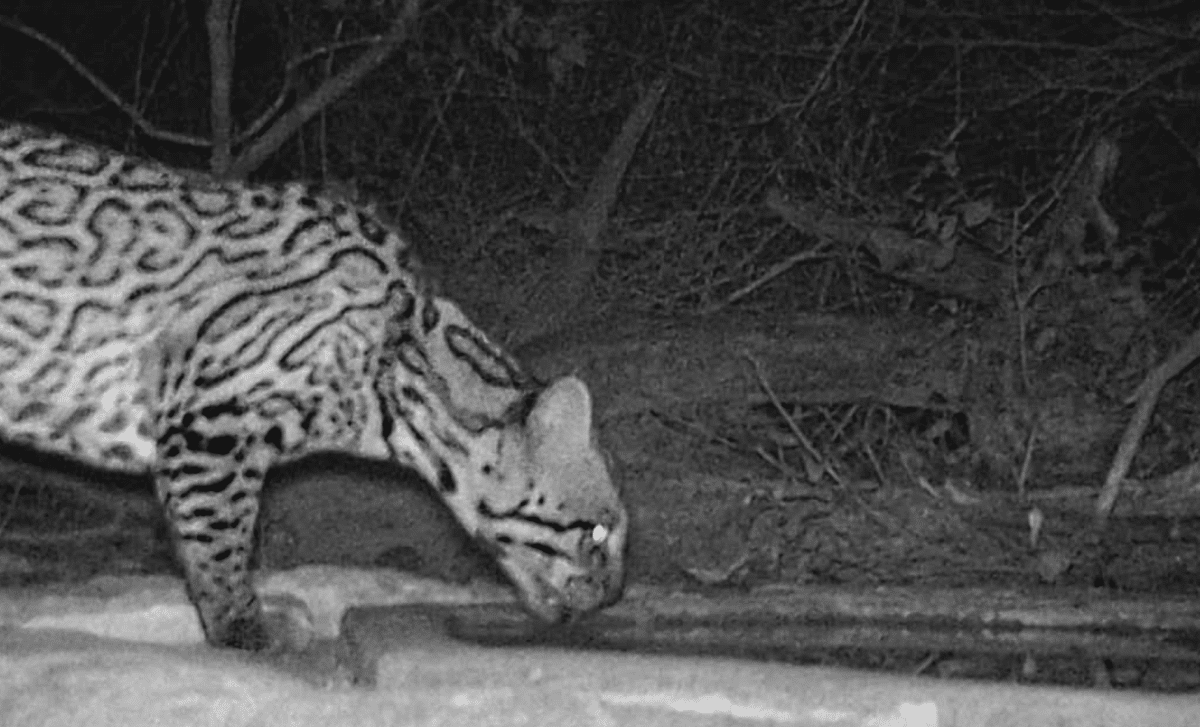
On January 19, a significant and rare moment occurred at the Laguna Atascosa National Wildlife Refuge in South Texas. A male ocelot was caught drinking water near a bird feeding station, a sight that was shared widely on social media by Amanda De Leon. The image, captured by a park host, not only showcased the rare beauty of the ocelot but also highlighted the ongoing conservation efforts aimed at preserving this endangered species. With fewer than 100 ocelots known to exist in Texas, each sighting like this brings a renewed sense of excitement and hope for their survival.
The Elusive Ocelot: A Glimpse of a Rare Wildcat
The ocelot, an elusive and secretive wildcat, has been a subject of fascination for conservationists and wildlife enthusiasts. These nocturnal creatures are known for their distinctive coat patterns, which serve as a form of camouflage in their natural habitats. As Amanda De Leon shared on social media, the recent footage of a male ocelot sipping water from a cement water basin serves as a beautiful reminder of the incredible wildlife that resides in South Texas. The image, captured at the Laguna Atascosa National Wildlife Refuge, speaks to the importance of continued conservation efforts to protect these elusive creatures.
For many people, seeing an ocelot in the wild is a rare event. The species’ secretive nature and preference for dense, wooded areas make them difficult to spot. Wildlife researchers at the refuge have been working tirelessly to monitor and track ocelot populations, relying on trail cameras to gather valuable data on their behavior and movements.
“Seeing one of these rare, secretive ocelots on camera is truly special and such a beautiful reminder of the INCREDIBLE and WILD WONDERS right here in our backyard,” said Amanda De Leon in her post.
The Ocelot’s Endangered Status and Conservation Efforts
The ocelot is classified as an endangered species under the Endangered Species Act, and its numbers in Texas are alarmingly low. Less than 100 individuals are believed to be living in the state, with the population concentrated in two isolated regions. These two groups, known as the Ranch Population and the Refuge Population, are critical to the species’ survival in Texas. The larger population is located in Willacy, Kenedy, and Kleberg counties, while the smaller population resides in and around Laguna Atascosa National Wildlife Refuge.
Despite the ongoing efforts to protect these wildcats, there are still many unknowns when it comes to the exact size and distribution of the ocelot population. Aislinn Maestas, the assistant regional director of the U.S. Fish and Wildlife Service, told Houston Chronicle, “Several ocelots are likely to exist in this population. However, the exact size and distribution of this population remain unknown due to lack of large-scale systematic surveys for ocelots on private property.” This gap in data makes it difficult for researchers to fully understand the extent of the ocelot’s range and to develop more targeted conservation strategies.
The Importance of Ocelot Sightings for Conservation
Every sighting of an ocelot in Texas is a moment of celebration for conservationists. Due to their elusive behavior, sightings are infrequent, and every encounter offers valuable information about the health of the population. As Maestas explained,
“Every ocelot sighting in Texas is rare. With less than 100 known individuals, and with ocelots being elusive, nocturnal animals, we share in the excitement when one is captured on a trail camera.”
These rare sightings help researchers monitor the condition of the species and assess their chances for survival in the wild.
In April, a record number of ocelots were documented at the Laguna Atascosa refuge. Researchers managed to capture footage of 22 ocelots, some of which were tagged with collars to track their movements. This surge in sightings has been attributed to better monitoring techniques, including the use of trail cameras at strategic locations. Elizabeth Grunwald, a research associate with the Caesar Kleberg Wildlife Research Institute, explained,
“For a lot of years, the numbers thrown about were about 15 to 18, but usually 14 or 16. And like I said, in less than two years, we have identified at least 22 on camera.”
The Path to Ocelot Recovery in Texas
Despite the challenges, conservationists remain hopeful that ocelots can recover and thrive in the wild. However, for this to happen, the population must reach a sustainable size.
“For ocelots to achieve recovery, there needs to be at least 200 ocelots in the wild in Texas for a minimum of 10 years,” Maestas said.
This means that each healthy individual documented in the wild is crucial for the species’ long-term survival.
The recent sighting of the male ocelot at the Laguna Atascosa National Wildlife Refuge is significant not only because it adds to the growing body of knowledge about the species but also because it demonstrates that ocelots are still surviving and thriving in their natural habitats. The sighting documents the health of an individual in the wild, providing vital information that will help shape future conservation strategies.