
Giraffes are best known for their very long necks, but we shouldn’t overlook the elongated limbs of the tallest animal in the world.
They’re famed for the adaptation that allows them to reach succulent leaves in the acacia canopy that shorter animals can’t access.
But this extreme feature comes at a cost: namely the energy required for the heart to pump blood up to the head against gravity. As a result, giraffes have high blood pressure, more than twice that of most mammals at an average of 200-250mmHg.
Researchers at the University of Adelaide, Australia, and the University of Pretoria, South Africa, have found that by raising the heart closer to the head, the giraffe’s long legs help alleviate some of this burden.
Studying the fossil record of the giraffe family shows the evolution of long legs actually preceded their long necks.
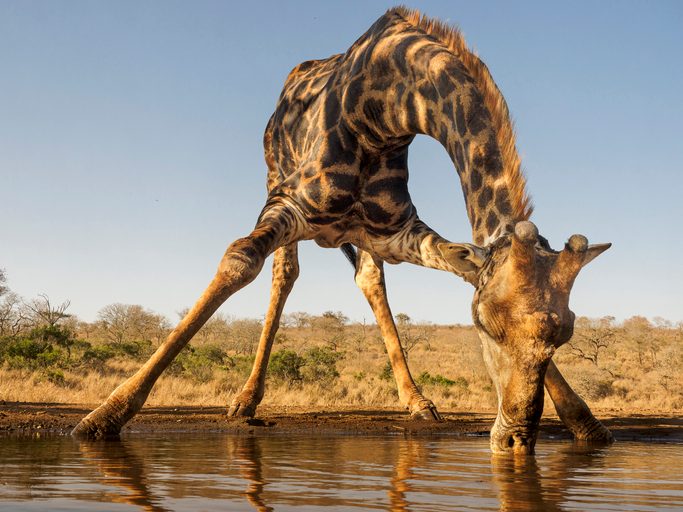
Yet long limbs can be a disadvantage too, especially when it comes to escaping predators: the cumbersome splayed stance of a giraffe at a waterhole leaves them vulnerable.
Leg length and neck length have co-evolved, allowing giraffes to exploit the longest distance between a heart and an erect head recorded in any terrestrial vertebrate.