
Check if your bit of Cork is at risk
12:36, 18 Feb 2026Updated 15:29, 18 Feb 2026
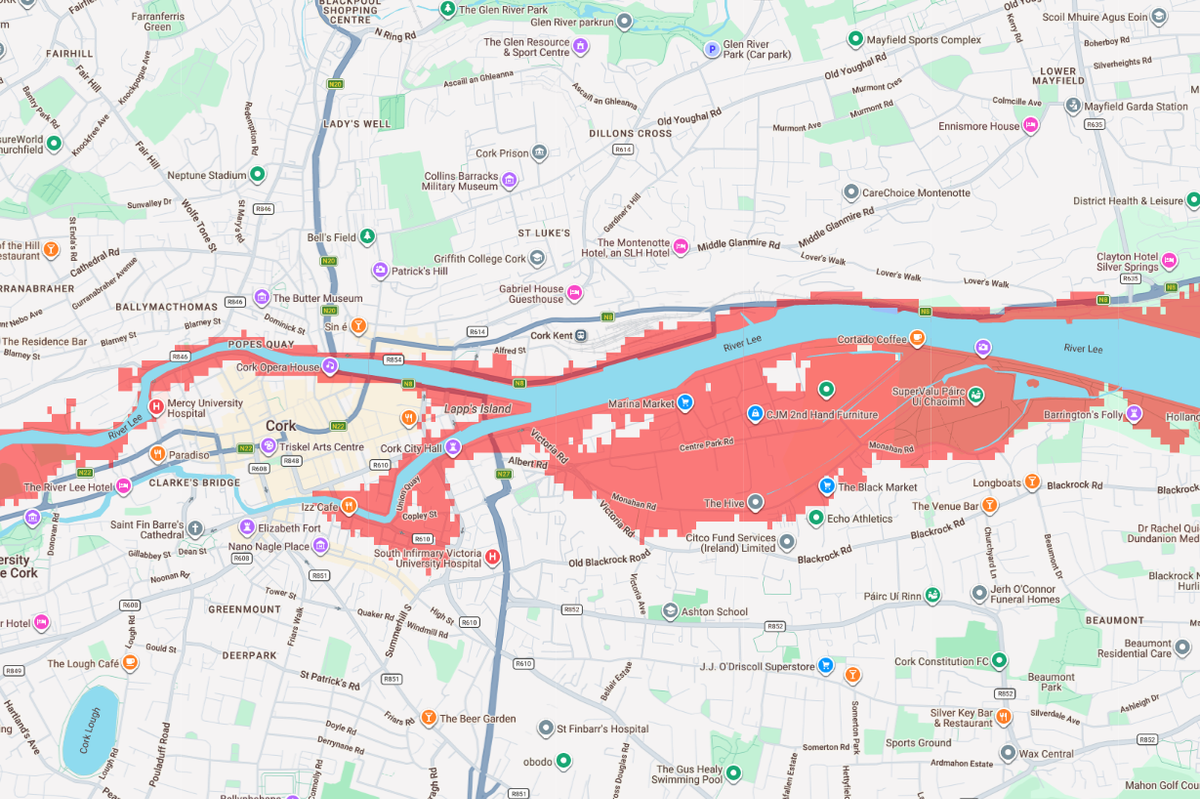
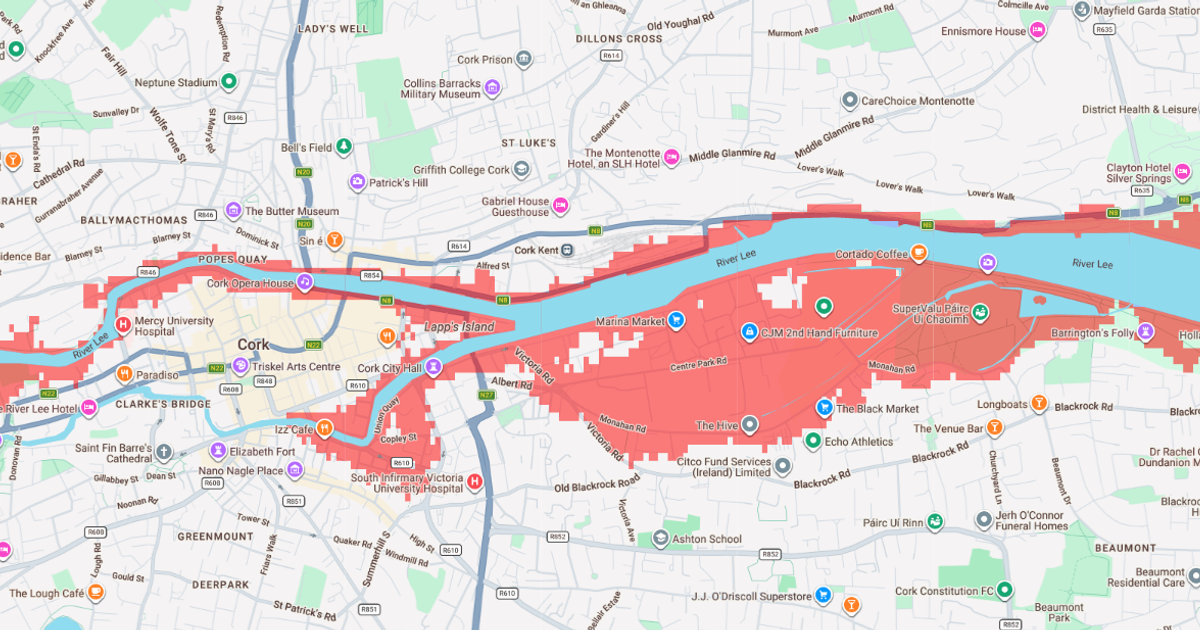
A flood risk map for Cork city for 2090(Image: Climate Central)
It’s been an extremely wet start to 2026, with Cork subject to washouts and now a 24-hour flood warning.
Parts of Cork have had 1.5 times the average rainfall in the last fortnight, with more outbreaks of rain to come in the days ahead. Conditions in recent years have demonstrated how vulnerable certain parts of the county are to flooding – which will only get worse if sea levels rise as predicted over the coming decades.
Updated climate models show the effect that melting ice sheets will have on Cork city in the near future – with the hilly northside set to escape much of the rising flood line, while the low-lying southside is at risk of a massive disruption. If the predictions are accurate, rising sea levels could sabotage major development plans for the city, which will see apartments, shops, and entire mini-cities built up along the Docklands over the next few years.
A rising flood line will also prove a major issue for low-lying transport links like the Jack Lynch Tunnel, which runs beneath the River Lee.
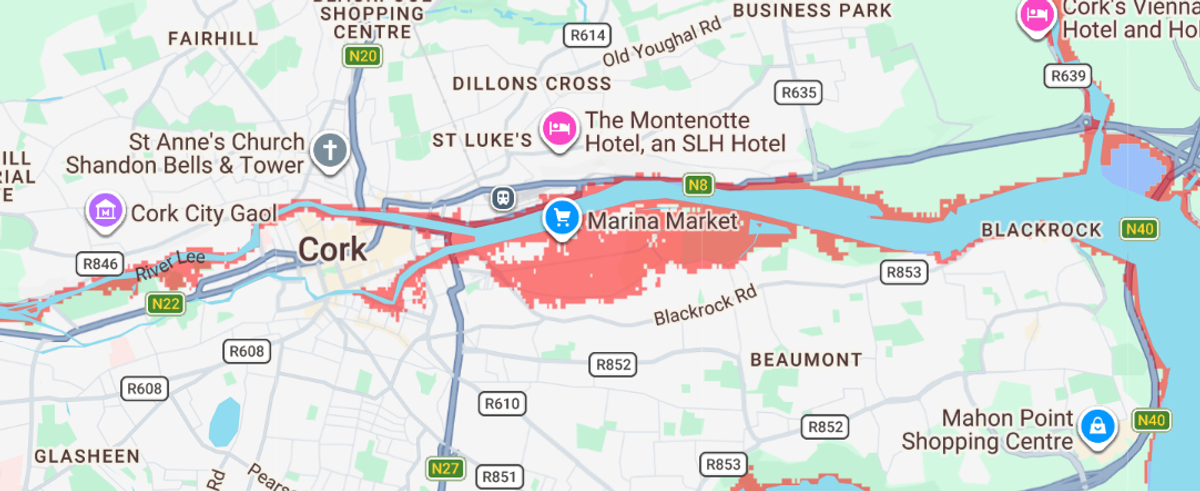
2030: The red areas indicate which parts of the city will lie below the annual floodline(Image: Climate Central)
The Coastal Risk Screening Tool from Climate Central draws on data from the Intergovernmental Panel on Climate Change (IPCC) – and allows you to explore maps of sea levels and flood lines in the coming years. As early as 2030, it’s expected that the Marina area of Cork will lie below the annual flood line, exposing the recently revamped part of the city to yearly washouts.
You can explore the map yourself here:
Cork is a famously low-lying city, with many of its major roads having been riverways up until the 18th century. But areas outside the city are also vulnerable to a rising flood level, with fields and villages around Carrigtwohill facing into a drastically expanding flood zone by the 2060s.
Last month, locals in Midleton – which was devastated by flooding during Storm Babet in October 2023 – decided that they could no longer wait on the authorities to complete long promised flood defence systems, and launched their own warning system. The system uses 17 monitors in the Owenacurra River to measure river levels, and warns users with automatic messages if the river is significantly above normal.
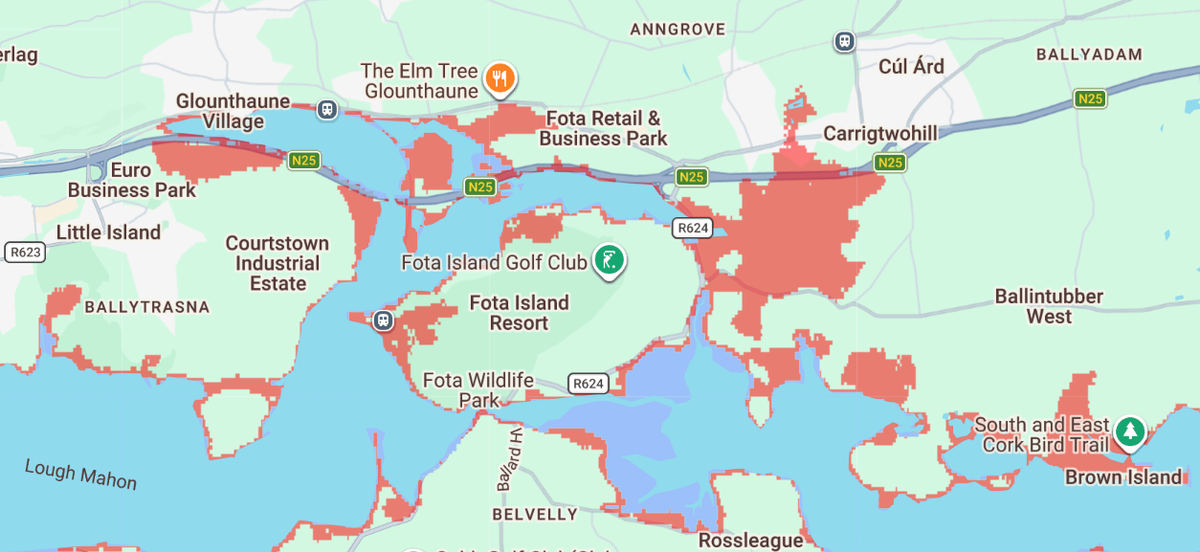
Areas below the annual flood line by 2060(Image: Climate Central)
According to the European Environmental Agency, the global mean sea level (GMSL) has risen about 21cm since 1900 as a result of human activities and carbon emissions – and the rate is increasing. The Agency says that a continued ‘high emissions scenario’ will see a whopping rise of five metres in European sea levels by 2150, while even a preferred ‘very low emissions scenario’ could see a half-metre rise by 2100.
In recent months, climate scientists have warned that we are on a rapid approach to an irreversible “hothouse” Earth – but melting ice caps could have unexpected effects closer to home. Even as average temperatures climb everywhere else, there are fears that northern Europe could be facing into a bizarre new Ice Age within the next century.
It’s down to the fact that a crucial Atlantic current system – Atlantic Meridional Overturning Circulation (AMOC) – could collapse as a result of thawing Arctic ice, which is introducing huge amounts of meltwater into the ocean and disrupting the natural flow. The existing Atlantic currents give us our relatively mild weather compared to snowy countries on similar latitudes like Russia and Canada.
Scientists have warned that the collapse of the AMOC currents could plunge northern Europe into deep freeze conditions – even as temperatures continue to rise to tropical levels elsewhere on Earth. A weakened AMOC system would also accelerate the decline of the Amazon rainforest, releasing even more carbon into the atmosphere, making the rest of the world even hotter while Europe alone gets much colder.
It could see the UK and Ireland enduring winters with temperatures as low as -20C. However, Met Eireann said: “Experts note that if a shutdown were to occur, it would likely take several decades or even centuries due to the ocean’s slow response.”
Nevertheless, the forecaster added: “While the associated heavy impacts may only arise in about a century from now due to the gradual transition to a state without AMOC, [a recent study] underscores the urgency of swift global greenhouse gas emissions reductions to minimize the risk of crossing this tipping point.”
A European deep-freeze would mean that Cork would still be at risk of major flood level rises – but that it could also see extreme winter freezes as well.
Want to see more of the biggest and breaking stories from Cork Beo? Making us your preferred source on Google means you’ll get more of our exclusives, top stories and must-read content straight away. To add Cork Beo as a preferred source, simply click here.