

It’s difficult to move at the pace of the slowest member of the group when they’re running in the opposite direction to everybody else.
Viktor Orban has made frustrating the rest of the European Union a selling point of his populist, far-right administration.
The Hungarian prime minister has blocked billions of euro in military aid from getting to Kyiv, scuppered joint efforts to penalise (or at times even criticise) Israel during its invasion of Gaza, and regularly threatened to unravel the net of economic sanctions the union has imposed on Russia since it invaded Ukraine.
It is taken as read that Orban will not sign his name to joint EU statements expressing support for Ukraine any more.
In power since 2010, Orban has led the central European state down an increasingly authoritarian path.
Péter Magyar, a former insider turned challenger who formed a new opposition party, Tisza, has a decent chance of dislodging the Hungarian prime minister in elections this April.
Senior EU officials and diplomats from other member states have pinned considerable hope on a change of administration in Budapest.
What happens, though, in a scenario where Orban’s illiberal Fidesz party sees off the challenge and secures another four years in office?
The Hungarian leader is a transactional politician. One option is to attach extra strings to future tranches of EU funding
There is also a nuclear option, known as Article 7, to strip Hungary of its EU voting rights. Such a drastic step needs four-fifths of the union’s governments to back it, though.
Orban is not totally isolated either. He can count on the support of Slovakia’s populist prime minister Robert Fico and Czech Republic premier Andrej Babis; maybe Italy’s hard-right prime minister Giorgia Meloni and others as well.
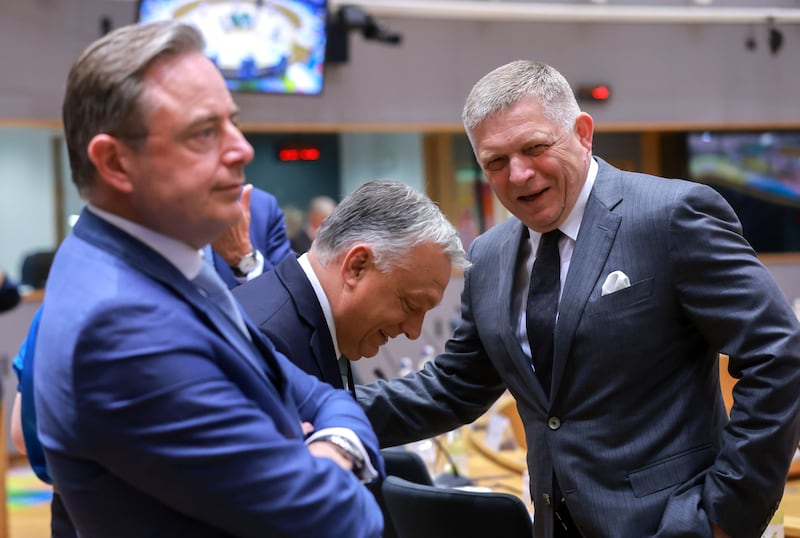 Belgian prime minister Bart De Wever (left) as Viktor Orban and Slovakia’s prime minister Robert Fico share a joke at the start of an EU leaders’ summit. Photograph: EPA
The headache Budapest is causing in Brussels has led to a recent rethink of how the EU arrives at decisions.
The preference has always been to agree by consensus, even where only a majority vote is needed. The result is often a compromise that nobody loves, but most can live with.
Capitals can veto EU decisions in certain sensitive areas, such as foreign policy and tax. The safeguards are meant to stop one member state being steamrollered on issues of national importance.
Orban’s frequent use, or misuse, of his veto has focused minds on what EU officials like to call “creative solutions”.
European leaders turned to emergency powers, known as “enhanced co-operation”, to get around Orban, Fico and Babis at a key summit in December, to approve a €90 billion loan for Ukraine. Hungary, Slovakia and the Czech Republic will not have to chip in towards future repayments or provide guarantees.
Now, there is talk of using the same clause, which is provided for in the Lisbon Treaty, to allow a smaller coalition of EU states drive ahead on tricky internal financial reforms.
Relying on enhanced co-operation to integrate national markets for capital, insolvency rules and regulatory oversight of financial systems would be a significant departure. At least a third of EU states would be needed to come on board. Others could join the effort later.
There is a frustration in some capitals at the slow pace of movement as a 27-state bloc, in what is a more hostile and uncertain world.
Orban has not been the only one holding the show up here. Most governments have been reluctant to align different national rules and systems towards a European standard.
Enhanced co-operation has been tried before. There was a stab at using the clause to establish a tax on financial transactions in 2013, which petered out. It was used successfully to create a European patent system and sync up some laws around divorce.
Most, but not all, EU states also opt in to the Schengen travel area, removing border checks between member states.
A new “E6” group of the six biggest economies – Germany, France, Italy, Spain, Poland and the Netherlands – has been formed to get momentum going on internal capital market reforms.
Tánaiste and Minister for Finance Simon Harris expressed reservations about big countries dominating the discussion on the set-up of an effective EU fast lane.
“I would much rather see a structure where countries come together on issues where they share a common view, rather than the entry to the club being based on your size exclusively,” he said this week.
Ireland has a natural ally in Luxembourg, another small country hosting a big financial services sector. They are both wary of letting the big European powers rewrite the union’s capital market rules.
The pair are opposed to proposals to move more powers from central banks to a single EU-level regulator, though they won’t want to be left behind in the slow lane either.