
 A comprehensive review of biomass torrefaction as a versatile platform for the synthesis of functional carbon materials
image: ©
Wei Han, Yifan Wang, Lei Wang, Peng Xie, Tianqi Liu, Qinglian Wu, Chunshuang Zhou, Xiaomeng Guo, Lina Luo, Tianmei Sun, Kuifeng Hao & Congyu Zhang
Scientists have identified biomass torrefaction as a key method for turning agricultural waste into advanced carbon materials. This thermal process creates high-performance components for energy storage, medical imaging, and environmental cleanup
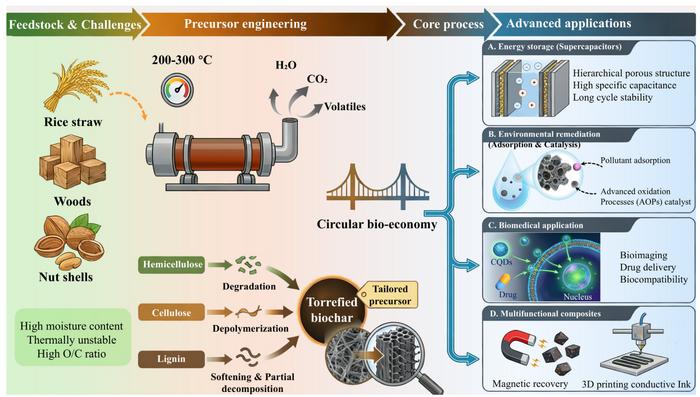
A comprehensive review published in Sustainable Carbon Materials on 17 February 2026 identifies biomass torrefaction as a versatile platform for synthesising high-value carbon materials. Rather than treating it as a simple pre-treatment step, researchers highlight its ability to transform agricultural and forestry waste into specialised precursors for energy storage, environmental remediation, and biomedical applications.
Torrefaction is a thermal process conducted at temperatures between 200°C and 300°C in low-oxygen conditions. This specific temperature range allows for the removal of oxygen-rich components while reorganising the biomass into more stable and durable carbon networks.
Engineering Porous Structures for Energy
The review details how the torrefaction process can be manipulated to create tailored carbon materials for energy storage devices. By controlling the thermal degradation of the biomass, scientists can engineer “hierarchical” pore structures that are essential for high-performance supercapacitors.
Enhanced capacitance:
The resulting carbon networks provide a massive surface area for storing electrical charge.
Cycling stability:
The stable structure formed during the thermal process ensures that electrodes remain effective over long periods of use.
Environmental remediation and catalysis
Torrefied carbon is also an exceptional tool for cleaning our air and water. Because the process creates a highly porous material, it acts like a microscopic sponge for toxins.
Pollutant adsorption:
The microscopic pores trap heavy metals and toxic dyes found in industrial wastewater.
Catalytic degradation:
Surface modifications allow the materials to act as catalysts, accelerating the breakdown of harmful organic compounds into benign substances.
Innovations in bioimaging and medicine
Beyond industrial uses, the study explores the potential for torrefaction to produce carbon quantum dots (CQDs). Through controlled carbonisation, researchers can generate tiny particles that exhibit tunable fluorescence, which is a critical feature for next-generation medical technologies.
These biomass-derived particles offer a sustainable alternative to traditional metallic quantum dots for use in bioimaging, chemical sensing, and targeted drug delivery. The review suggests that because these materials originate from renewable biomass, they may offer better biocompatibility for medical applications.
Future development and scalability
The authors conclude that while laboratory results are promising, the technology must now transition to larger scales. Future research is focusing on “multifunctional composites,” including magnetic carbon materials that can be easily recovered from treated water and conductive inks for 3D-printed flexible electronics.
By optimising reactor designs and evaluating the economic impact of large-scale production, torrefaction could bridge the gap between abundant renewable waste and the global demand for advanced, sustainable materials.