
NASA’s Artemis II Fueling Test (Official Feed) – YouTube
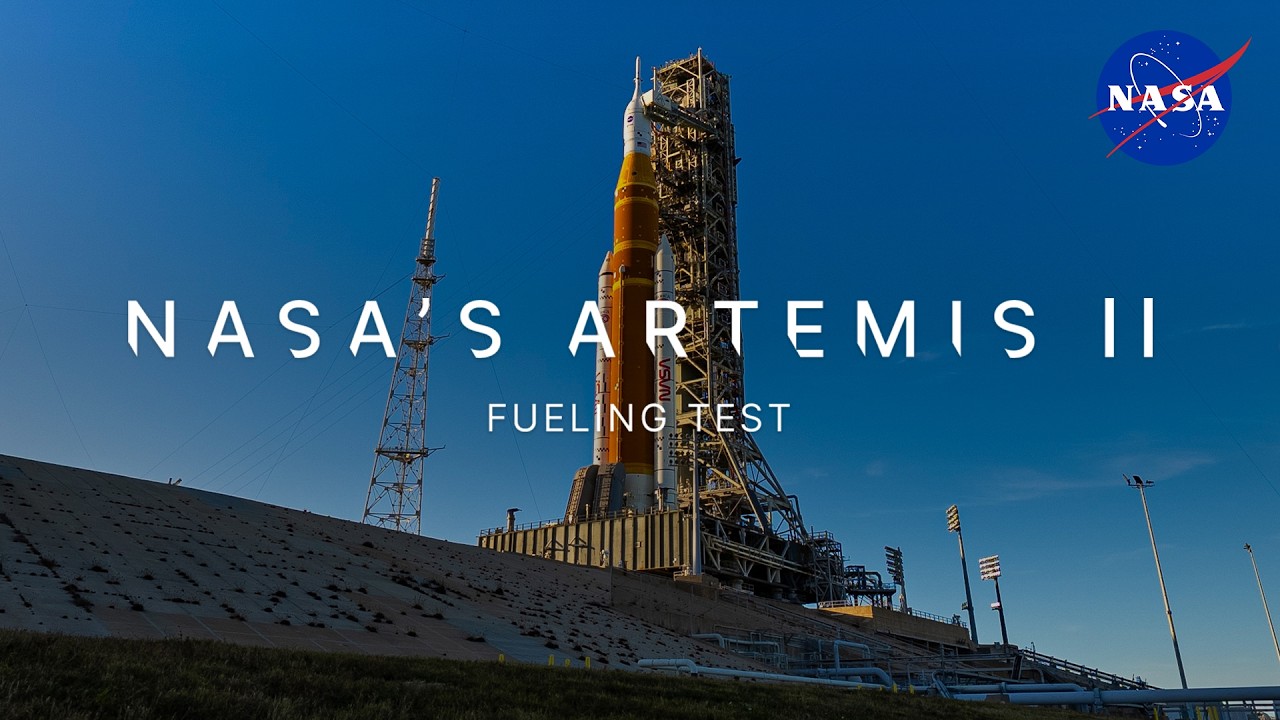
The second prelaunch test campaign for NASA’s Artemis 2 moon rocket is underway, and one of its most critical operations will happen today (Feb. 19).
You may like
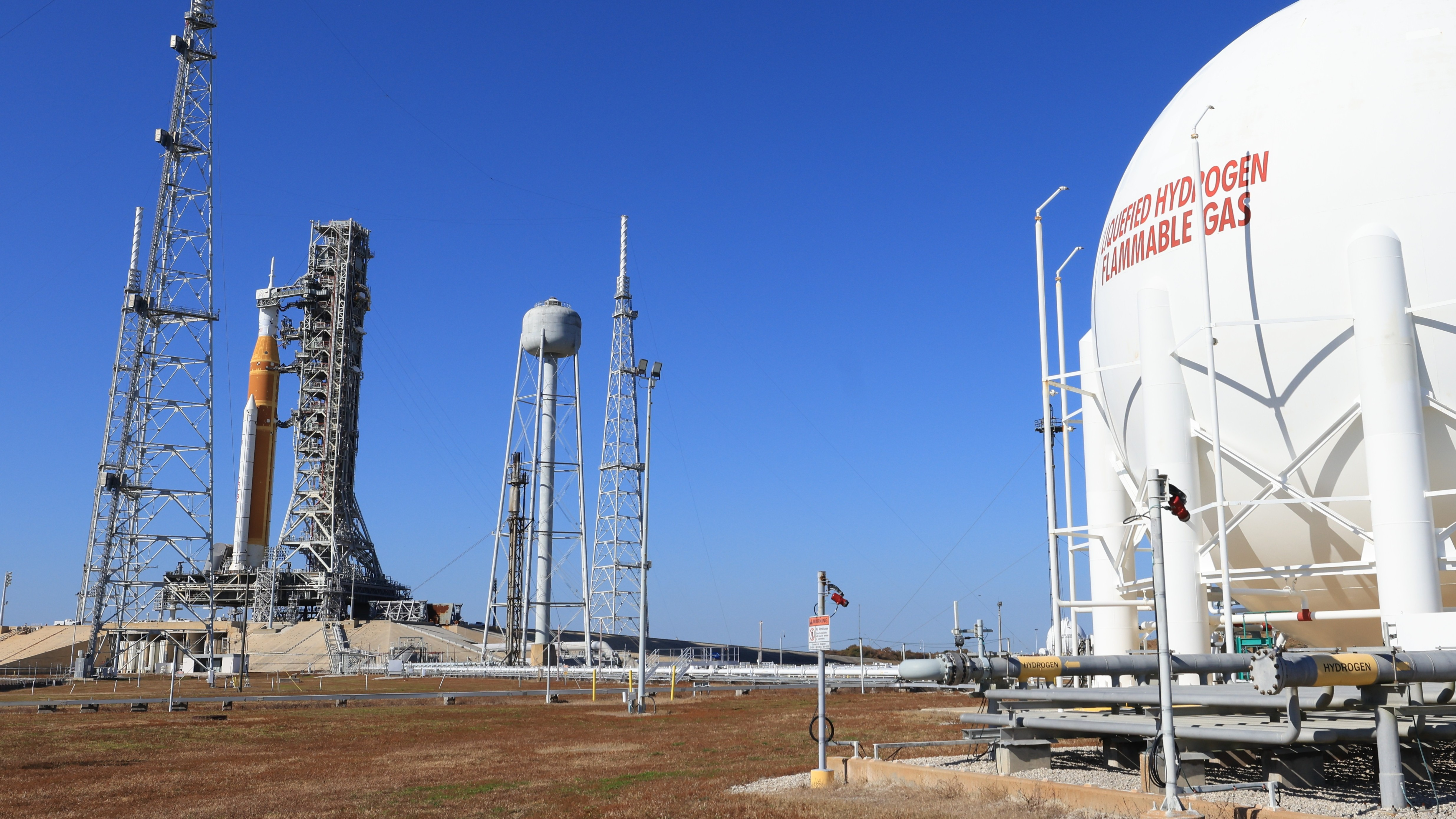
NASA’s Artemis 2 SLS (Space Launch System) rocket with the Orion spacecraft and launch abort system atop stands vertical in the background with a 1.4-million-gallon, 83-foot-wide, liquid hydrogen sphere in the foreground at Launch Complex 39B at NASA’s Kennedy Space Center in Florida on Feb. 10, 2026. (Image credit: NASA/Ben Smegelsky)
Artemis 2 SLS wet dress rehearsal latest news: NASA continues 2nd Artemis rocket fueling test
NASA is providing a commentary-free, 24-hour livestream of SLS during the WDR, which can be viewed here on Space.com as well as on YouTube. The agency said that it will also air a separate stream featuring important WDR activities; Space.com will simulcast that feed, if it’s made available.
Our hand-picked selection of NASA Artemis 2 swag

(Image credit: Future/NASA)
Love the Artemis 2 mission but can’t get there in person? We’ve curated a list of the best NASA Artemis 2 goodies for superfans, including everything from Lego sets to baseball caps.
A “go/no-go” poll to begin tanking is expected today at around 9:50 a.m. EST (1450 GMT), with the core stage’s LH2 “slow fill” beginning about an hour later. Fueling operations, including vehicle stage cool-downs, are scheduled to last from 9:50 a.m. EST (1450 GMT) until 3:30 p.m. EST (2030 GMT), when a planned countdown hold will be implemented as the LH2 and LOX lines enter a replenishing phase.
The two-day-long WDR is meant to put Artemis 2 and ground teams through their paces and ensure that all equipment, personnel and procedures are appropriately in place and ready to launch astronauts to the moon. Artemis 2 is the second mission of NASA’s Artemis program and the first to fly with a crew aboard the Orion capsule.
WDR — Wet Dress Rehearsal
SLS — Space Launch System
LOX — Liquid Oxygen
LH2 — Liquid Hydrogen
KSC — Kennedy Space Center
Once cleared for launch, Orion will carry NASA astronauts Reid Wiseman, Victor Glover and Christina Koch and the Canadian Space Agency‘s Jeremy Hansen on a 10-day trip around the moon and back to Earth on the first crewed lunar voyage since the Apollo missions ended in 1972.
Throughout testing today, engineers at KSC will be keeping a close eye on a section of the SLS mobile launch platform that connects to the bottom of the rocket, known as the tail service mast, where umbilical lines run to supply fuel and other resources to the rocket.
The tail service mast “quick disconnect,” where it interfaces with the rocket, was the site of LH2 leaks during the first Artemis 2 WDR earlier this month, and is also the same component that plagued the rocket with leaks during the Artemis 1 launch campaign in 2022. Those issues resulted in three rollbacks of SLS to the Vehicle Assembly Building at KSC that year — a repeat of which NASA is hoping to avoid this time around. Officials say that lessons learned from Artemis 1 have resulted in hardware modifications and improved procedures, which will allow them to better manage thermal conditions during cryogenic fueling and (hopefully) avoid similar leaks.
Should mission teams reach the other side of today’s tanking operations, the wet dress rehearsal will enter a series of countdown milestones to simulate a variety of launch scenarios, including holds on the clock, launch scrub conditions and detanking. A successful WDR could put Artemis 2 on track to lift off as early as March 6, though NASA officials say they are waiting to review WDR data before setting an official target date.
The March window for Artemis 2 extends from March 6-9, and includes March 11. A subsequent window opens in the beginning of April. Further opportunities fluctuate around the starts and ends of each month thereafter, as they correspond with the phase of the moon for optimal launch conditions.
A full timeline of today’s procedures, which work toward a T-0 of 8:30 p.m. EST (0130 GMT, Feb. 20), is as follows, courtesy of NASA:
L-16 hours and counting (around 4:40 a.m. EST)L-15H30M – L-13H30M: All non-essential personnel leave Launch Complex 39BL-14H15M – L-12H05M: Air-to-gaseous nitrogen (GN2) changeover and vehiclecavity inertingL-13H45M – L-12H15M: Ground Launch Sequencer (GLS) activationL-12 hours and countingL-12H35M – L-9H50M: 2-hour 45-minute built in countdown hold beginsL-10H50M: Launch team decides if they are “go” or “no-go” to begin tanking therocketL-10H50M – L-9H35M: Orion cold soakL-10H40M – L-10H325M: Core stage LOX transfer line chilldownL-10H40M – L-9H55M: Core stage LH2 chilldownL-10H20M – L-9H40M: Core stage LOX main propulsion system chilldownL-10 hours and countingL-9H55M – L-9:35H: Core stage LH2 slow fill startL-9H50M: Resume T-Clock from T-8H10ML-9H45M – L-9H30M: Core stage LOX slow fillL-9H35M – L-8H10M: Core stage LH2 fast fillL-9H30M – L-7H10M: Core stage LOX fast fillL-9H15M – L-8H45M: ICPS LH2 chilldownL-8H45M – L-7H55M: ICPS LH2 fast fill startL-8H10M – L-7H10M: ICPS LOX main propulsion system chilldownL-8H10M – L-8H: Core stage LH2 toppingL-8H – terminal count: Core stage LH2 replenishL-7H55M – L-7H40M: ICPS LH2 vent and relief testL-7H40M – L-7H25M: ICPS LH2 tank topping startL-7H25M – terminal count: ICPS LH2 replenishL-6H45M – L-6H15M: Orion communications system activated (RF to missioncontrol)L-6H40M – L-6H05M: Core stage LOX toppingL-6H30M – L-5H45M: ICPS LOX fast fillL-6H05M – terminal count: Core stage LOX replenishL-6 hours and countingL-5H45M – L-5H30M: ICPS LOX vent and relief testL-5H30M – L-5H10M: ICPS LOX toppingL-5H40M: Stage pad rescueL-5H40M: Closeout crew assembleL-5H10M – terminal count: ICPS LOX replenishL-5H10M: All stages replenishL-5H10M: Start 1-hour 10-minute built in holdL-4H40M-L-4H25M: Closeout crew to white roomL-4H30M – L-4H20M: Crew module hatch preps and closureL-4H20M – L-3H20M: Counterbalance mechanism hatch sealpress decaychecksL-3H20M – L-2H40M: Crew Module hatch service panel install/closeoutsL-2H50M – L2H25M: Launch Abort System (LAS) Hatch closure for flightL-1H10M: Launch Director brief – Flight vehicle/TPS Scan results with CICEL-1H45M – L-1H40M: Closeout crew departs Launch Complex 39BL-40 minutes and holdingL-40M: Built in 30-minute countdown hold beginsL-25 minutes and holdingL-25M: Transition team to Orion to Earth communication loop following final NTDbriefingL-16M: The launch director polls the team to ensure they are “go” for launchT-10 minutes and countingT-10M: Ground Launch Sequencer (GLS) initiates terminal countT-8M: Crew Access Arm retractT-6M: GLS go for core stage tank pressurizationT-6M: Orion set to internal powerT-5M57S: Core stage LH2 terminate replenishT-4M: GLS is go for core stage auxiliary power unit (APU) startT-4M: Core Stage APU startsT-4M: Core stage LOX terminate replenishT-3M30S: ICPS LOX terminate replenishT-3M10S: GLS is go for purge sequence 4T-2M02S: ICPS switches to internal battery powerT-2M: Booster switches to internal batter powerT-1M30S: Hold for three minutes to verify core stage certification hold timeT-1M30S: Core stage switches to internal powerT-1M20S: ICPS enters terminal countdown modeT-50S: ICPS LH2 terminate replenishT-33S: GLS sends “go for automated launch sequencer” commandT-33S: GLS Cutoff/Recycle