
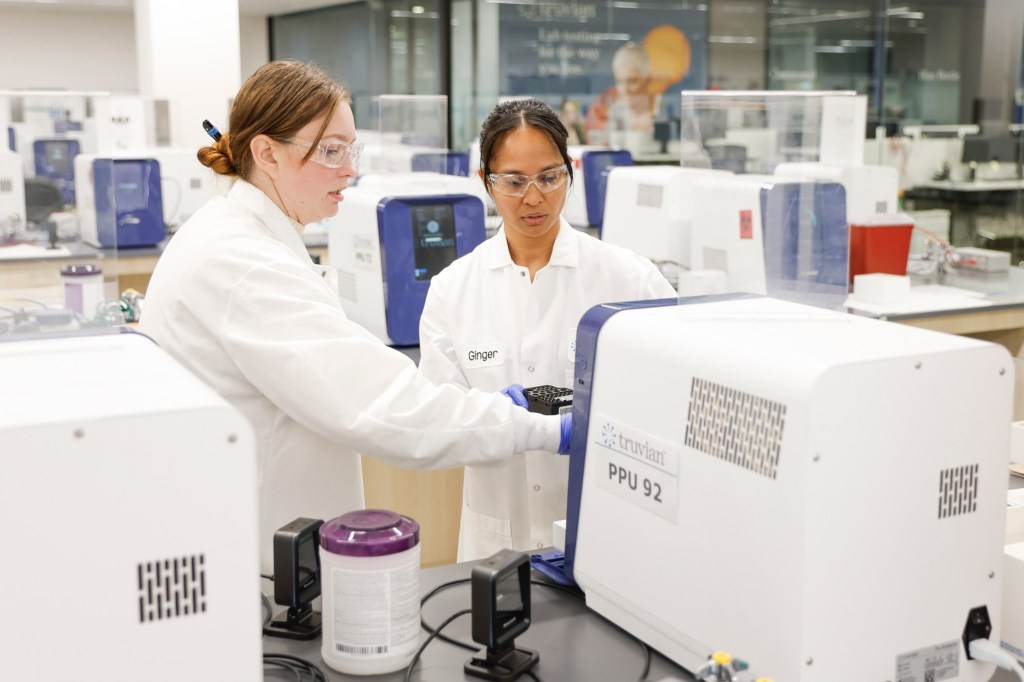
This San Diego company miniaturized a multimillion-dollar blood-testing lab into a device the size of a microwave.
Truvian,created an instrument that can deliver 26 different blood tests in 30 minutes — with only eight drops of blood. And according to the Food and Drug Administration, the results are just as accurate as the room-sized equipment that run the same tests at core laboratories.
No more drawing tubes of blood and waiting days for results to arrive via email, explained Dena Marrinucci, co-founder and chief operating officer of Truvian. With eight drops of blood, the device stands to redefine health care by putting lab-grade results directly in patients’ hands.
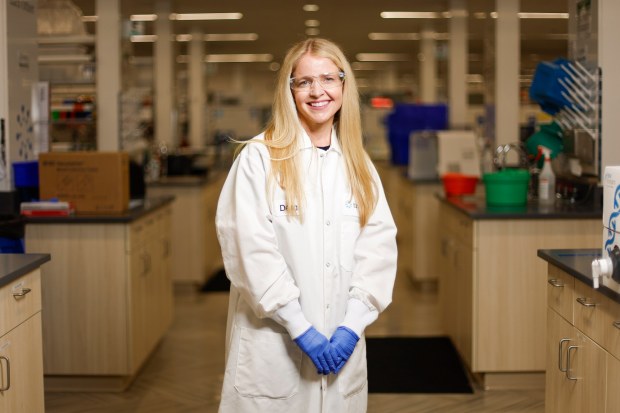 Dena Marrinucci, co-founder and chief operating officer of Truvian, at the company’s lab. She says with Truvian’s new blood-testing device, patients won’t need to have tubes of blood drawn or wait days for test results. (Meg McLaughlin / The San Diego Union-Tribune)
If any of this sounds familiar, that’s because Elizabeth Holmes, the founder of Theranos, long claimed she had created a similar blood diagnostic technology, tricking investors out of millions. The fraud landed her in federal prison.
Unlike Theranos, Truvian has pursued — and recently earned — regulatory approval at every step with the help of medical leaders and scientists.
While proving that their technology works has been hard, maintaining executive leadership has been tough, too. In eight years, the company has had three chief executives. Now, Truvian is looking for a CEO who can bring its technology to market.
Miniaturizing the science
Inside Truvian’s University City lab, dozens of the newly FDA-cleared devices — dubbed the TruVersus— line the benchtops. The device looks like a first-generation Mac PC. Housed under the plastic casing are three different diagnostic mechanisms that can run 26 tests in a single run.
Marrinucci plugged the device into a standard outlet. “It’s like an Easy-Bake Oven,” she said with a laugh.
She put eight drops of her blood into the machine. The tray closed, and the machine whirled.
“There was so much doubt that we actually put a clear cover over the machine to show all of the science that went into them,” Marrinucci said.
Thirty minutes later, her blood results are illuminated on the screen.
“The reality is actually a lot of what Elizabeth Holmes was trying to do wasn’t off. It wasn’t like it was impossible. She was just cutting corners left and right,” explained Dr. Michael Mina, chief medical officer at Truvian.
The actual amount of blood that goes into a test is extraordinarily small. “The challenge is not the biology. The biology is done every single day at any core lab in the world. The challenge was really creating a machine,” said Mina.
For FDA testing, the TruVersus benchtop device ran over 20,000 tests against what Mina called the “laboratory gold standards” in the industry: the Swiss pharma giant’s Roche Cobas, which tests for chemistry and immunoassay, and the Japanese company’s Sysmex, which tests for hematology labs.
The Cobas weighs as much as a baby hippopotamus, requires 60 liters of water a day, costs over a quarter-million dollars, and it needs a specialized electric infrastructure.
These large devices live in hospitals and core labs around the world, executing tens of thousands of blood tests every day. Hospitals and clinics that don’t have the machinery send blood to labs that do.
Truvian proved their device could run dozens of common blood tests — checking from cholesterol and blood sugar to liver function — just as accurately as the Cobas and Sysmex, according to the FDA. In an independent review from UC San Diego Anti-Viral Research Center, the TruVerus ran 107 tests against the Cobas and Sysmex, with 98% run reliability.
The company did not say how much the device or testing kits would cost, as they are still developing relationships with manufacturers.
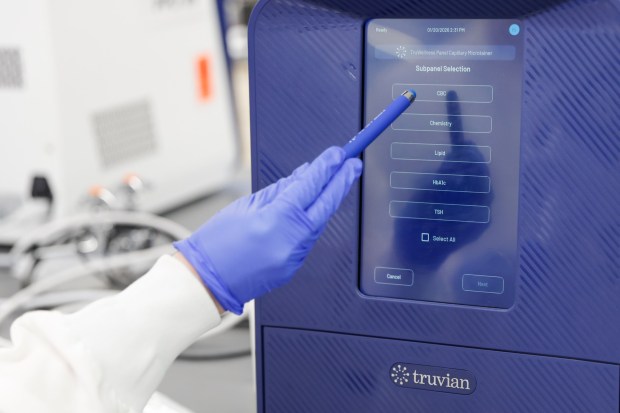 Truvian’s newly FDA-cleared device is called the TruVersus. Housed under the plastic casing are three different diagnostic mechanisms that can run 26 tests in a single run. (Meg McLaughlin / The San Diego Union-Tribune)
To the clinic, Canada, and “every corner”
While it’s still early days, Truvian has ambitious plans. Today, they are in talks with hospital systems, retail pharmacies, telehealth companies and Canadian clinics.
Truvian plans to roll out pilot programs “in the next couple of quarters,” said Mina.
Mina, who is also an adviser to Hims & Hers, a major telehealth company, described a sweeping reimagining of primary care.
In his vision, you could order lab work from your phone and test results would be processed just in time for a Zoom call with your doctor.
“This isn’t crazy, because these things exist now. Like an Uber or drone picks up your blood test, and they bring it to the Truvian micro-lab. And because our whole lab is literally a box, you can have 50 of them around a metropolitan area,” said Mina.
Truvian leaders envision micro-labs “at every corner.” Picture those coin counter kiosks in grocery stores: One day, you — or Amazon labs — may drop off your blood kit on the way out of Ralph’s, Mina explained.
To date, Truvian has raised over $200 million. They plan to raise additional capital in 2026.
One of Truvian’s largest deals was outside of the U.S. In 2024, they partnered with Canada’s largest pharmacy, Shoppers Drug Mart, which included $74 million in capital.
Doctor’s notes
Despite the FDA clearance, doctors have been hesitant to endorse the device because they haven’t used it.
“Our process for adopting new platforms is intentionally rigorous,” said Dr. Anil Keswani, Scripps Health chief medical officer. Devices used at Scripps must go through internal quality control, he explained.
Dr. David J. Lee, board-certified hematologist-oncologist at UC San Diego, concurred. “Reliability is very difficult to prove in practice,” he said. “FDA approval is an important first step, but you need a lot more of the secondary regulation, training and proficiency testing.”
Truvian understands this.
“These doctors are right to be hesitant,” acknowledged Dr. Alan Wu, chief of the clinical chemistry and toxicology laboratories at San Francisco General Hospital, who also serves on Truvian’s scientific advisory board. Before Wu took a position advising Truvian, he advised Theranos.
“Truvian has gone overboard to prove that their technology is sound and works. They won’t release anything until everybody is comfortable with it, and we’re still not there yet,” he said.
There are a handful of specific blood tests that are pending FDA clearance, and Truvian still needs to run more peer-reviewed studies to show how its device operates outside of controlled settings.
“We have a scientific advisory board, and we have seen the data. I know the data is sound,” said Wu. Now it’s time for a peer review to decide “if it’s real or not. It’s not enough for the company to say so, it’s not enough for just the FDA to say so, although that’s a big step.”
The biggest difference between Truvian and Theranos, according to Wu, is transparency.
He wasn’t able to see the Theranos device or data until he left his job and signed a contract with Holmes. “This is completely unlike Truvian, where from day one I was shown the device, shown the data, actually even was given the opportunity to be a patient and to participate,” he said.
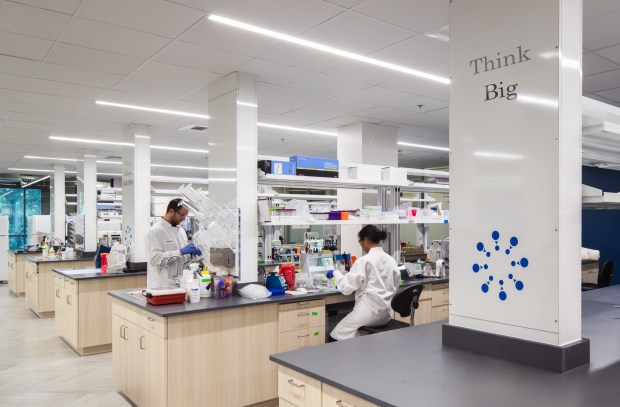 Truvian scientists work on its compact blood-testing machine that aims to deliver results faster, with less blood than current systems. (Darren Bradley)
No one at the helm
On Jan. 15, Truvian scientists shed their goggles and gloves to gather in the community kitchen. They cut into a chocolate cake – everyone celebrated and had a slice, except the CEO, because there wasn’t one.
Since September, Truvian has been operating without a chief executive.
But this isn’t the first time Truvian has been without a leader. Since the company’s founding, there has been turnover in the C-suite.
Of the six founders who started Truvian in 2015, Marrinucci is the only one left involved in the day-to-day operations. Most of the founders moved on after a few years to pursue other startups while staying close as supporters.
“This evolution was consistent with expectations from the early days,” the company said.
Kim Kamdar, the founding CEO, stepped down after the Series A round, but still holds a seat on the board. Since Kamdar, there have been two other Truvian CEOs: Jeff Hawkins served as chief executive from 2018 to 2022 before leaving to lead Quantum-Si. Jay Srinivasan succeeded Hawkins, but left for “personal reasons” right before Truvian received FDA clearance.
“I just had dinner with him (Srinivasan),” said Marrinucci. “He’s cheering us on, supporting us from the sidelines.”
Now, Truvian is looking for a new leader who has experience bringing a product like this to market, Marrinucci said.
“We don’t want to just rush into something. We want to find the best person,” Marrinucci said.
Truvian has a little bit of time to find a chief executive because they still have more work to do.
The company is working with the FDA on additional tests, pursuing waivers required to place devices in pharmacies and urgent-care clinics, awaiting further peer review and finalizing its manufacturing strategy.
“We’re making them in small quantities,” said Marrinucci. They have made 100 devices so far. “We have a validated manufacturing line and ISO certification. The instruments are produced by a contract manufacturing partner based in California.” (Meaning their manufacturing process meets international quality standards.)
Truvian’s San Diego facility can manufacture a million Truvian “kits” — which are just the tests, not the device itself.
FDA clearance is a big step. But bringing the device to market may prove to be harder. It will take millions of dollars, a highly skilled manufacturer, and a leader with experience distributing devices like this.
But finding this leader with experience may be just as hard as this device is the first of its kind. “True, true,” Marrinucci said. “But there are lots of successful leaders out there that have brought a product to the marketplace that have a big impact on patients.”