
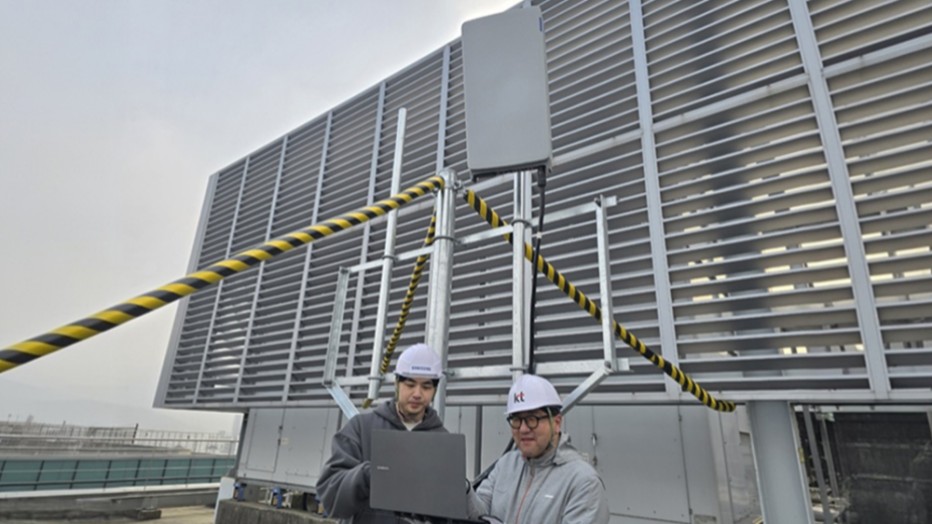
Samsung Electronics today announced it has reached a significant milestone in 6G development, successfully verifying eXtreme multiple-input multiple-output (X-MIMO) technology in the 7 GHz band — a key candidate frequency for future 6G networks — with KT Corporation (KT) and Keysight Technologies.
Through outdoor field testing, the companies demonstrated a peak downlink data rate of up to 3 gigabits per second (Gbps) in the 7 GHz band using X-MIMO. The breakthrough was enabled by ultra-high-density antenna technology that integrates significantly more antenna elements into equipment of comparable size. Considered a foundational component of 6G, ultra-high-density antenna technology achieves four times the antenna density of current 5G systems.
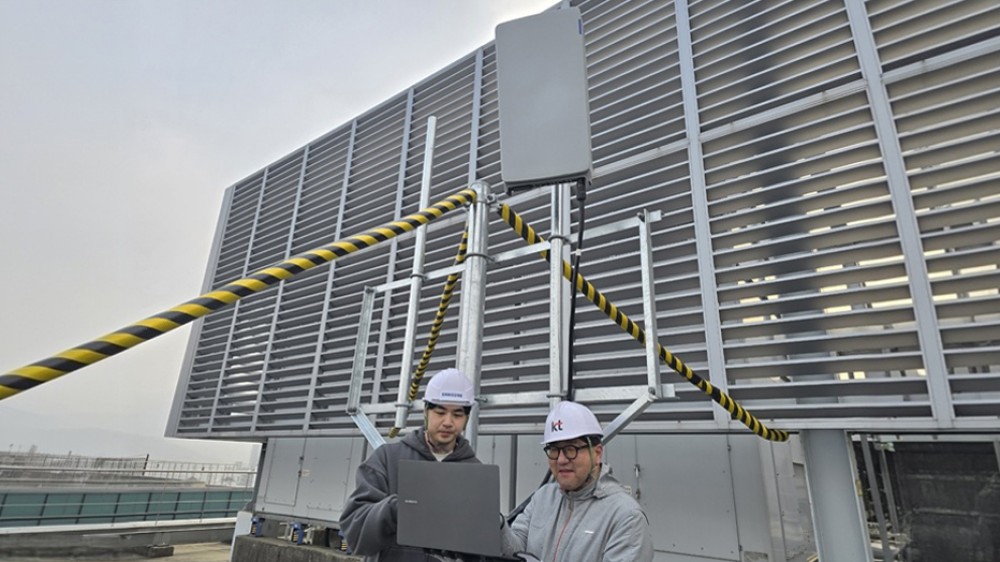 ▲ Researchers from Samsung Research of Samsung Electronics and KT Corporation verify X-MIMO technology in 7 GHz Band for 6G development.
Overcoming 7 GHz Band Challenges
As data demands surge due to advancements in AI, immersive services and fixed wireless access (FWA), 6G is becoming increasingly important in meeting evolving global connectivity needs. The 7 GHz band stands out as a promising candidate for future communications, offering an optimal balance of coverage and capacity between the 5G 3.5 GHz band and millimeter-wave frequencies.
X-MIMO technology in the 7 GHz band is regarded as a core 6G technology because it enhances data throughput by increasing antenna density enabled by shorter wavelengths while achieving coverage comparable to 5G by compensating for the shorter propagation distance of 7 GHz.
Strengthening the 6G Ecosystem Through Collaboration
The verification took place at Samsung Electronics’ Seoul R&D Campus, where researchers measured data rates during the simultaneous transmission of eight data streams from the base station to a single user. To replicate real-world network conditions, Samsung collaborated with KT to establish an outdoor wireless test environment. The testing also utilized Samsung’s 6G base station prototype featuring 256 digital ports and Keysight’s 6G terminal testbed.
“Through our collaboration with KT and Keysight, we have demonstrated the potential for significant improvements in data rates for next-generation communications,” said JinGuk Jeong, Executive Vice President and Head of Advanced Communications Research Center, Samsung Research at Samsung Electronics. “We remain committed to pioneering future network technologies that will enable diverse services and enhanced user experiences in the 6G era.”
“The validation of ultra-high-density antenna technology performance in the 7 GHz band marks a critical step toward 6G commercialization. By securing stable, high-capacity operation in high-frequency bands, we have established a foundational technology for enabling ultra-fast, immersive services,” said Jong-Sik Lee, Executive Vice President and Head of Future Network Laboratory at KT Corporation. “Moving forward, we will continue to drive network innovation in collaboration with Samsung Electronics.”
“This work with Samsung and KT highlights how Keysight’s industry-leading 6G capabilities are accelerating real-world innovation, unlocking new spectrum for early 6G deployments and bridging the gap between research and commercial readiness to enable next-generation AI-driven wireless communications that deliver greater value to customers,” said Kailash Narayanan, Senior Vice President and President of Communications Solutions Group at Keysight.
In addition to this achievement, Samsung and KT successfully validated user-level AI-based radio access network (AI-RAN) optimization technology in a commercial network in December 2025. Including further collaboration with KT on uplink coverage technologies, Samsung will continue working closely with global partners to make data transmission faster and more reliable for users.