
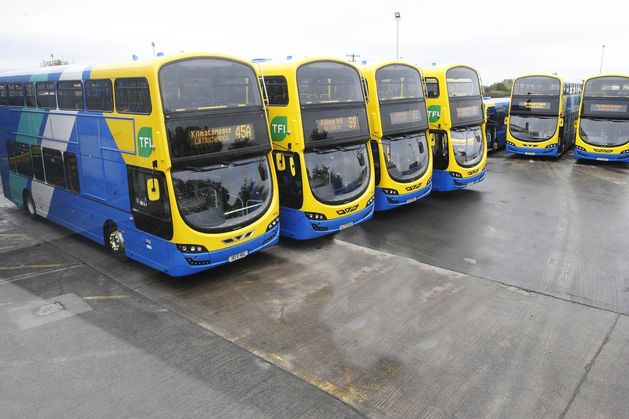
The issue emerged following a series of questions to officials from the National Transport Authority (NTA) at a recent meeting of the Public Accounts Committee (PAC).
Although the NTA conducted a publicly advertised competitive tender process in 2024–2025, no other bus companies applied for the contract.
The NTA re-tendered the original 2018 contract under three lots: a North package, a South package, and a combined North and South package.
Go-Ahead Ireland was identified as the preferred bidder for the combined package, and the five-year contract was formally signed in December 2025.
Had there been other bidders, the NTA would have used an in-depth assessment process, typically weighting quality at 35pc and price at 65pc.
In the original 2017–2018 tender for these routes, Go-Ahead Ireland faced competition from Bus Éireann.
During that process Bus Éireann reportedly submitted a bid that was €3 million lower than Go-Ahead’s. Go-Ahead Ireland was still awarded the contract based on higher “quality” scores in the NTA’s weighted assessment.
For the current 2025 contract, major state-owned operators like Dublin Bus and Bus Éireann were ineligible to bid for these specific routes as they were concurrently negotiating contracts for their own existing networks for the 2024–2029 period.
While large international firms like Transdev or FirstGroup have shown interest in Ireland previously, several factors discouraged new entrants for this specific Wicklow/Dublin tender.
The contract required the operator to provide its own depot facilities. Go-Ahead Ireland already had the infrastructure, whereas a new competitor would have faced massive upfront capital investment.
Go-Ahead had been operating these exact routes since 2018. They had established recruitment pipelines and local operational knowledge, making it difficult for outsiders to outbid them on “quality” scores.
This latest revelation did not sit well with PAC chair Wicklow TD John Brady.
“This situation is not an accident, nor is it a surprise. It is the inevitable outcome of a deeply flawed privatisation agenda being driven by the Government, where competitive tendering has been imposed on public bus routes with little regard for service quality or passenger experience.
“The so-called competitive tendering process has once again been exposed as a failure. In this case, it resulted in a situation where Go-Ahead were the only operator to submit a tender and were effectively rewarded with a new five-year contract despite presiding over five years of misery for commuters under their previous contract.”
While Go-Ahead Ireland has seen significant passenger growth, it has also faced substantial financial penalties from the NTA for failing to meet minimum performance standards.
Figures provided to the PAC show that the NTA levied fines of more than €5.8 million on Go-Ahead between 2021 and 2024 for poor service delivery.
According to NTA and Go-Ahead Ireland reports, service issues in the Wicklow area have been attributed to driver and mechanic shortages.
Older automatic vehicle location equipment on some buses caused “ghost bus” data errors on real-time apps. The NTA is currently replacing this with live data equipment expected to be fully operational across the fleet by late 2026.
Traffic congestion is also cited as a major factor affecting excess waiting times on orbital and commuter routes in the region.
Deputy Brady believes the contract awarded to Go Ahead should be rescinded.
“That this operator could be handed another five-year contract speaks volumes about how broken this system has become.
“I am calling on the Minister to urgently investigate the process that led to the awarding of this contract. He owes it to commuters who are sick to the back teeth of a failed privatisation model that has prioritised ideology over reliable, publicly accountable transport services.”
Social Democrats TD for Wicklow, Jennifer Whitmore, has raised issues with the Go-Ahead Ireland local link service, the L2, with the Taoiseach in the Dáil this week.
The L2 services Kilcoole, Newcastle and Bray, and drivers have routinely been skipping stops along the route.
Deputy Whitmore says many of the issues previously flagged still persist.
“It’s gotten to a point now where this can no longer be put down to teething issues – Go-Ahead are not providing a satisfactory or even acceptable service in Wicklow and something must be done to address that,” she explained.
“The main issue being raised with me regarding the L2 is that it is not following its predetermined route and is routinely skipping certain stops – the Sea Road in Kilcoole in particular. This problem has been raised with me by many, many people and I have directly raised it with the NTA and with Go-Ahead.”
The Taoiseach was informed about how the service is impacting passengers in the area.
“Lily, a local Kilcoole woman who has physical and intellectual disabilities, was on the L2 going home one afternoon after being at her day service in Bray and the driver did not go to her stop in Kilcoole, even though it is part of the route.
“The bus continued to the next village, Newcastle, and when she asked the driver to bring her back to Kilcoole, he refused. Lily was left on the side of the road in the dark on a wet rainy afternoon.
“On top of deviating from the prescribed route, drivers of the L2 are also intentionally not stopping for groups of teenagers who are trying to hail the bus. This is shocking behaviour and has the potential to put a child in harm’s way.
“Go Ahead are, at every turn, failing to provide the service at the standard that they have been contracted to, and it is time that this contract is reviewed,” Deputy Whitmore concluded.
Reports suggest some drivers may bypass stops or ask passengers to disembark early to “make up time” when behind schedule.
Due to frequent cancellations on preceding services, the buses that do arrive are often already at capacity, forcing them to legally bypass waiting passengers.
The NTA treats “unreasonable refusal to stop” as a serious contractual breach. Each verified instance of a bus bypassing a waiting passenger without a valid reason can contribute to the performance deductions Go-Ahead Ireland faces, which totalled over €1 million in 2024–2025.
Go-Ahead Ireland has highlighted the new Kilpedder satellite depot, which became operational in early 2025, as the cornerstone of their strategy to stabilise services across Wicklow.
Previously, many buses serving Wicklow had to travel from the main depot in Ballymount, Dublin. Buses spent more than an hour in traffic before even starting their first route in Bray or Greystones. If a bus was delayed leaving Dublin, the entire Wicklow schedule collapsed.
By basing at least 35 vehicles and 90 staff (drivers and engineers) directly in north Wicklow, the depot offers dedicated oversight. The site handles daily fuelling, cleaning, and light maintenance, ensuring Wicklow’s “L” routes have a dedicated fleet that doesn’t get diverted to Dublin city routes during shortages.
Since the depot’s full integration, Go-Ahead Ireland reported that reliability on Wicklow local routes hit the 98pc target for the first time in late 2025. While punctuality remains a challenge due to N11 traffic, the total disappearance of services has decreased.
Funded by the Local Democracy Reporting Scheme